
A one-product store can prove that customers want what you sell. Turning that demand into a sustainable ecommerce brand takes more work. You need a clear audience, a product worth choosing over alternatives, and a customer experience you can deliver consistently.
Your first successful product provides useful evidence. It shows which messages attract buyers, what customers expect, and where the product falls short. The next step is using that evidence to decide what deserves further investment.
That does not mean adding dozens of products or ordering custom packaging immediately. Some businesses benefit from improving their core product first. Others find a natural next step through related accessories, personalized items, or better support.
In this guide, “sustainable” means financially and operationally sustainable over time. The goal is to build a business that can serve customers, cover its costs, and adapt when demand changes.
Here is how to make that transition with a practical plan.
1. Check Whether Your Product Is Ready for Brand Investment
Before investing more in your one-product store, check what its sales actually tell you.
A short sales spike can justify further testing. It does not automatically justify a large inventory order or product development project.
Separate repeatable demand from a temporary spike
Review sales across several normal selling periods. Include both strong and weak weeks.
Look at:
- Units sold at normal prices versus promotional prices.
- Customer acquisition cost by channel.
- Refunds, returns, and replacement orders.
- Sales linked to individual creators or campaigns.
- Stockouts that may have limited sales.
- Seasonal events that may explain unusual demand.
Suppose a product sells 200 units after one popular video. That is useful, but the next question matters: can the business attract customers profitably after the video stops generating traffic?
Avoid building a forecast from your best week alone.
Calculate what each order contributes

Revenue shows how much customers spend. Contribution shows how much remains to cover fixed expenses and profit.
For this article, use:
Contribution per order = Sales revenue − Variable costs associated with that order
Those costs should include the product, fulfillment, payment processing, customer acquisition, and expected after-sales losses.
The following figures are hypothetical teaching examples, not industry averages or supplier quotes.
|
Per-order item |
Current product |
With upgraded packaging |
|
Sales revenue |
$40 |
$40 |
|
Product and fulfillment |
$18 |
$20 |
|
Payment fees |
$2 |
$2 |
|
Customer acquisition |
$12 |
$12 |
|
Expected after-sales losses |
$2 |
$2 |
|
Contribution per order |
$6 |
$4 |
At the same price and sales volume, the packaging upgrade reduces contribution by one-third.
That does not make better packaging a bad investment. It means the extra cost needs a reason. It might reduce damage, support a gift offer, or help justify a price customers will actually pay.
Measure that result instead of assuming it.
The U.S. Small Business Administration’s break-even guidance explains the relationship between fixed costs and contribution. Positive contribution still needs to cover your business overhead.
Turn feedback into a list of business priorities
Read reviews, support tickets, and return reasons together.
A one-product store gives you a focused set of customer experiences to study. Use that advantage.
|
Customer feedback |
Possible response |
Evidence to collect |
|
“I could not understand how to use it.” |
Better instructions or a product adjustment |
Support contacts and use-related returns |
|
“The size was wrong for me.” |
Clearer sizing information or another size |
Returns by size and customer type |
|
“It is difficult to carry.” |
A storage accessory or design change |
Repeated requests and purchase interest |
|
“I bought it as a gift.” |
A gift option or personalized version |
Gift orders and customer feedback |
Your next step: identify three recurring problems. Rank them by frequency, customer impact, and the cost of solving them.
2. Define the Customer and Promise Behind Your Brand
Your one-product store needs a reason to exist beyond offering a particular item.
Start by defining the customer problem your business understands best.
Describe the customer’s situation
“Pet owners” is a large audience. “Owners of long-haired indoor cats who struggle with regular grooming” gives you a more useful starting point.
Throughout this article, imagine a hypothetical store selling a grooming brush to that audience.
The product is a brush. The broader customer need is easier, more consistent grooming.
That distinction helps guide product choices, educational content, and future offers.
Ask:
- Who gets the most value from this product?
- What situation leads them to look for a solution?
- What have they tried before?
- What makes them hesitate before buying?
- What does a successful result look like?
Use customer language from actual conversations where possible. Avoid filling the gaps with guesses about age, income, or interests.
Write a promise you can support
Use this structure:
We help [specific customer] achieve [desired outcome] through [product approach], supported by [credible evidence].
For the grooming example, a practical promise might focus on clear product selection and easy-to-follow grooming guidance.
Support that promise with evidence. Show the product dimensions, explain suitable coat types, and demonstrate the cleaning process.
Avoid vague claims such as “the ultimate solution for every pet.” Broad promises are difficult to deliver and harder to prove.
Align the store with the promise
Review the homepage, product page, FAQ, and support messages.
They should agree on:
- Who the product suits.
- What it does.
- What it does not do.
- How to choose the right version.
- When customers can expect delivery.
- Where to get help.
A brand becomes easier to trust when these details are consistent.
Your next step: write a one-sentence positioning statement and three pieces of evidence that support it.
3. Build Product Differentiation Customers Can Notice
Product differentiation should make the buying or ownership experience better.
A logo can help customers recognize your business. It does not, by itself, solve a product problem.
For a one-product store, the most useful improvement is often the one customers already ask for.
Start with the smallest valuable change
Work through possible improvements in order of complexity.
|
Improvement level |
Example |
Main question |
|
Information |
Better sizing guide or instructions |
Can customers choose and use it correctly? |
|
Packaging and accessories |
Protective packaging or a useful storage pouch |
Does this improve ownership enough to justify the cost? |
|
Product specifications |
Different size, material, or handle |
Does it solve a repeated customer problem? |
|
Deeper development |
A revised structure or new component |
Is the demand strong enough to support development? |
For the hypothetical grooming brush, clearer coat-type guidance might be the first change. A handle adjustment could follow if customers repeatedly report difficulty holding it.
Do not jump straight to a complex redesign when a simpler fix can be tested.
Know when ODM becomes relevant
ODM generally refers to an arrangement in which a manufacturer provides design capabilities or an existing design that can be adapted for a buyer. The scope varies by supplier and project.
It should not be treated as another name for every logo or packaging change.
ODM becomes worth evaluating when:
- The standard product leaves an important need unmet.
- Customers repeatedly describe the same problem.
- You can define the required change.
- You have funds for samples, revisions, and purchasing commitments.
- The expected improvement can support the added cost.
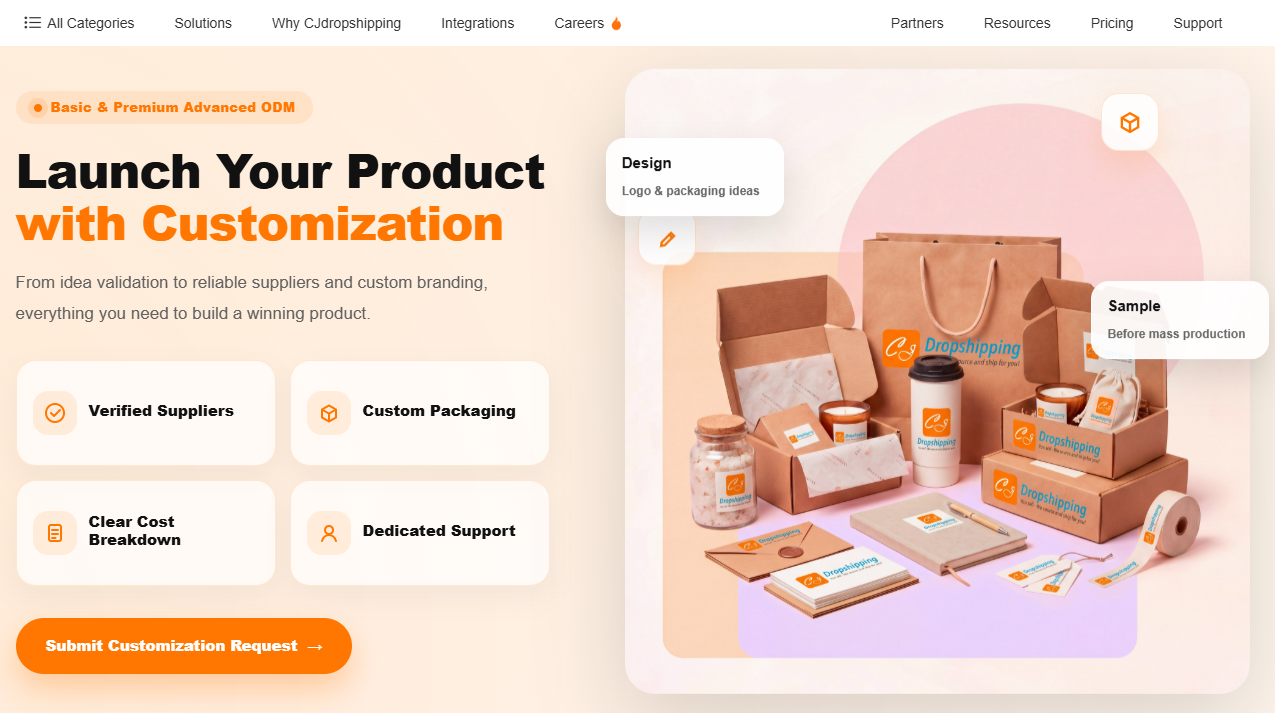
CJdropshipping’s ODM service offers different support levels for product customization, supplier sourcing, cost analysis, and branding. Use it as a starting point for evaluating a project, then confirm the specifications, deliverables, fees, and production requirements in writing.
Prepare a development brief before asking for quotes
A useful brief includes:
- Target customer and use case.
- Current product limitations.
- Required changes.
- Optional changes.
- Target unit cost and total budget.
- Sample approval criteria.
- Packaging and transport requirements.
- Expected order quantity.
- Required launch timing.
- Written arrangements for designs, tooling, and related rights.
“Make it more premium” is difficult to quote or inspect. “Improve grip comfort, retain the current dimensions, and provide samples of two handle materials” gives a supplier something concrete to assess.
Test the improvement before expanding the commitment
Order samples and compare them with the existing product.
Use a consistent test procedure. Record what improved, what stayed the same, and what new problems appeared.
For a one-product store, one poorly tested change can affect the entire offer.
Your next step: choose one improvement, define its acceptance criteria, and set a spending limit before commissioning samples.
4. Expand Around the Same Customer
A larger catalog can create more work without creating more customer value.
Your one-product store should expand when a new item fits the audience and has a clear job.
Build a product family around your strongest offer
Consider three paths.
|
Expansion path |
Customer question |
Grooming-store example |
|
Complementary product |
“What else helps me use this?” |
A suitable storage or cleaning accessory |
|
Another version |
“Is there one that fits my needs?” |
A different size for another coat type |
|
Related need |
“What should I use for the next task?” |
Another relevant grooming tool |
Each addition should have its own cost and demand assessment.
Do not assume that customers who buy a brush will also buy every pet-related product.
Use POD when personalization fits the audience
Print on demand, or POD, allows eligible products to be produced or printed after an order is placed.
It can suit a brand with demand for artwork, personal expression, or gifts. It is less useful when the only reason for adding a product is that printing is available.
For example, customers of a pet-focused business might show interest in personalized pet artwork. That is a separate demand hypothesis to test. It should not be assumed from grooming-product sales.
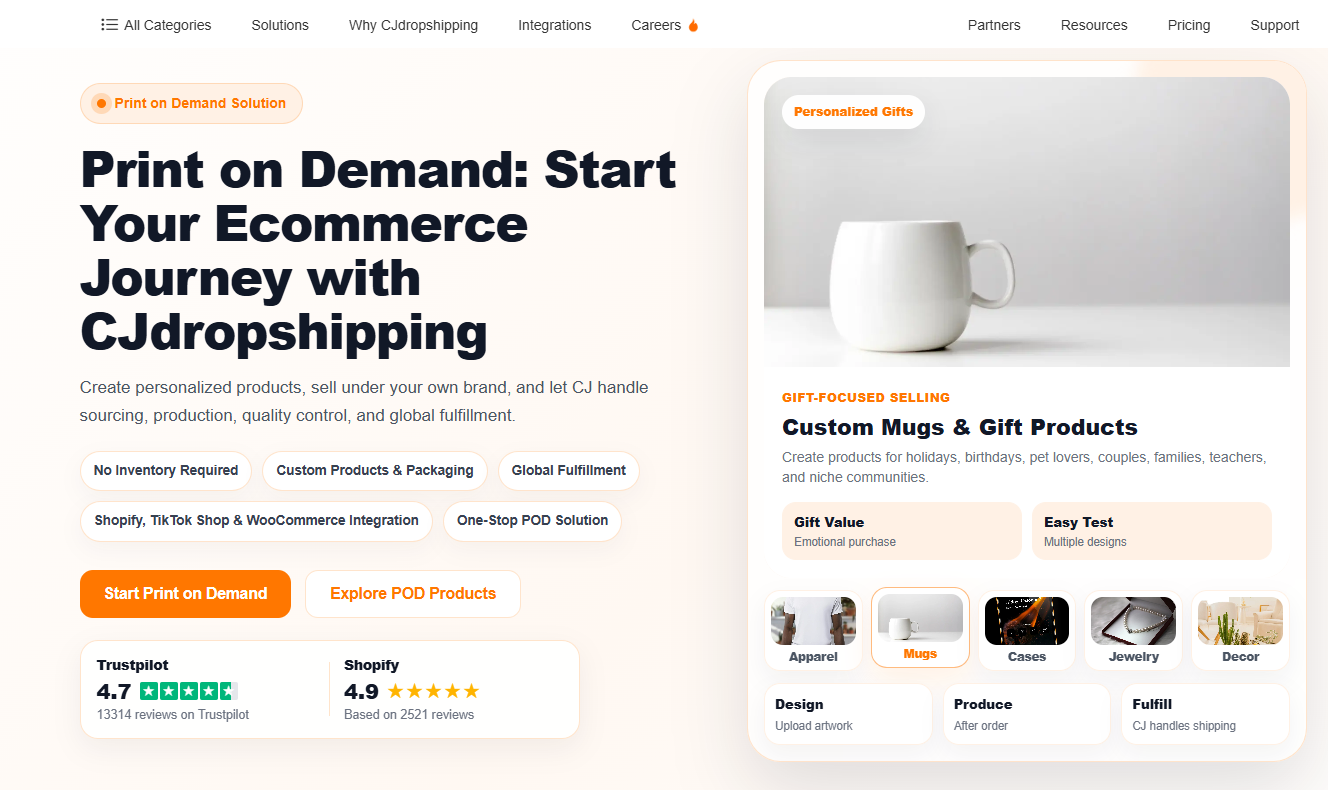
The CJdropshipping POD service includes customizable product categories and production and fulfillment support. Confirm the available customization, sample options, production time, and total delivered cost for each item before listing it.
Use artwork you created or have permission to use. Check design quality on a physical sample rather than relying only on a mockup.
Compare expansion paths by the problem they solve
|
Business need |
Option to evaluate |
|
Test demand for a useful accessory |
An existing standard product |
|
Test artwork or personalization |
|
|
Improve product function or specifications |
Custom sourcing or ODM |
|
Improve protection or gift presentation |
Packaging changes |
These routes can coexist. They do not have to become a fixed sequence.
Measure contribution, not just average order value
Imagine an accessory adds $10 to an order. Its product cost, extra fulfillment, payment fees, and expected support costs total $7.
The incremental contribution is $3.
If you then offer a $4 discount to encourage the bundle, that addition contributes negative $1, assuming no other costs or benefits change.
Average order value rises, but the economics worsen.
Your next step: test one related offer. Compare contribution per visitor as well as contribution per order, since a bundle may also change conversion.
5. Make Fulfillment Part of Your Brand
Your one-product store makes a promise before checkout. Fulfillment determines whether customers experience that promise.
A good product page cannot compensate for unclear delivery information or repeated shipping mistakes.
Set expectations around the complete timeline
Separate:
- Design approval, if needed.
- Production.
- Order processing.
- Transportation.
A personalized product may need time before it is ready to ship. Explain that clearly.
If products ship from different locations, test whether mixed orders produce separate parcels. Give customers useful delivery information before they pay.
Avoid presenting the fastest shipment you have seen as the normal delivery experience.
Turn product quality into a repeatable process
An approved sample is a reference point. You also need a way to check later supply.
Document:
- Approved specifications.
- Dimensions and materials.
- Packaging requirements.
- Inspection criteria.
- Common defects.
- The process for handling failed checks.
Keep a record of issues by batch or supplier where possible.
If customers report a new defect, compare those reports with the specification and inspection history. This is more useful than treating every complaint as an isolated event.
Test the experience yourself
Place an order through the live store.
Check the confirmation email, tracking updates, packaging, instructions, and support route.
For a one-product store, this exercise can reveal problems that are easy to miss when you only view the business from the admin dashboard.
Your next step: record every point where a customer might become confused. Fix the most serious issue before spending more on acquisition.
6. Give Customers Reasons to Return and Recommend
Repeat purchases matter, but the right retention strategy depends on the product.
A durable tool may not need replacement for years. A consumable may have a regular replenishment cycle.
Your one-product store should respect that difference.
Match follow-up to the ownership journey
|
Product type |
Useful follow-up |
|
Consumable |
Usage guidance and timely replenishment reminders |
|
Durable tool |
Setup help, maintenance, and relevant accessories |
|
Personalized gift |
Order confirmation, care advice, and suitable future occasions |
|
Product with a learning curve |
Tutorials, troubleshooting, and support |
For the grooming example, a useful follow-up could explain cleaning and storage. An immediate discount on a second identical brush may be less relevant.
Send messages with a clear purpose. More emails do not automatically create stronger retention.
Build content around customer questions
Your product page serves buying intent. Supporting content can help customers choose and use the product.
Possible topics include:
- How to select the right version.
- Common mistakes during use.
- Cleaning and maintenance.
- When the product may not be suitable.
- How related products compare.
Link each article to the next relevant resource. Avoid creating several near-identical pages around slightly different keywords.
This gives your SEO work a practical role in the customer journey.
Review customers in comparable groups
Group customers by first-purchase month and compare results over the same period.
For example:
90-day repeat purchase rate = Customers in a first-purchase group who place another order within 90 days ÷ Total customers in that group
In a hypothetical group of 100 first-time customers, 12 buying again within 90 days gives a 12% repeat purchase rate.
Wait until every customer in the group has had the full observation window. Otherwise, recent buyers have less time to return.
Google Analytics cohort exploration supports examining groups of users over time. Use your order records to validate customer-level purchase measures, since tracking settings and identification can affect analytics results.
Also track:
- Contribution after refunds.
- Return reasons.
- Accessory purchases.
- Delivery complaints.
- Referral orders where identifiable.
- Non-brand search visits and their business outcomes.
Your next step: create a monthly review that combines customer behavior, service performance, and financial results.
7. Follow a 90-Day Brand-Building Plan
Treat the next 90 days as a learning and investment cycle. Product development may take longer, so adjust the schedule to confirmed lead times.
|
Period |
Priority |
Deliverable |
Decision |
|
Days 1–30 |
Understand demand and economics |
Cost baseline, feedback summary, positioning statement |
What problem deserves investment? |
|
Days 31–60 |
Test one improvement |
Sample, revised page, or related-product test |
Does the evidence support continuing? |
|
Days 61–90 |
Review and refine |
Results, fulfillment findings, next-stage budget |
Expand, revise, pause, or stop? |
Days 1–30: Establish the baseline
Collect order and support data. Calculate contribution using consistent assumptions.
Choose the customer group you serve best. Write a clear promise and identify the evidence behind it.
End the month with one prioritized improvement.
Days 31–60: Run a controlled test
Set the budget, duration, and review criteria before starting.
Keep other major variables stable where practical. If you change price, packaging, advertising, and the product at once, it becomes difficult to explain the result.
For example, test clearer product-selection guidance before commissioning a new size range.
Days 61–90: Decide what deserves another investment
Compare the test with the baseline.
Ask:
- Did customers value the change?
- Did contribution improve?
- Did service problems decrease?
- Can the supplier deliver consistently?
- Is the result strong enough to justify another commitment?
A decision to stop is useful when it prevents a larger loss.
To explore sourcing, customization, or fulfillment options for the next stage, create a CJdropshipping account. Bring a specific product brief and compare current quotes before committing funds.
Your one-product store does not need to become a large catalog quickly. It needs a stronger reason for customers to choose it and a reliable way to deliver value at a workable cost.
8. Frequently Asked Questions
1. Can a One-Product Store Become a Long-Term Ecommerce Brand?
Yes. A brand can remain focused on one core product if it serves a clear audience and delivers consistent value. Long-term strength depends on demand, product quality, contribution, customer trust, and operational reliability. Adding more products is one option, rather than a requirement for every business.
2. When Should I Add More Products to My Store?
Add a product when it solves a related need for your existing audience and its economics support testing. Start with evidence from customer questions, purchase behavior, or a small offer test. Check incremental fulfillment costs and support work. Avoid expanding simply because another product is trending.
3. What Is the Difference Between ODM and POD?
ODM generally involves manufacturer design capabilities or adapting a supplier’s design for a buyer. POD focuses on producing or printing eligible products after orders arrive. ODM may suit functional or specification changes. POD may suit artwork and personalization. The actual scope, costs, and commitments depend on the provider and product.
4. How Much Should I Spend on Branding and Product Customization?
Build the budget around the problem you want to solve and the cash your business can spare. Include samples, revisions, setup fees, minimum purchases, packaging, testing, and working capital. Set a loss limit before starting. A smaller test with clear review criteria can provide better evidence than a large early commitment.
5. How Can I Tell Whether My Store Is Becoming a Stronger Brand?
Look for improvement across several measures: healthy contribution, fewer recurring complaints, reliable delivery, relevant repeat purchases, and customer recommendations. Review results over comparable periods. Growth in followers or revenue alone is not enough. A stronger brand should create customer value while making the business more dependable to operate.