
European e-commerce has reached a stage where growth depends on much more than finding a product and launching a store.
A merchant selling into Belgium, the Netherlands, Germany and France may operate one e-commerce business, but customers across those markets do not necessarily shop in the same way. Language, payment preferences, delivery expectations, returns, advertising channels and regulatory requirements all change as a business moves across borders.
Behind the storefront, the supply chain becomes equally important. Sellers must decide where products should be sourced, when it makes sense to continue fulfilling from China, when inventory should move into Europe, how much stock to hold and how to improve delivery without destroying margins.
Those are precisely the issues that make Antwerp a relevant location for the next CJ E-commerce Conference.
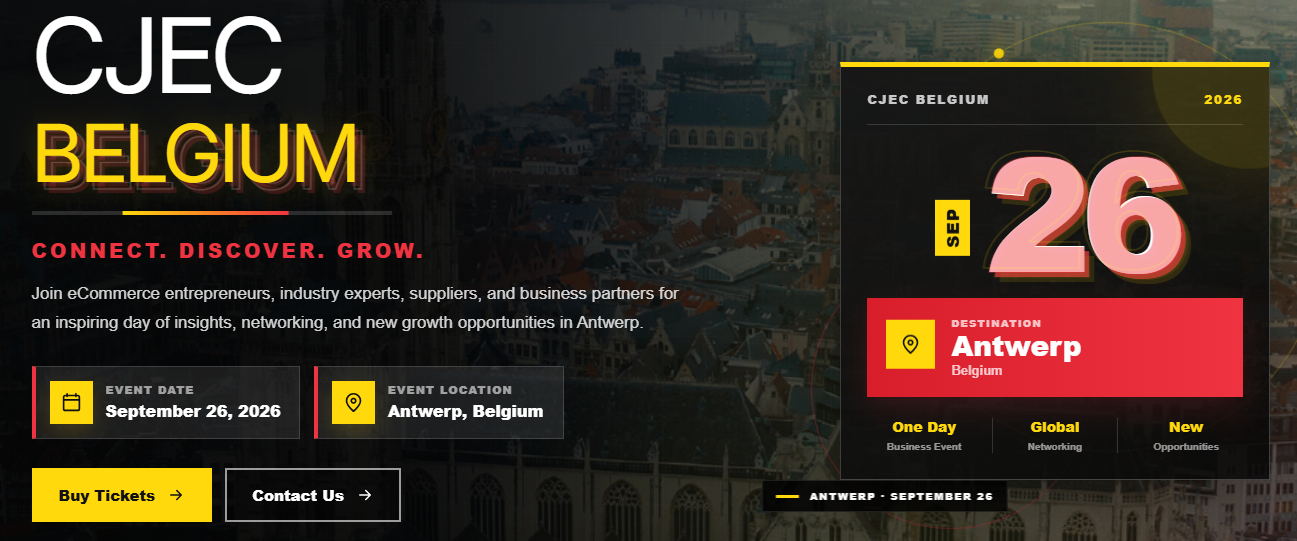
CJEC Antwerp Belgium 2026 takes place on September 26, 2026, at Filip Williotstraat 9, 2600 Antwerp, Belgium.
The choice of Antwerp is particularly fitting. Port of Antwerp-Bruges is the second-largest port in Europe, with more than 300 liner services connecting it to over 800 destinations. The port handles around 290 million tonnes of international maritime cargo annually and supports roughly 164,000 direct and indirect jobs.
For physical e-commerce, that matters. The transaction may happen on a screen, but the product still has to move through factories, freight networks, customs, warehouses and last-mile carriers before it reaches the customer.
CJEC Antwerp brings those two worlds together.
CJEC Antwerp Belgium 2026 at a Glance
| Event Detail | Information |
|---|---|
| Event | CJEC Antwerp Belgium 2026 |
| Date | September 26, 2026 |
| Time | 10:00 AM–5:30 PM currently listed on Eventbrite |
| Location | Filip Williotstraat 9, 2600 Antwerp, Belgium |
| Format | In-person e-commerce conference |
| Language | English |
| Access Pass | €99 |
| Lunch | Included |
| Guest | One complimentary guest |
| Organizer | CJ E-commerce Conference / CJdropshipping |
The current €99 Access Pass includes admission to CJEC Antwerp, lunch, one complimentary guest, keynote and expert sessions, access to CJdropshipping specialists and networking with sellers, suppliers and industry partners. It also currently includes a complimentary two-day CJEC Guangzhou ticket and Canton Fair admission assistance for eligible international attendees.
The Canton Fair benefit should be understood accurately: CJEC provides registration assistance for eligible attendees; it does not override the Canton Fair's own eligibility, identification or application requirements.
Why Antwerp Is a Relevant Meeting Point for European E-Commerce
Antwerp is known internationally for logistics and trade, but that connection goes deeper than simply having a major port nearby.
A European e-commerce order can involve several countries before the parcel reaches its customer.
A product may be manufactured in China, imported through a European port, cleared through customs, transferred to a regional warehouse and finally delivered to a consumer in Belgium, France, Germany or the Netherlands.
That supply chain might look like this:
Manufacturer
→ International freight
→ EU customs
→ European inventory
→ Regional fulfillment
→ Last-mile carrier
→ Customer
Every step affects cost, speed and customer satisfaction.
Port of Antwerp-Bruges describes itself as an international and European logistics hub. Its customs ecosystem includes more than 200 specialized service providers supporting customs representation and related import and export processes.
For e-commerce businesses trying to scale in Europe, that makes Antwerp more than a convenient conference city. It is a physical reminder of what happens behind every online order.
European E-Commerce Is Large, but Europe Is Not One Market
The opportunity across Europe is substantial.
Eurostat reported that 78% of EU internet users bought or ordered goods or services online in 2025, compared with 62% in 2015. E-commerce also has a meaningful role at the business level: e-sales represented 19% of total turnover among EU businesses in 2025. Belgium was among the countries with the highest share, with e-sales accounting for approximately 30% of business turnover in Eurostat's comparison.
But high adoption does not mean every European market behaves identically.
An online store that performs well in the Netherlands cannot simply translate three buttons and assume it will work equally well in France.
A seller expanding through Europe has to think about two systems at the same time.
The first should become increasingly centralized:
- product sourcing;
- inventory planning;
- technology;
- supplier management;
- quality control;
- fulfillment data;
- finance.
The second needs to remain localized:
- language;
- offers;
- payment methods;
- customer service;
- creative strategy;
- shipping expectations;
- market positioning.
That tension between operational efficiency and local customer experience is one of the most important challenges facing cross-border e-commerce businesses.
It is also why meeting suppliers, logistics partners, payment companies, platforms and other sellers in the same environment can be valuable.
What Is CJEC?
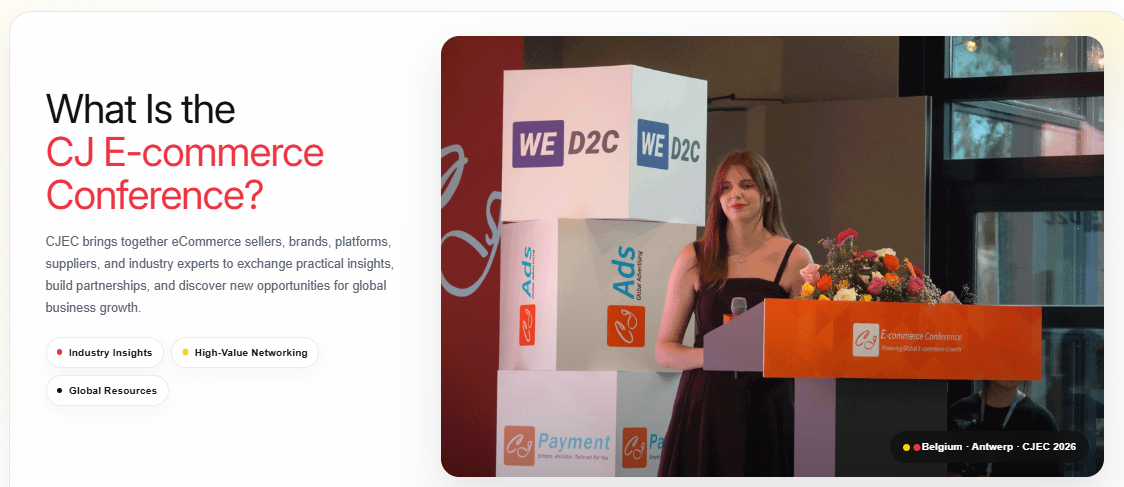
CJEC, the CJ E-commerce Conference, brings together sellers, brands, platforms, suppliers and service providers to discuss practical aspects of operating and growing online businesses.
The Antwerp edition is structured around several connected areas rather than a single platform or business model.
The official agenda highlights:
- e-commerce trends;
- product sourcing;
- fulfillment and logistics;
- branding and customization;
- Shopify and platform growth;
- operator networking.
CJEC describes the objective as helping attendees exchange practical insights, build partnerships and identify new opportunities for international growth.
That makes the audience intentionally mixed.
A Shopify merchant may come looking for an EU warehouse.
A supplier may want relationships with European brands.
An agency may want merchants with established advertising budgets.
A logistics provider may want sellers moving consistent order volume.
A DTC founder may be evaluating whether to move from generic products into private label.
A payment provider may want partnerships with companies operating between Europe and Asia.
The value comes from bringing those different parts of e-commerce into the same conversation.
What You Can Expect to Learn at CJEC Antwerp
The strongest part of the Antwerp agenda is its focus on operational issues that become more important as sellers scale.
Understanding Where European E-Commerce Is Moving
E-commerce changes quickly, but merchants do not benefit from chasing every trend.
The more useful question is:
Which changes will actually affect the way we acquire customers, source products and fulfill orders?
CJEC Antwerp's trend sessions are designed to address changes in consumer behavior, platforms and international e-commerce rather than treating trends as a list of viral products.
For a business owner, that discussion can influence decisions about where to invest next.
Should the business expand to another European market?
Should it develop TikTok Shop?
Should it move more inventory closer to customers?
Should it continue focusing on a single Shopify store?
Should its next investment go into advertising or into the supply chain?
These are strategic decisions with much larger consequences than selecting another app.
Product Sourcing: The Difference Between Finding a Product and Building Supply

Finding a product is easy.
Building a reliable supply chain around that product is much harder.
At the beginning of a dropshipping business, a seller might ask:
How much does this product cost?
Once a product begins generating volume, the questions become more detailed:
Who actually manufactures it?
Is there a better factory?
Can the material be improved?
What is the MOQ?
How stable is production?
Can packaging be customized?
How long is the manufacturing lead time?
What happens if weekly demand triples?
Can the supplier maintain the same quality across production batches?
CJEC Antwerp specifically includes Product & Sourcing Insights, covering supplier comparison, risk reduction and stronger product strategies.
That distinction matters.
The cheapest supplier is not automatically the best supplier.
Saving €1 on a product does not improve profitability if defect rates rise, customer complaints increase or production becomes unreliable.
For serious sellers, sourcing eventually becomes a balance between cost, quality, speed, reliability and differentiation.
The China-to-Europe Supply Chain
China remains central to global e-commerce manufacturing, but European sellers need to think beyond the first international parcel.
A common early-stage model looks like:
China supplier
→ individual international shipment
→ European customer
This can work extremely well for testing.
The seller does not need to purchase hundreds of units before knowing whether a product will sell.
But once demand becomes predictable, the economics begin to change.
The seller may need to compare:
international fulfillment per order
against:
bulk procurement + EU inventory + regional fulfillment
That creates a different model:
Factory
→ bulk international transport
→ European warehouse
→ local fulfillment
→ customer
The second model requires more inventory planning, but it can also support faster delivery, better cost control and easier returns.
CJEC Antwerp's official topics specifically include China Supply Chain, efficient sourcing and global fulfillment.
For European sellers, that conversation is particularly timely because supply-chain strategy increasingly affects the customer experience directly.
Dropshipping Should Validate Demand, Not Define the Business Forever
Dropshipping is often discussed as if a seller must choose between being a “dropshipper” and holding inventory.
In practice, the two models can work at different stages of the same product.
Consider a new item with uncertain demand.
Buying 2,000 units immediately creates unnecessary inventory risk.
Dropshipping allows the seller to test:
- market interest;
- selling price;
- advertising performance;
- preferred variants;
- return rates;
- customer feedback.
Once the seller has enough evidence, the decision changes.
A proven product may justify:
Dropshipping
→ consistent sales
→ bulk purchase
→ EU warehouse
→ faster fulfillment
→ better packaging
→ private label
The transition does not need to happen overnight.
But successful sellers should continually ask whether their fulfillment structure still matches the stage of the product.
EU Warehousing and the Customer Experience
Customers generally do not care where a warehouse is located.
They care about what that warehouse enables.
Faster dispatch.
Predictable tracking.
Reliable delivery.
Simpler returns.
Fewer unexplained delays.
These operational details become part of the brand experience.
If two stores sell similar products but one consistently delivers within several days while the other takes several weeks, logistics becomes part of the competitive advantage.
That is why CJEC Antwerp places Fulfillment & Logistics among its main event themes, with a focus on smarter fulfillment planning and improving delivery experience.
A seller discussing warehouse strategy at the event should not simply ask:
How much is storage?
More useful questions include:
- Which European countries can this location serve efficiently?
- What are the pick-and-pack costs?
- How are returns handled?
- How quickly is inventory received?
- How is stock synchronized?
- Can B2C and B2B orders be fulfilled from the same inventory?
- What happens during peak periods?
- Can inventory later move between warehouses?
Those answers determine whether a logistics relationship will still work after the business grows.
From Generic Products to Recognizable Brands
One of the limits of generic dropshipping is that the product is often identical everywhere.
If customers can find the same item with the same photographs on ten websites, price becomes one of the easiest ways to compare sellers.
Branding changes the basis of competition.
CJEC Antwerp's official program includes Branding & Customization, with topics such as custom packaging, print on demand, private label and branded customer experiences.
A typical progression might look like:
Generic product
→ validated demand
→ better sourcing
→ original photography
→ custom packaging
→ product bundle
→ private label
→ exclusive or modified product
Branding is not simply placing a logo on a package.
The goal is to create reasons for customers to remember the store, trust it and return.
That can involve product quality, packaging, customer support, design, delivery and the consistency of the entire buying experience.
Shopify, TikTok Shop and Platform Growth
European sellers increasingly operate across several channels.
A business might use TikTok for product discovery, Shopify for its direct-to-consumer experience and marketplaces to reach customers who already have strong buying intent.
CJEC Antwerp's platform discussions currently cover Shopify, TikTok Shop, WooCommerce, marketplaces and social commerce.
The useful strategic question is therefore not necessarily:
Which platform is best?
It is:
What role should each platform play?
For example:
TikTok / creators
→ discovery
Shopify
→ brand experience and direct sales
Marketplaces
→ access to existing demand
Email and retention
→ repeat purchases
Fulfillment infrastructure
→ consistent delivery across every channel
A multi-channel business only becomes stronger if the underlying operations can support it.
Adding sales channels faster than the supply chain can handle them creates a different kind of growth problem.
Networking Is Not a Side Activity at CJEC Antwerp
The presentations may bring people into the room, but the conversations between them can produce the longer-term business value.
European e-commerce often requires a network of partners.
A growing brand may need:
- a product supplier;
- quality inspection;
- international freight;
- an EU warehouse;
- last-mile delivery;
- payment infrastructure;
- advertising expertise;
- local creators;
- technology integrations.
Very few companies excel at every part of that system internally.
That makes partnership-building particularly important.
CJEC Antwerp explicitly includes Operator Networking, giving sellers, partners, creators, agencies, suppliers and CJ team members opportunities to meet face to face.
What a Useful Business Conversation Looks Like
Good networking is not about collecting the largest number of contacts.
A merchant attending with a specific problem can have much more productive conversations.
Consider a seller doing stable monthly volume in Belgium and the Netherlands while every order is still shipped individually from Asia.
A useful conversation with a logistics partner might start with:
“At what monthly volume would EU inventory make economic sense for us?”
That can lead into:
- warehouse costs;
- inventory requirements;
- delivery times;
- returns;
- customs;
- cash flow.
A discussion with a supplier might begin:
“This product already sells consistently. Can we improve the materials and packaging without changing its core function?”
That can lead into:
- MOQ;
- samples;
- manufacturing;
- pricing;
- quality control;
- private label.
The seller arrives with one business problem and leaves with several possible solutions.
That is much more valuable than simply saying, “I'm here to network.”
Suppliers Can Meet European Buyers Directly
CJEC Antwerp is not only for merchants.
Manufacturers and suppliers also face a problem: reaching the right buyers.
A factory can have strong production capability but limited understanding of what European brands actually need.
Meeting merchants directly can help suppliers learn:
- which products are selling;
- what quality standards customers expect;
- which MOQs are realistic;
- which packaging matters;
- which markets are growing;
- what kinds of customization brands request.
Instead of relying only on marketplace inquiries, suppliers can build relationships with businesses already operating in the target markets.
Agencies, SaaS Companies and Service Providers Can Find Clients
For B2B companies, CJEC functions differently.
An advertising agency may not attend because it needs a supplier.
It may attend because sellers need advertising.
A payment company may be looking for merchants operating between Europe and Asia.
A SaaS platform may want integrations.
A logistics provider may want e-commerce clients.
For those companies, the event can be a business-development environment as much as an educational conference.
The official Antwerp page currently features partners across payments, logistics, commerce technology and manufacturing, reflecting the broader ecosystem the event is designed to connect.
Cross-Border Payments Are Part of the Supply Chain Too
Products and parcels are only one side of international commerce.
Money also needs to move.
A European seller may collect revenue in euros while paying suppliers in U.S. dollars or Chinese yuan. The same business may pay international agencies, logistics providers and software companies in several currencies.
CJEC Antwerp currently lists WorldFirst among its sponsored partners. The event page describes its services around international payments, currency conversion and multi-currency accounts for cross-border businesses.
For sellers expanding internationally, payment efficiency can affect:
- currency-conversion cost;
- supplier settlement;
- working capital;
- cash-flow visibility.
It is another example of why e-commerce growth cannot be reduced to advertising alone.
Centralize the Supply Chain, Localize the Market
One of the most useful frameworks for European growth is deciding what should be standardized and what should remain local.
| Centralize | Localize |
|---|---|
| Sourcing | Language |
| Quality control | Marketing creative |
| Inventory data | Payment methods |
| Core technology | Offers |
| Supplier management | Customer service |
| Supply-chain planning | Market positioning |
| Analytics | Delivery expectations |
A company does not need a completely different supply chain for Belgium, Germany and France.
But it may need different ways of presenting the product to consumers in each country.
The strongest cross-border operations try to gain efficiency behind the scenes without making the customer experience feel generic.
How CJdropshipping Fits Into the Conversation
CJEC is organized by CJdropshipping, so attendees can also meet CJ team members to discuss sourcing and operational challenges directly.
The official event page specifically highlights onsite access to CJ specialists across sourcing, logistics, branding and operations.
A seller might use those conversations to explore:
Product sourcing
Finding a better supplier or version of an existing product.
Quality control
Checking products before they reach overseas customers.
Custom packaging
Improving presentation after product demand has been validated.
Private label and customization
Creating more differentiation from generic marketplace products.
Global fulfillment
Comparing cross-border shipping with regional inventory.
Warehousing
Moving proven products closer to major customer markets.
The most useful conversation is usually based on the seller's actual operating data rather than a hypothetical store.
What Does the €99 CJEC Antwerp Pass Include?
The current promotional CJEC Antwerp Access Pass is €99.
According to the official event page, it includes:
- access to CJEC Antwerp 2026;
- lunch;
- admission for one complimentary guest;
- keynote, panel and expert sessions;
- networking with sellers and industry leaders;
- supplier and partner networking;
- direct onsite access to CJdropshipping team members;
- practical e-commerce growth sessions;
- one complimentary two-day CJEC Guangzhou ticket;
- Canton Fair admission assistance for eligible international attendees.
The guest benefit means one primary pass holder can currently bring one guest free of charge, with the guest checking in alongside the primary attendee.
For founders attending with a co-founder, colleague or business partner, that can make the event particularly practical.
From Antwerp to Guangzhou: Connecting European Demand With Chinese Supply
The complimentary CJEC Guangzhou ticket creates a logical link between the two events.
Antwerp sits close to the European customer and logistics ecosystem.
Guangzhou sits close to one of the world's most important manufacturing regions.
The questions asked in the two cities can therefore be different.
In Antwerp:
Which European market should we enter?
How quickly should we deliver?
Where should inventory sit?
Which customer expectations are changing?
Which platforms should we use?
In Guangzhou:
Which factory can produce the product?
Can we change the material?
What does customization cost?
Can we lower the MOQ?
How should the product be packaged?
The two sides are connected.
European demand
→ product decisions
→ manufacturing
→ international logistics
→ European fulfillment
→ customer
For sellers building international businesses, understanding both ends of that chain is valuable.
How to Prepare Before CJEC Antwerp
A conference becomes much more productive when attendees arrive with clear objectives.
Do not begin with:
“I want to meet interesting people.”
Start with one or two real business needs.
For example:
We need an EU warehouse.
We want to enter Germany.
Our supplier's defect rate is too high.
Our top product is ready for private label.
We need a better international payment solution.
We are looking for European creators.
That immediately helps other attendees understand whether they can help.
Prepare a short introduction
You do not need a five-minute company presentation.
Thirty seconds is enough.
Explain:
- who you are;
- what you sell;
- where you sell;
- where you are in your growth stage;
- what you are looking for.
For example:
“We run a home-products Shopify brand selling mainly in Belgium and the Netherlands. Our top SKU is now doing consistent volume, and we're evaluating EU warehousing before expanding into Germany.”
That is much easier to respond to than:
“We're in e-commerce.”
Know a few operating numbers
You do not need to reveal confidential financial information.
But knowing approximate figures such as:
- monthly order volume;
- main customer countries;
- average delivery time;
- major product category;
- current warehouse location;
can make supply-chain conversations more useful.
Follow up quickly
A good conversation at 3 PM on September 26 should not become an unread business card in October.
For relevant contacts, follow up within 24 to 48 hours.
Remind them where you met, what you discussed and what the next step should be.
A conference introduction becomes valuable only when something happens after it.
Who Should Attend CJEC Antwerp?
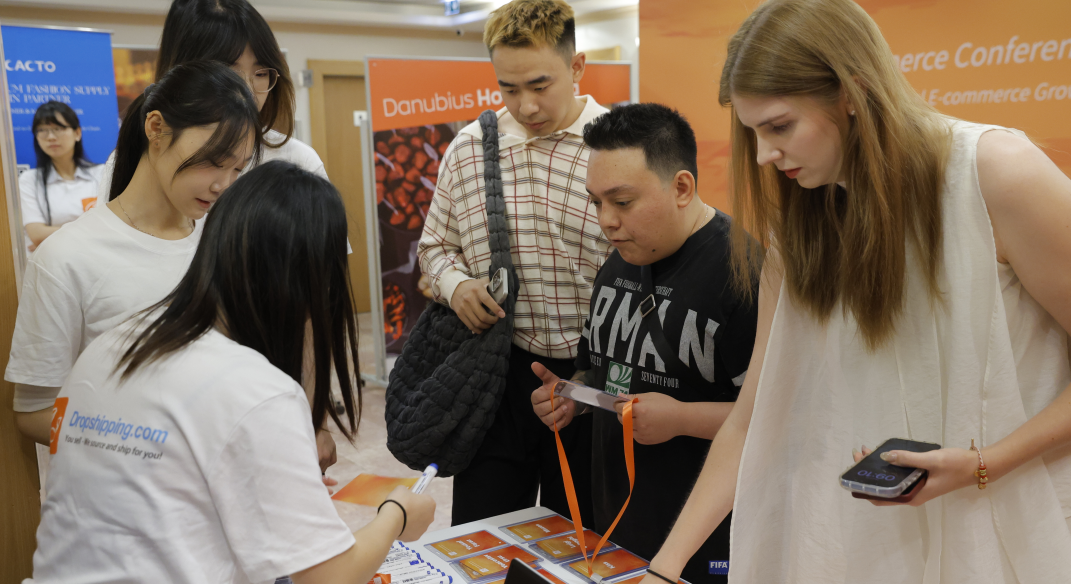
CJEC Antwerp is particularly relevant to several groups.
Dropshipping sellers can explore sourcing, delivery, EU warehousing and the transition from testing to inventory.
Shopify and DTC brands can discuss private label, packaging, fulfillment and European expansion.
TikTok Shop and social-commerce sellers can connect with suppliers, creators and operational partners.
Suppliers and manufacturers can meet European merchants and gain direct market feedback.
Advertising and e-commerce agencies can find merchants who need growth support.
Logistics and warehouse providers can meet businesses with cross-border fulfillment needs.
Payment and financial companies can connect with internationally operating sellers.
SaaS and technology businesses can identify customers, integration opportunities and ecosystem partners.
CJEC's FAQ also makes clear that attendees do not need to be existing CJdropshipping users. The event is open to the wider e-commerce community.
Is CJEC Antwerp Worth Attending?
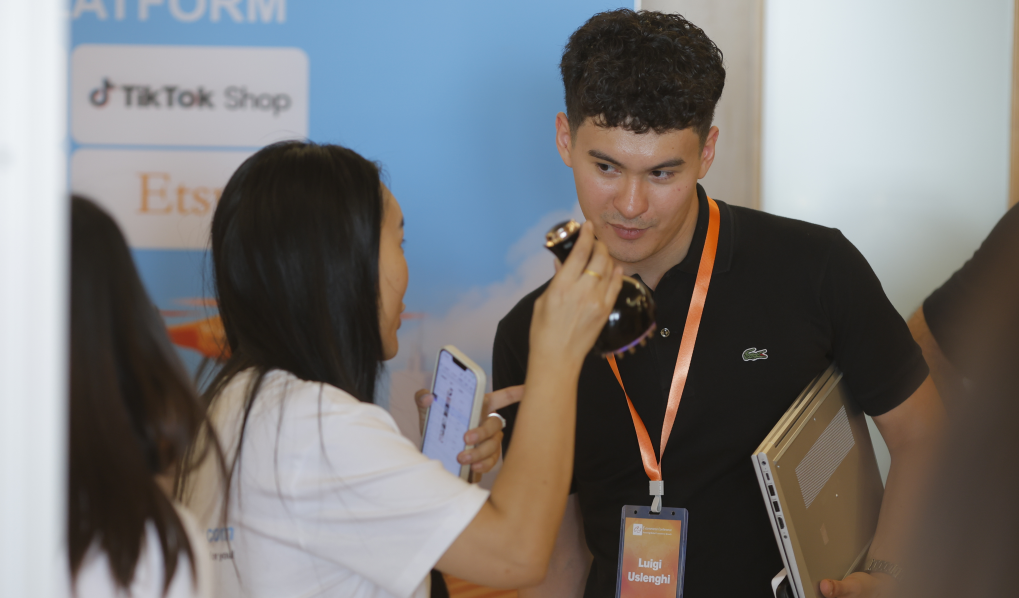
The answer depends on what you need from it.
If your only objective is to sit in a room and collect general e-commerce tips, almost unlimited information is already available online.
The stronger reason to attend is access.
Access to sellers operating in other European markets.
Access to suppliers.
Access to logistics specialists.
Access to payment partners.
Access to agencies.
Access to people dealing with the same operational problems.
For a merchant trying to decide whether to move inventory into Europe, one useful logistics relationship could significantly affect the next year of operations.
For a supplier, one serious European brand could become a long-term buyer.
For an agency, one new client could be worth many times the cost of attending.
For a seller, one conversation may prevent an expensive sourcing or fulfillment mistake.
That is a more realistic way to evaluate an event than counting how many presentation slides you see.
CJEC Antwerp Belgium 2026 FAQs
1. When is CJEC Antwerp Belgium 2026?
CJEC Antwerp takes place on September 26, 2026.
2. What time does the conference run?
Eventbrite currently lists the event from 10:00 AM to 5:30 PM on September 26. Attendees should check the final CJEC agenda before traveling in case registration or program times change.
3. Where is CJEC Antwerp?
The official CJEC page currently lists the conference address as Filip Williotstraat 9, 2600 Antwerp, Belgium.
4. How much is a CJEC Antwerp ticket?
The current promotional Access Pass is €99.
5. Can I bring a guest?
Yes. The current €99 Access Pass allows the primary attendee to bring one complimentary guest.
6. Is lunch included?
Yes. Lunch is currently included for registered CJEC Antwerp attendees.
7. Does the ticket include CJEC Guangzhou?
Yes. The current Antwerp pass includes one complimentary ticket to the two-day CJEC Guangzhou event, subject to the event's registration and redemption requirements.
Final Thoughts
European e-commerce growth is no longer simply a question of whether consumers are willing to buy online.
They already are.
In 2025, 78% of EU internet users purchased online, and Belgium was among Europe's stronger economies for business e-sales.
The harder questions now sit behind the transaction.
Where should a product be manufactured?
When should a seller move from dropshipping to inventory?
Where should European stock be held?
How quickly should customers receive orders?
Which parts of the business should be centralized?
Which parts need to be localized?
How do sellers build better relationships with suppliers, logistics providers, platforms and other partners?
Those are not problems that can always be solved by installing another app.
They require decisions, infrastructure and often the right people.
That is where CJEC Antwerp Belgium 2026 has a clear role.
On September 26, e-commerce sellers, brands, suppliers and service providers will meet in Antwerp, a city closely connected to the physical infrastructure of European trade. The agenda moves from products and sourcing to fulfillment, branding, platform growth and international expansion, while the networking environment gives attendees an opportunity to turn those discussions into actual business relationships.
For European sellers, the goal should not simply be to ship more orders.
It should be to build a business capable of serving more markets without losing control of product quality, margins or customer experience.
Antwerp is where that conversation becomes practical.