
Supplement dropshipping looks attractive for a reason. Many products in the wellness category are compact, consumable, and designed for repeat use. Compared with one-time purchases such as gadgets or home accessories, supplements may give ecommerce sellers more opportunities to build repeat orders, subscriptions, and longer customer relationships.
But supplement dropshipping is not a category where you should simply find a trending product, import the supplier's description, and start running ads.
Supplements are consumed by customers. That makes product quality, ingredients, labeling, documentation, advertising claims, storage, fulfillment, and regulatory compliance especially important. A supplier mistake can become your customer-service problem—and potentially something more serious.
For sellers considering this category, the opportunity is not just finding a cheap product. The real challenge is building a reliable system around it.
This guide explains how to sell supplements online, how to evaluate supplement dropshipping suppliers, how to build a Shopify store, how to calculate realistic margins, and how sourcing and fulfillment services such as CJdropshipping may fit into the supply chain.
What Is Supplement Dropshipping?
Supplement dropshipping is an ecommerce fulfillment model where you sell eligible supplement products without purchasing and storing large amounts of inventory before customers place orders.
The basic flow looks like this:
Customer → Your Online Store → Supplier/Fulfillment Partner → Customer
In a typical order:
-
A customer visits your store and purchases a product.
-
Your ecommerce platform records the payment and order.
-
The order is sent to your supplier or fulfillment partner.
-
You pay the product and fulfillment costs.
-
The supplier prepares the order.
-
The package is shipped directly to the customer.
-
Tracking information is returned to your store.
-
You handle customer communication, refunds, and after-sales service.
The biggest misconception is that the supplier handles the entire business.
They do not.
The supplier may store and ship the product, but customers purchased from your store. If an order is late, a label is unclear, the wrong item arrives, or the customer wants a refund, you remain the first point of contact.
That is why supplement dropshipping depends much more on supply-chain reliability than simply finding the lowest product price.
How Does Supplement Dropshipping Work?
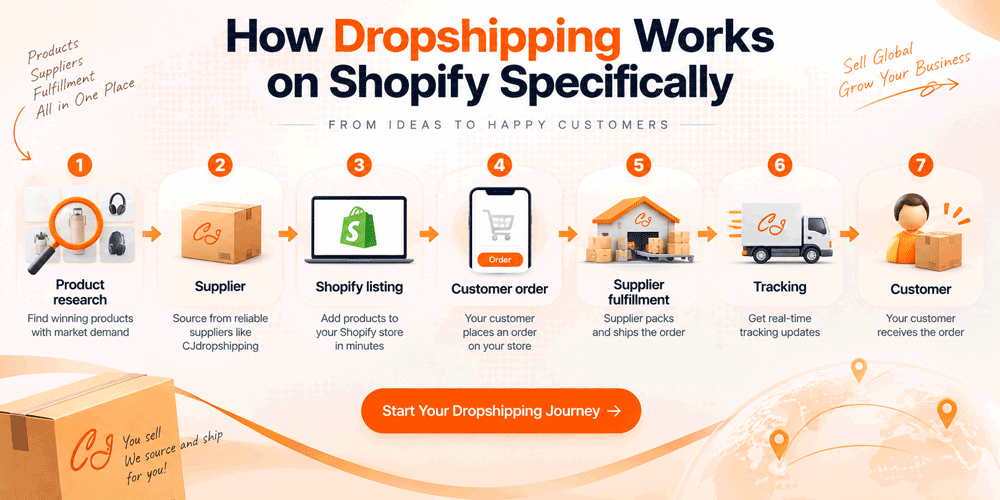
The operating model is similar to normal dropshipping, but product verification requires more attention.
A practical workflow is:
Choose a niche → Research demand → Check compliance → Find suppliers → Verify products → Order samples → Build your store → Launch marketing → Fulfill orders → Retain customers
Step 1: Choose Your Market
Before choosing products, decide where you plan to sell.
A supplement that is acceptable in one country may face different ingredient, labeling, import, or advertising requirements in another.
You should know:
-
Where your business operates
-
Which countries you intend to sell to
-
Where the product will be manufactured
-
Where inventory will be stored
-
How it will reach customers
Do not build a 100-product catalog first and investigate compliance later.
Step 2: Research Demand
Look for established customer demand rather than relying on a viral social-media post.
Useful sources include:
-
Google Trends
-
Keyword research tools
-
Marketplace reviews
-
Competitor stores
-
Social search
-
Customer forums and communities
-
Existing brand reviews
The goal is to identify not only a product but also a specific customer problem or buying context.
Step 3: Verify the Product
Before listing a product, understand:
-
Ingredients
-
Label information
-
Product specifications
-
Shelf life
-
Manufacturing information
-
Packaging
-
Applicable documentation
-
Shipping requirements
Then order a sample.
Step 4: Build the Store
Create accurate product pages, policies, payment settings, shipping expectations, and customer-support processes.
Step 5: Launch a Controlled Test
Do not immediately increase ad spend because the first few orders arrive.
Measure:
-
Conversion rate
-
Customer acquisition cost
-
Average order value
-
Refund rate
-
Fulfillment performance
-
Contribution margin
-
Repeat purchase rate
These numbers tell you whether the business is actually working.
Is Supplement Dropshipping Legal?
Supplement dropshipping can be legal, but there is no single global rule that applies to every product or market.
Compliance can depend on:
-
Product ingredients
-
Product classification
-
Manufacturing
-
Labeling
-
Product claims
-
Advertising
-
Seller location
-
Customer location
-
Import regulations
-
Consumer-protection rules
Selling Supplements in the United States
One common misunderstanding is that every dietary supplement must be individually approved by the FDA before being sold.
That is generally not how U.S. dietary supplement regulation works.
The FDA explains that companies are responsible for ensuring dietary supplements meet applicable safety, manufacturing, and labeling requirements, while the regulatory framework differs from premarket approval used for many drugs.
Sellers should therefore avoid statements such as:
“FDA approved supplement”
unless that description is genuinely applicable and can be substantiated.
Likewise, an FDA-registered facility should not automatically be presented as proof that every individual product has received FDA approval.
Product Claims Require Special Attention
There is a major difference between explaining what a supplement contains and claiming that it can diagnose, cure, treat, or prevent a disease.
Product descriptions, advertisements, videos, testimonials, headlines, and images can all contribute to the claim a customer understands.
For a CJ official blog, the safest practical rule is simple:
Do not turn a supplier's cautious product information into aggressive medical promises just because stronger wording may improve clicks.
The same principle applies when working with creators, affiliates, or user-generated content.
Selling Internationally
If you plan to sell into the EU, UK, Canada, Australia, or other markets, review their specific requirements.
Check:
-
Whether the ingredients are permitted.
-
How the product is classified.
-
What must appear on the label.
-
Which claims are permitted.
-
Whether import requirements apply.
-
Whether additional registrations are required.
For complex products or multi-country expansion, professional legal or regulatory advice may be appropriate.
Pros and Cons of Supplement Dropshipping
Supplement ecommerce offers an interesting business model, but its advantages come with additional responsibilities.
| Advantages | Disadvantages |
|---|---|
| Lower initial inventory exposure | More regulatory complexity |
| Potential repeat purchases | Supplier quality is especially important |
| Subscription opportunities | Advertising claims require caution |
| Many products are compact | Products may have storage or shelf-life requirements |
| Strong branding potential | Customer trust can take time to build |
| Easy to test a focused range | Documentation needs careful review |
| Can transition to private label later | Some products are harder to advertise |
| Customer lifetime value can matter | Cross-border expansion adds compliance complexity |
For beginners, the most interesting advantage is often not markup.
It is repeat purchasing.
If acquiring a customer costs $25 and the first order only contributes $10 after variable costs, the first sale alone does not look attractive.
If a meaningful percentage of customers later reorder without requiring another $25 acquisition cost, the economics can improve.
But never build a financial model assuming every customer will return.
Track the real retention rate.
What Types of Supplements Should You Dropship?
There is no universal “winning supplement.”
Rather than chasing whatever is trending, start with mainstream categories that you can source responsibly and sell within applicable rules in your target market.
When evaluating any product, use a framework like this:
| Factor | What to Evaluate |
|---|---|
| Demand | Are people actively looking for the category? |
| Competition | How established are current brands? |
| Repeat potential | Is replenishment a natural part of the product? |
| Selling price | Does the market support your required price? |
| Product cost | What will the product actually cost? |
| Shipping | What is the delivered cost per order? |
| Shelf life | Will inventory remain sellable throughout fulfillment? |
| Documentation | Can the supplier provide relevant information? |
| Marketing | Can you promote it without questionable claims? |
| Differentiation | Why should customers buy from your store? |
Avoid products whose main selling point depends on extreme promises.
A product that only looks attractive when promoted with unrealistic claims may be a poor foundation for a long-term ecommerce business.
How to Choose a Supplement Niche
New sellers often make one of two mistakes.
They either create an enormous “everything wellness” store or choose such a narrow niche that there is little room to expand.
A better starting point is the customer.
Instead of:
General Supplements
consider positioning around a defined audience or use case, such as:
Simple everyday wellness products for busy professionals
The point is not that this exact niche is guaranteed to work.
The advantage is focus.
A defined customer makes it easier to decide:
-
Which products belong in the store
-
What content to publish
-
Which creators to work with
-
How the site should look
-
What problems product pages should address
-
Which products to add next
Validate Demand Before Building
Use several sources.
Google Trends
Look at whether interest is stable, seasonal, declining, or growing.
Search Keywords
Separate informational searches from commercial searches.
Someone asking a broad educational question may behave differently from a customer comparing products.
Competitors
Study existing brands for evidence of demand.
Review:
-
Pricing
-
Product range
-
Bundles
-
Subscriptions
-
Reviews
-
Content strategy
-
Positioning
Competition is not always a negative sign. It can confirm that customers spend money in the category.
Reviews
Reviews often reveal more than supplier descriptions.
Look for recurring complaints about:
-
Packaging
-
Flavor or format
-
Delivery
-
Value
-
Product information
-
Customer service
-
Subscription management
Repeated complaints can show you where a better customer experience is possible.
How to Find Reliable Supplement Dropshipping Suppliers
Supplier selection is one of the most important parts of dietary supplement dropshipping.
The cheapest supplier is not automatically the best supplier.
A low product price becomes irrelevant if poor fulfillment leads to refunds, customer complaints, and chargebacks.
What to Check
Manufacturing Information
Ask:
-
Where is the product manufactured?
-
What quality processes are used?
-
Who manufactures or distributes it?
-
Can relevant documentation be provided?
Product Information
Check:
-
Ingredients
-
Label
-
Serving information
-
Packaging
-
Expiration or shelf life
-
Batch information where applicable
Traceability
A supplier should be able to identify and investigate products if a quality issue develops.
Shipping
Understand:
-
Processing time
-
Available shipping methods
-
Delivery estimates
-
Tracking
-
Damaged-order procedures
-
Lost-package procedures
Samples
Order the product to an address in the market where you intend to sell.
Evaluate the entire customer experience:
Order → Processing → Tracking → Packaging → Delivery → Product presentation
That test often tells you more than a supplier sales page.
Where CJdropshipping Can Fit Into the Supply Chain
For an official CJ blog, it is important to distinguish between what CJ can help merchants do operationally and whether a specific supplement can be sourced and sold in a particular market.
CJdropshipping provides product sourcing services when sellers cannot find the product they need in the existing catalog. Sellers can submit a sourcing request using product information, images, or links, and CJ works with its supplier network to look for matching products.
That can be useful when researching an ecommerce product line, but supplements require extra checks.
Before selling any sourced supplement, merchants should still verify:
-
Product eligibility
-
Ingredients
-
Documentation
-
Labeling
-
Destination-market requirements
-
Shipping restrictions
-
Advertising restrictions
Product availability should never be treated as automatic proof that a product is suitable for every market.
Connecting CJdropshipping With Shopify
For sellers using Shopify, CJ supports store integration that can synchronize products and orders between the two systems.
A typical workflow can look like:
Shopify Store → CJ Connection → Product/Sourcing → Product Connection → Customer Order → Order Sync → Fulfillment → Tracking
This is particularly useful when a seller wants to reduce repetitive order handling.
However, automation does not replace product due diligence.
Moving Beyond Pure Dropshipping
CJ also offers 3PL fulfillment services for merchants who eventually decide to purchase inventory rather than fulfill only one order at a time.
Its current fulfillment service supports store integrations, inventory storage, order fulfillment, quality inspection, and custom packaging options.
That creates a possible progression:
Dropshipping test → Validate demand → Purchase inventory → Store inventory → Improve fulfillment → Develop branding
For products with stable demand, this hybrid model can sometimes provide more control than remaining in pure dropshipping indefinitely.
Supplement Dropshipping vs. Private Label Supplements
Many sellers eventually face this decision.
Should you continue dropshipping an existing product or invest in your own branded inventory?
| Factor | Dropshipping | Private Label |
|---|---|---|
| Initial investment | Lower | Higher |
| Inventory risk | Lower | Higher |
| Branding control | Limited | Greater |
| Launch speed | Faster | Usually slower |
| MOQ | Often low or none | Often required |
| Product differentiation | Lower | Higher |
| Fulfillment complexity | Lower initially | More planning required |
| Long-term brand potential | Moderate | Stronger if executed well |
Start With Validation
A beginner may use dropshipping to determine whether there is real demand.
Instead of ordering 2,000 units immediately, test:
-
Customer interest
-
Conversion
-
Pricing
-
Advertising cost
-
Refund behavior
-
Repeat purchasing
Move Toward Branding
Once a product demonstrates consistent demand, you may explore:
-
Branded packaging
-
Better supplier terms
-
Bulk purchasing
-
Private inventory
-
Faster fulfillment
-
Related products
CJ's platform currently includes services such as sourcing, private inventory, custom packaging, and 3PL fulfillment, which can support different stages of this transition depending on product eligibility and merchant requirements.
How to Build a Shopify Supplement Store
The technical side of creating a Shopify store is not usually the hardest part.
The harder part is convincing customers that your store deserves their trust.
Keep the Design Clean
For this category, prioritize:
-
Mobile usability
-
Fast loading
-
Clear typography
-
Logical navigation
-
Product education
-
Easy checkout
Avoid filling every section with flashing countdown timers and aggressive urgency messages.
A health and wellness store should generally feel trustworthy before it feels exciting.
Essential Pages
A professional store should normally include:
-
Home
-
Shop
-
Product pages
-
About Us
-
Contact
-
FAQ
-
Shipping Policy
-
Refund Policy
-
Privacy Policy
-
Terms and Conditions
Depending on your product and market, additional notices may be appropriate.
Trust Comes From Information
Trust badges may help visually, but they cannot replace transparency.
Customers look for:
-
Clear labels
-
Detailed product information
-
Professional images
-
Real contact details
-
Transparent shipping
-
Clear policies
-
Genuine reviews
-
Responsive support
How to Write Supplement Product Pages
Do not publish the raw supplier description without reviewing it.
Your product page may need to communicate information such as:
-
Product name
-
Ingredients
-
Quantity
-
Serving information
-
Product format
-
Allergen information where applicable
-
Storage information where applicable
-
Packaging details
-
Shipping information
-
Return terms
The exact requirements depend on the market and product.
Avoid Unsupported Claims
Poor copy might look like:
The miracle solution that fixes your health and guarantees results.
Apart from sounding untrustworthy, claims of this type may create serious advertising and regulatory problems.
A better product page explains:
What the product is → What it contains → How it is presented → Who the product is intended for according to its compliant labeling → How ordering and shipping work
Do not invent benefits just because a competitor uses them.
Use Original Content Where Possible
Supplier photos may be convenient for testing.
As the store grows, consider developing:
-
Original product photography
-
Packaging images
-
Short videos
-
Educational content
-
FAQ graphics
-
Brand-specific creative
CJ's Help Center currently lists product-related services including video and photo shooting and custom packaging among its available services.
Original creative can help differentiate a store from dozens of merchants using the same supplier assets.
How to Price Supplement Products
A common beginner mistake is:
Product costs $10 → Sell it for $20 → Profit $10
Real ecommerce economics do not work that way.
Use:
Selling Price
– Product Cost
– Shipping
– Payment Fees
– Customer Acquisition Cost
– Software/Operating Allocation
– Refund Allowance
= Estimated Contribution Profit
Consider this hypothetical example:
| Item | Amount |
|---|---|
| Retail price | $39.99 |
| Product | -$10.00 |
| Shipping | -$5.00 |
| Payment fee | -$1.50 |
| Advertising cost per customer | -$12.00 |
| Refund/operating allowance | -$2.00 |
| Estimated contribution | $9.49 |
The gap between $10 and $39.99 looks impressive.
The actual contribution is $9.49 before other fixed overhead.
That is the number worth paying attention to.
Factor in Shipping Before Listing
CJ provides shipping-cost and delivery-time tools as part of its dropshipping platform. For CJ users, comparing product cost and available shipping routes before setting the retail price can prevent unpleasant margin surprises later.
Why Repeat Customers Matter
Supplements differ from many one-time ecommerce purchases because some products may naturally be replenished.
This makes retention important.
Track:
-
Repeat purchase rate
-
Average order value
-
Customer acquisition cost
-
Customer lifetime value
-
Refund rate
-
Subscription churn
Imagine two stores.
Store A earns $15 on the first order but almost nobody returns.
Store B earns $8 on the first order but a meaningful percentage of satisfied customers later place additional profitable orders.
Store B could eventually have stronger customer economics.
The key word is could.
Do not assume repeat purchases. Measure them.
How Much Does Supplement Dropshipping Cost to Start?
There is no single required startup amount.
A practical budget might include:
| Expense | Lean Test | More Developed Store |
|---|---|---|
| Ecommerce platform | Basic plan | Higher plan if justified |
| Domain | Low | Low |
| Samples | Essential | Multiple samples |
| Theme | Free | Premium optional |
| Branding | DIY/basic | Professional |
| Product content | Supplier + original | Professional photography/video |
| Apps | Minimal | Reviews, email, subscription, analytics |
| Compliance support | As required | Greater as complexity grows |
| Marketing | Organic/small tests | Structured paid testing |
| Refund reserve | Recommended | Essential |
If your starting budget is limited, prioritize:
-
Product verification
-
Samples
-
Supplier reliability
-
Product content
-
Fulfillment testing
before buying unnecessary software.
How to Market Supplements Online
Selling supplements effectively requires more than pushing product ads.
Customers often want to understand what they are buying first.
SEO and Educational Content
SEO can be valuable because wellness shoppers frequently research products and categories.
Useful formats include:
-
Ingredient explainers
-
Product comparisons
-
Buying guides
-
FAQs
-
Lifestyle content
-
Product-selection guides
For health-related subjects, editorial quality matters.
Use reliable sources and avoid turning educational articles into disguised medical claims.
For a CJ blog or CJ merchant store, informational content can support both customer trust and organic search visibility when it genuinely answers user questions.
TikTok and Short-Form Content
Short videos can help customers discover a brand, but your content should not depend on sensational claims.
Ideas include:
-
Product packaging
-
Daily routines
-
Brand stories
-
Product FAQs
-
Educational clips
-
Behind-the-scenes fulfillment
-
Product format demonstrations
The objective is to make the product understandable.
Influencer and Creator Marketing
A smaller creator with the right audience may be more valuable than a very large general account.
Before working with creators, clarify:
-
Deliverables
-
Content usage rights
-
Disclosure requirements
-
Claims they can use
-
Content review
-
Tracking
Do not allow an influencer to make medical promises that you would not publish on your own website.
Email and Retention Marketing
A consumable product can give you more opportunities to communicate after the first purchase.
Useful flows include:
Welcome Flow
Explain the brand and product range.
Post-Purchase Flow
Provide order updates and appropriate product information.
Replenishment Reminder
Remind customers when a reorder may be useful.
Subscription Communication
If you offer subscriptions, make:
-
Pricing
-
Billing
-
Renewal
-
Pause options
-
Cancellation
clear and easy to understand.
Win-Back Campaign
Reconnect with customers who have not purchased in some time.
The goal is convenience and loyalty, not making cancellation difficult.
Fulfilling Supplement Orders
After marketing gets the sale, operations determine what customers experience next.
A typical fulfillment flow is:
Customer Order → Store → Supplier/Fulfillment System → Processing → Shipping → Tracking → Delivery
When Shopify is connected to CJ, products and orders can be synchronized into CJ's system, reducing the need to manually transfer every customer order.
Automation is useful, but sellers should still watch for exceptions.
Out-of-Stock Product
Pause promotions if necessary and find out when inventory will return.
Delayed Shipment
Investigate before the customer has to chase you.
Lost Package
Check tracking and follow your published refund or replacement policy.
Wrong Product
Resolve the customer issue and investigate whether SKU mapping or warehouse processing caused the mistake.
Customer Product Questions
Give accurate product information, but do not improvise individualized medical advice.
Where appropriate, direct medical questions to qualified healthcare professionals.
Common Supplement Dropshipping Mistakes
1. Choosing Products Only for Margin
A high markup does not compensate for poor quality or compliance risk.
Better approach: Evaluate demand, supplier reliability, documentation, shipping, and margin together.
2. Choosing the Cheapest Supplier
Saving $1 per unit may cost far more in refunds.
Better approach: Compare total delivered cost and service quality.
3. Skipping Samples
You cannot properly judge the customer experience from a supplier listing.
Better approach: Order and inspect the product before scaling.
4. Copying Supplier Claims
A supplier description is not a license to repeat every statement in your advertising.
Better approach: Review product information and claims before publishing.
5. Uploading Too Many Products
A giant catalog can make a new store look unfocused.
Better approach: Start with a coherent product range for one audience.
6. Ignoring Delivery Expectations
Customers become frustrated when the actual shipping experience differs from the promise.
Better approach: Compare shipping options before setting expectations.
7. Focusing on Revenue Instead of Contribution
Sales screenshots do not show profitability.
Better approach: Track customer acquisition cost and contribution margin.
8. Ignoring Retention
Constantly buying first-time customers can become expensive.
Better approach: Develop email, service, replenishment, and loyalty systems.
9. Scaling Before Testing Fulfillment
Ten orders are manageable. A hundred bad shipments are a serious problem.
Better approach: Test the complete workflow before increasing volume.
10. Treating Compliance as a One-Time Checkbox
Products, policies, markets, and regulations change.
Better approach: Build regular review into your operating process.
How to Scale a Supplement Dropshipping Business
Scaling should not simply mean spending more on advertising.
A healthier path looks like this:
Stage 1: Test
Use dropshipping to test product-market fit without committing to excessive inventory.
Stage 2: Validate
Measure:
-
Orders
-
Profitability
-
Complaints
-
Refunds
-
Shipping performance
-
Repeat purchases
Stage 3: Improve Supplier Terms
With consistent volume, better sourcing or purchasing terms may become available.
CJ's sourcing service can be used to submit requests for products not currently available on the platform, allowing merchants to explore supply options through CJ's supplier network.
Stage 4: Improve Branding
Explore original creative, custom packaging, and a more consistent unboxing experience where appropriate.
Stage 5: Purchase Inventory
Once demand is more predictable, inventory may improve stock control or unit economics.
Stage 6: Use 3PL Fulfillment
CJ's 3PL service supports merchant inventory, store integrations, order fulfillment, quality inspection, and custom packaging options.
This creates a potential long-term model:
Dropshipping → Product Validation → Bulk Purchase → Warehouse Inventory → Branded Fulfillment
Not every seller needs to follow all of these stages.
The important point is that dropshipping does not have to be the permanent operational model.
Is Supplement Dropshipping Worth It?
Supplement dropshipping can make sense for sellers who want to test a wellness ecommerce concept without buying large amounts of inventory on day one.
It can offer:
-
Lower initial inventory exposure
-
Repeat-purchase opportunities
-
Subscription potential
-
Strong content potential
-
A path toward private labeling
-
Long-term brand-building possibilities
But supplements are not the easiest possible dropshipping category.
You have to care about:
-
Product quality
-
Documentation
-
Customer trust
-
Claims
-
Advertising
-
Fulfillment
-
Shipping
-
Market-specific rules
If your goal is simply to find a product tonight and run aggressive ads tomorrow, another category may be easier.
If your goal is to build a credible ecommerce brand and you are willing to invest in supplier verification and customer experience, the category can be worth researching.
Start Small, Verify Everything, Then Scale
The smartest way to approach supplement dropshipping is not to launch as many products as possible.
Start with a system you can control.
Step 1: Choose one customer group.
Step 2: Research demand.
Step 3: Understand the requirements of your target market.
Step 4: Shortlist a small number of products.
Step 5: Compare suppliers and documentation.
Step 6: Order samples.
Step 7: Calculate the complete delivered cost.
Step 8: Build accurate product pages.
Step 9: Test checkout and fulfillment.
Step 10: Launch controlled marketing.
Then use real customer data to decide what happens next.
If you cannot find a suitable product through the existing CJ catalog, you can explore CJ's sourcing service. If demand later becomes predictable, inventory, 3PL fulfillment, and custom packaging can become part of the next stage of the business. CJ currently provides sourcing, Shopify integration, private inventory, fulfillment, and packaging-related services designed to support merchants across different stages of their ecommerce operations.
The goal is not simply to find a supplement with the highest markup.
It is to build a supply chain in which the product is appropriate for the market, the information customers see is accurate, orders arrive reliably, and the economics still work after all costs are included.
That is a much stronger foundation for a long-term ecommerce business.