
Makeup is one of the few eCommerce categories where customers can buy the same type of product repeatedly while still being excited by something new.
A shopper may already own three lip products and still purchase another because the shade, texture, finish, packaging, or brand story feels different. That combination of replenishment demand and product discovery is one reason cosmetics remain attractive to online sellers.
The market itself continues to expand. Grand View Research estimates that the global cosmetics market will grow from $330.1 billion in 2025 to approximately $349.4 billion in 2026, with a projected CAGR of 6.6% through 2033.
The strength of consumer demand is visible at the retailer level as well. In August 2026, Ulta Beauty raised its annual forecasts after second-quarter net sales increased nearly 9% year over year to roughly $3 billion. The retailer pointed to product assortment, marketing investment, exclusive brands, and expansion into channels such as TikTok Shop as important drivers.
For a dropshipper, however, strong beauty demand is only part of the equation.
Makeup is applied directly to the skin, eyes, and lips. Customers care about ingredients, texture, shades, packaging, leakage, consistency, and product safety in ways that are very different from selling phone cases or home decor. A foundation that changes color between batches can destroy customer trust. A lip gloss that leaks during shipping can wipe out the margin from several successful orders.
The supplier therefore matters enormously.
The best makeup dropshipping suppliers are not necessarily the companies with the cheapest products. They are the suppliers that can combine reliable products with clear ingredient information, manageable minimum order quantities, consistent fulfillment, branding options, integrations, and a path to scale.
What We Looked for in a Makeup Dropshipping Supplier
A supplier that works well for general dropshipping is not automatically a good cosmetics supplier.
For this list, the most important factors are product depth, fulfillment model, branding options, entry requirements, and the amount of control a seller can maintain as the business grows.
Product selection matters first. A serious makeup supplier should offer more than beauty accessories. Depending on the supplier, that may include lipsticks, glosses, blush, foundation, concealer, mascara, eyeliner, eyeshadow, palettes, brow products, primers, brushes, and related beauty products.
Product information matters just as much. Ingredient lists, manufacturing details, labeling information, and relevant documentation are particularly important in cosmetics.
The regulatory environment makes that more important in 2026. Under the U.S. Modernization of Cosmetics Regulation Act, or MoCRA, many cosmetic facilities and products are subject to registration and listing requirements. As of June 30, 2026, FDA data showed 16,398 active cosmetic facility registrations and 1,298,361 active cosmetic product listings.
That does not mean a product is “FDA approved.” FDA specifically states that facility registration and product listing are not cosmetic approval programs. It does mean sellers should take supplier documentation seriously rather than relying on vague claims.
We also considered private label capability. There is a major difference between selling a supplier's existing product and having your brand name printed directly on the cosmetic container.
Finally, we looked at scalability. A supplier should ideally support the seller not only when the store is generating five orders a week but also when a winning product begins generating hundreds.
Here is the shortlist.
| Supplier | Best For | Private Label | MOQ / Entry | Makeup Depth | Key Strength |
|---|---|---|---|---|---|
| CJdropshipping | Overall sourcing and scaling | Product-dependent | Varies | Broad | Sourcing + global fulfillment |
| Blanka | Ready-to-brand makeup | Yes | Zero MOQ for dropshipping | Strong | Private label + automation |
| Selfnamed | Clean beauty brands | Yes | Zero MOQ | Curated | US/EU fulfillment |
| viaGlamour | Deep makeup customization | Yes | Zero MOQ | Very strong | 800+ beauty formulas |
| Zendrop | Testing trending makeup | Limited / product-dependent | Per-order model | Broad | Easy sourcing and automation |
| Syncee | Comparing regional suppliers | Supplier-dependent | Supplier-dependent | Broad marketplace | US/EU/UK/AU supplier network |
| Beauty Joint | Existing branded cosmetics | No traditional private label | No inventory pre-purchase | Strong | Wholesale cosmetics dropshipping |
| DR.HC Cosmetic Lab | US-made private label | Yes | Zero MOQ for PL dropshipping | Makeup + beauty | US manufacturing |
| Jubilee | Shopify private-label testing | Yes | Program-based | Makeup-focused | Shopify-first customization |
| AliExpress | Low-cost product discovery | Usually limited | Seller-dependent | Extremely broad | Variety and low barrier |
1. CJdropshipping — Best Overall for Sourcing, Fulfillment, and Scaling
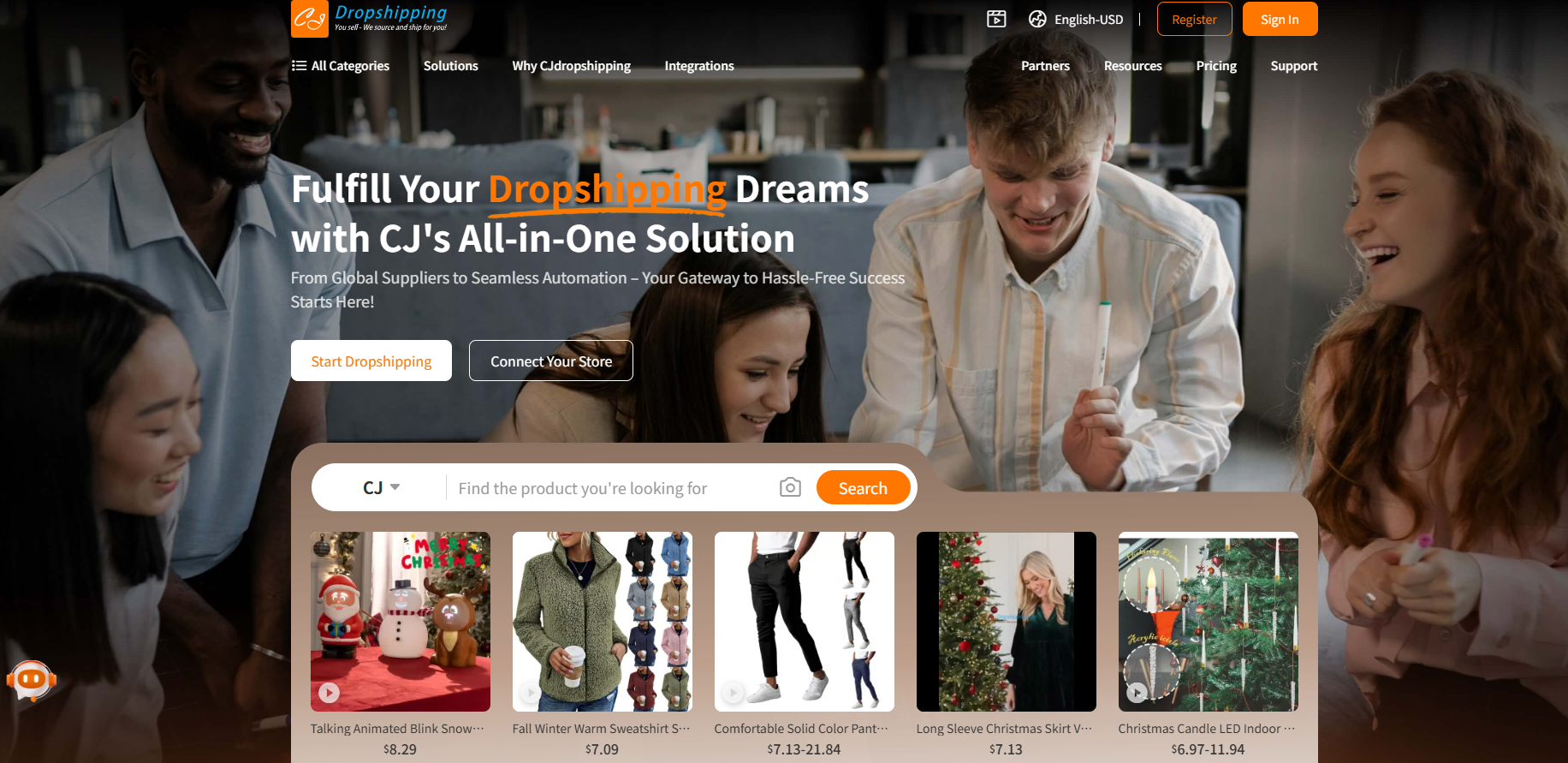
CJdropshipping is different from several suppliers on this list because it is not primarily a private-label cosmetics laboratory.
Its strength is the wider supply-chain infrastructure around the product.
CJ currently lists makeup products such as eyeliner, eyebrow pencils, lip oils, lip gloss, blush, contour products, setting products, and other beauty items in its Health & Beauty category. Sellers who cannot find the exact product they need can also submit a sourcing request.
That sourcing capability becomes important when a seller does not want to build the entire business around whatever happens to be listed in a fixed supplier catalog.
Suppose a particular liquid blush begins selling well. Instead of being permanently tied to the original listing, a seller can request sourcing for alternative suppliers, different packaging, a better unit price, or a variation that better fits the brand.
CJ also combines sourcing with services including custom packaging, ODM, bulk purchasing, print on demand, warehousing, and 3PL fulfillment. Its current network includes more than 10 global warehouses.
Custom packaging is particularly relevant in beauty. CJ currently offers more than 500 packaging options and says some custom-packaging options can begin with an MOQ as low as one unit.
Why CJdropshipping works well for makeup sellers
The platform is strongest for sellers who want to move through several stages:
Test → source → improve → brand → stock → fulfill.
A seller can begin with ordinary dropshipping, identify which products convert, and then investigate custom packaging, bulk purchasing, alternative suppliers, or stocked fulfillment for products that prove demand.
CJ also supports product sourcing when an item cannot be found in its existing catalog.
That flexibility is useful because beauty trends can change quickly.
What to consider
CJ should not be treated as if every makeup SKU automatically includes private-label formula manufacturing.
Customization, documentation, MOQ, ingredients, packaging, and private-label options depend on the individual product and supplier.
For cosmetics, sellers should confirm those details product by product and request samples before scaling.
Best for
Sellers who want a broad sourcing and fulfillment partner rather than being locked into one fixed cosmetics catalog.
2. Blanka — Best for Ready-to-Brand Private Label Makeup
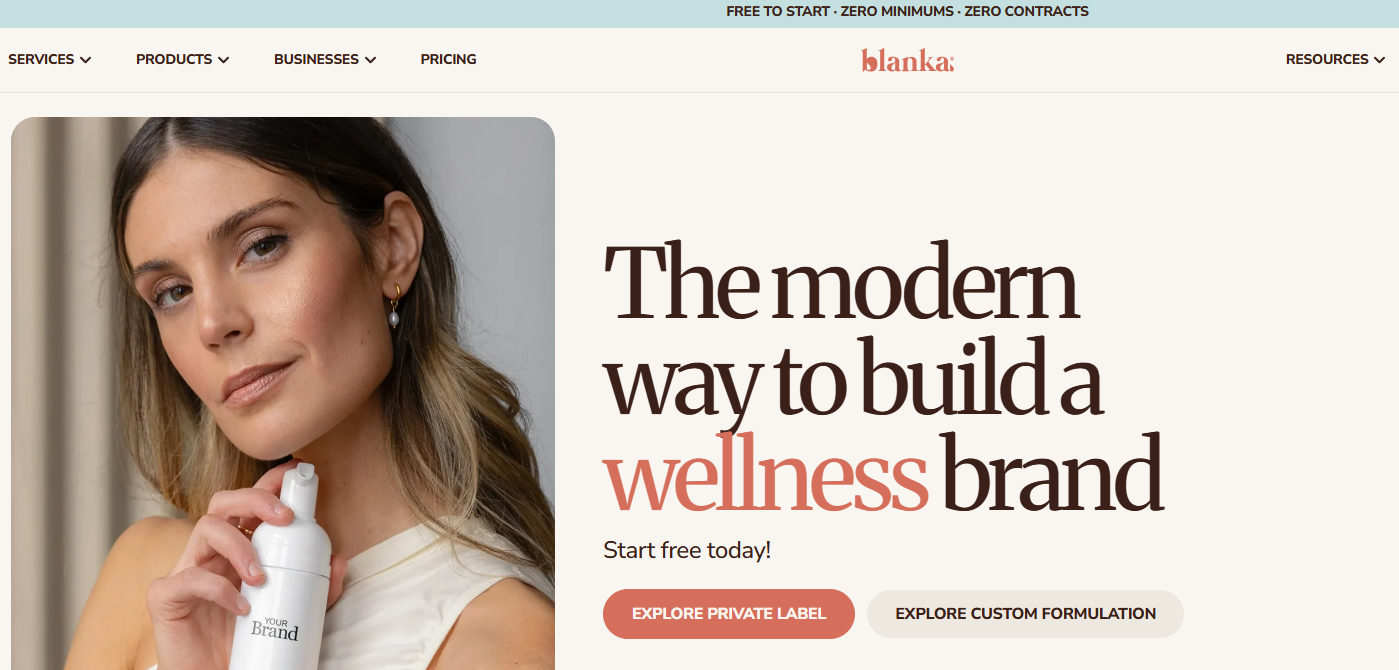
Blanka is one of the strongest options for sellers whose priority is building a brand from the beginning.
Instead of selling an unbranded product and adding a logo only to the shipping box, Blanka focuses on private-label beauty products that can carry the seller's branding.
Its current catalog includes 450+ ready-to-brand beauty products across makeup, skincare, haircare, body care, fragrance, and related categories. Blanka supports both dropshipping and wholesale.
For makeup specifically, the catalog includes products such as blush palettes, bronzers, tinted moisturizers, cheek products, lip products, and face makeup.
The major advantage is the entry model.
Blanka currently states that its dropshipping model has zero minimum order quantities. Sellers can create a branded product line without purchasing hundreds of units first.
Orders can be fulfilled on demand, and Blanka supports integrations with Shopify, Wix, and WooCommerce.
Where Blanka stands out
Blanka is particularly useful if the business model is:
“My makeup brand”
rather than:
“My store sells different makeup products.”
That distinction matters.
Private labeling gives the seller greater control over positioning, product names, packaging design, price architecture, collections, and customer retention.
Blanka also offers custom formulation through Blanka Labs for businesses that eventually want to move beyond ready-made private-label formulas. That is a different model from zero-MOQ dropshipping: custom formulations have higher requirements and longer development times.
What to consider
Private-label convenience generally comes with a higher unit cost than buying generic cosmetics from a mass-market marketplace.
That means sellers need to build enough perceived value through brand identity, content, packaging, bundles, or professional positioning to justify the retail price.
Best for
Creators, makeup artists, beauty entrepreneurs, salons, and eCommerce stores that want a branded makeup line without initially carrying inventory.
3. Selfnamed — Best for Clean Beauty and Skin-First Makeup
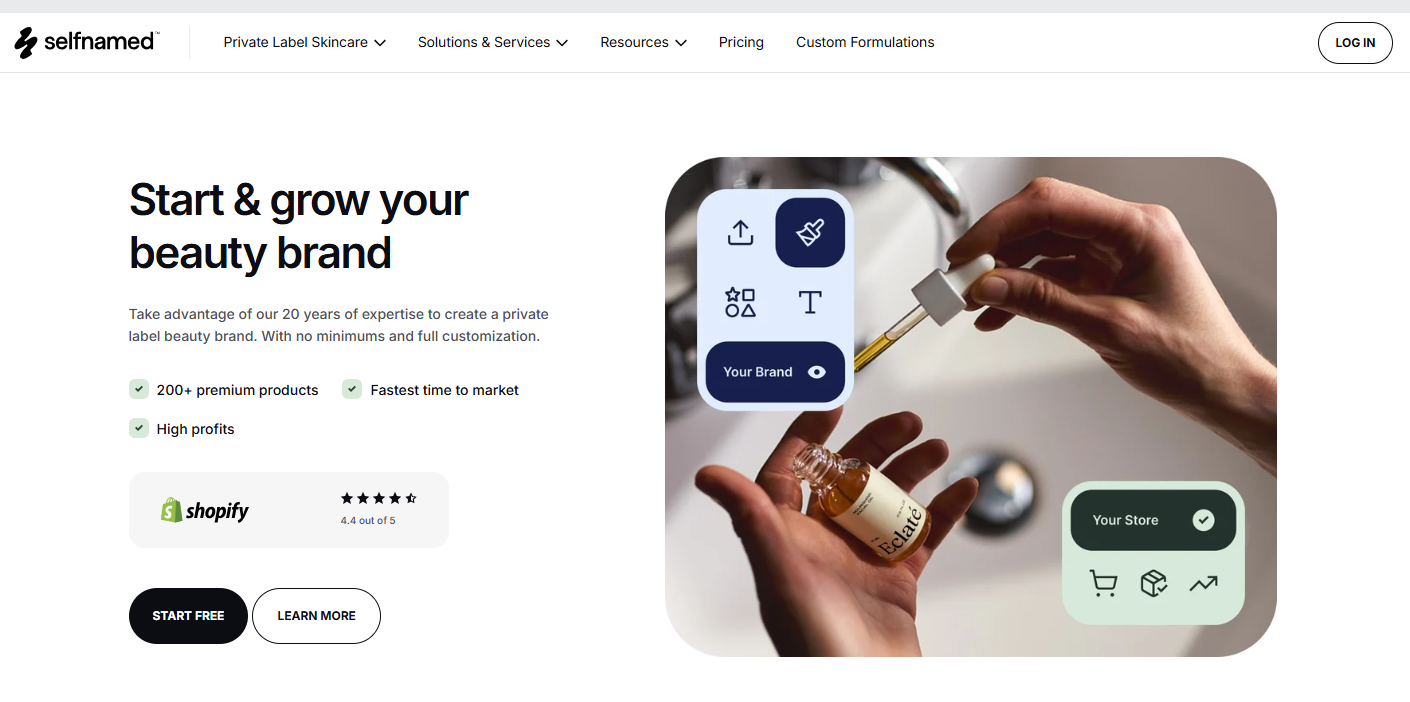
Selfnamed has traditionally been known for skincare, but its current platform includes a dedicated makeup catalog and has expanded toward broader clean beauty.
The company currently offers 200+ premium beauty products across categories and supports dropshipping as well as bulk ordering. It operates fulfillment from facilities in the United States and Europe.
Its private-label makeup page highlights products such as foundation, mascara, lipstick, and other natural or clean-beauty-oriented makeup formulas.
One of Selfnamed's strongest advantages is the entry model.
There is no minimum order quantity for its on-demand private-label model. Sellers can order one unit, test a product, and expand without committing to a large production run.
The company also supports store connections including Shopify, WooCommerce, Squarespace, and Wix, with automatic order fulfillment available.
Why Selfnamed is different
Its positioning is more “clean beauty laboratory” than “trending cosmetics marketplace.”
That makes it a better fit for stores built around natural-looking makeup, skin-first formulas, minimalist packaging, and premium positioning.
Selfnamed also provides compliance information publicly. Its site states that its products are registered in CPNP where applicable, manufactured under relevant cosmetics standards, and supported by facilities in the U.S. and Europe.
That level of transparency is useful in a category where sellers should never assume compliance.
What to consider
The makeup catalog is more curated than platforms built around thousands of general consumer products.
That is not necessarily a weakness. For a focused beauty brand, a smaller but more coherent product range can be easier to merchandise.
Best for
Clean-beauty brands, estheticians, creators, salons, and sellers who want makeup to sit alongside skincare rather than operating as a purely trend-driven cosmetics store.
4. viaGlamour — Best for Deep Makeup Selection and Custom Branding
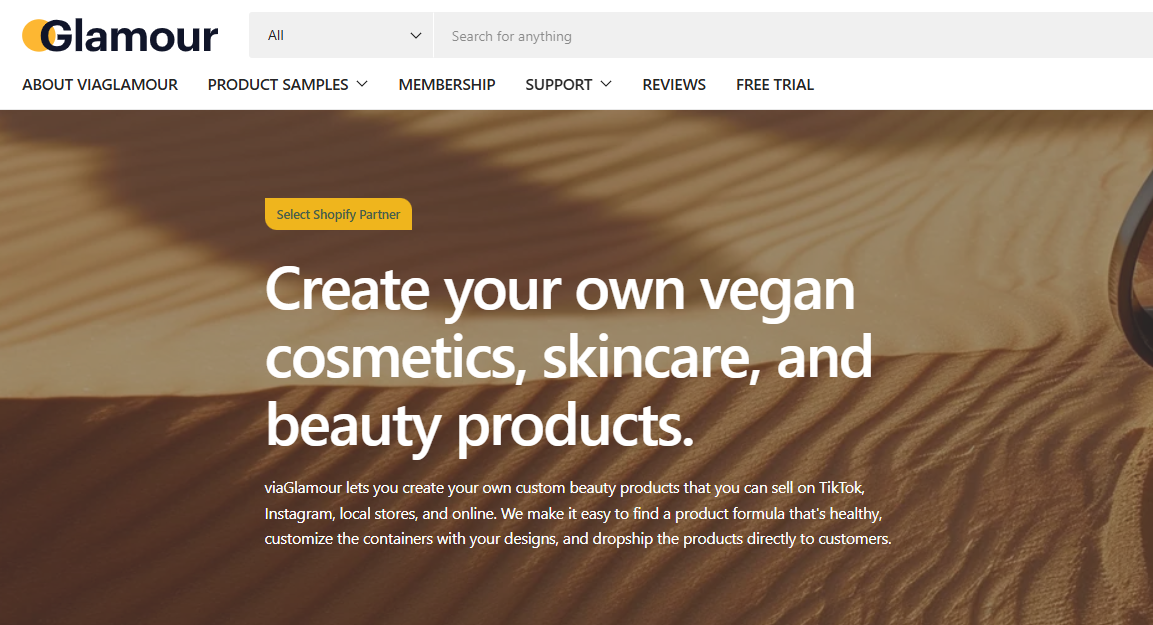
viaGlamour is one of the most makeup-focused suppliers in this list.
The Toronto-based cosmetics laboratory offers an unusually broad range of products including lipsticks, lip gloss, bronzer, concealer, contour palettes, eye pencils, eyeshadow, foundation, eyeliner, primers, makeup brushes, mascara, highlighters, and other cosmetics.
The company states that it has 800+ formulas available for brands and does not require a minimum order quantity for its dropshipping model. Products can be customized with the seller's branding and shipped directly to customers.
That makes viaGlamour especially interesting for someone who wants an actual makeup line rather than a beauty store where makeup is only one small category.
Why viaGlamour stands out
The makeup assortment is deep.
A brand could build an entire collection around:
-
Foundation
-
Concealer
-
Lip products
-
Eyeshadow
-
Blush
-
Bronzer
-
Contour
-
Eyeliner
-
Mascara
-
Brushes
without mixing several unrelated suppliers.
viaGlamour formulates and ships from Canada and offers Shopify integration. Samples are available, which is important for checking color, finish, packaging, and texture before adding products to a store.
The company also offers wholesale ordering, allowing a brand to move from per-order dropshipping toward inventory later.
What to consider
A deep private-label catalog can tempt new sellers to launch too many products.
That is usually a mistake.
A new makeup brand is often stronger with a tightly edited collection of perhaps five to ten hero products than with 100 products that customers cannot distinguish.
Best for
Entrepreneurs who want substantial control over a private-label makeup assortment and prefer a cosmetics specialist rather than a broad dropshipping marketplace.
5. Zendrop — Best for Testing Trending Makeup and Beauty Products
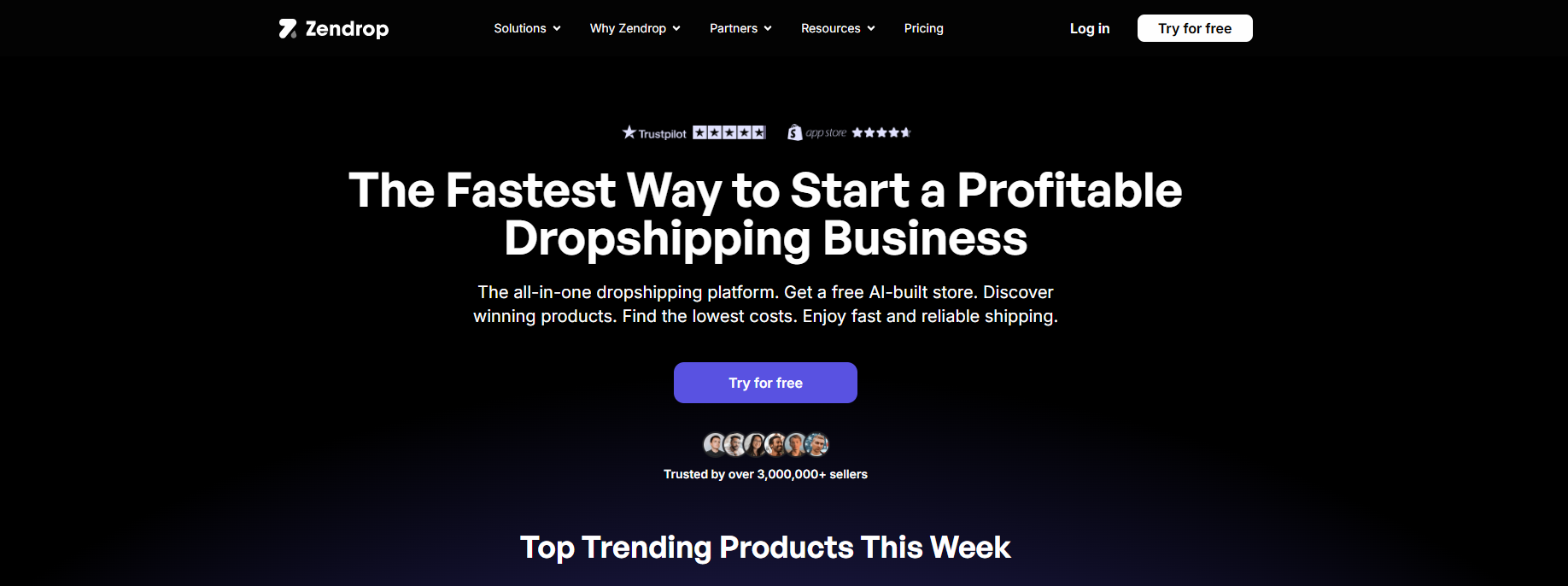
Zendrop is a better fit for product testing than for building a deeply customized private-label cosmetics line from day one.
Its current beauty catalog includes skincare, beauty tools, makeup accessories, cosmetic sets, eyeshadow palettes, highlighter products, primers, brush sets, and other items.
The platform combines sourcing with automated fulfillment, product importing, order tracking, and shipping from U.S. and China fulfillment locations.
For a seller trying to answer the question:
“Which beauty product can I actually sell?”
that simplicity has value.
Why Zendrop works
Beauty products can be imported into a connected store quickly, and the supplier handles fulfillment after a customer orders.
That makes it practical for testing several product concepts without immediately making a private-label commitment.
For example, a seller could compare demand for:
-
Makeup brush kits
-
Cosmetic organizers
-
Highlighter sticks
-
Eyeshadow palettes
-
Beauty tools
and then concentrate on the products that receive the strongest customer response.
Zendrop's 2026 beauty content also emphasizes products that can be easily demonstrated through short-form content, an important characteristic in modern beauty commerce.
What to consider
Product sourcing and private-label manufacturing are not the same thing.
If the end goal is a premium proprietary makeup brand, a seller may eventually need to move a winning product into a more controlled sourcing, manufacturing, or private-label arrangement.
Best for
Beginners and general dropshippers who want to validate makeup or beauty demand before making a larger branding commitment.
6. Syncee — Best for Comparing Makeup Suppliers Across Different Regions
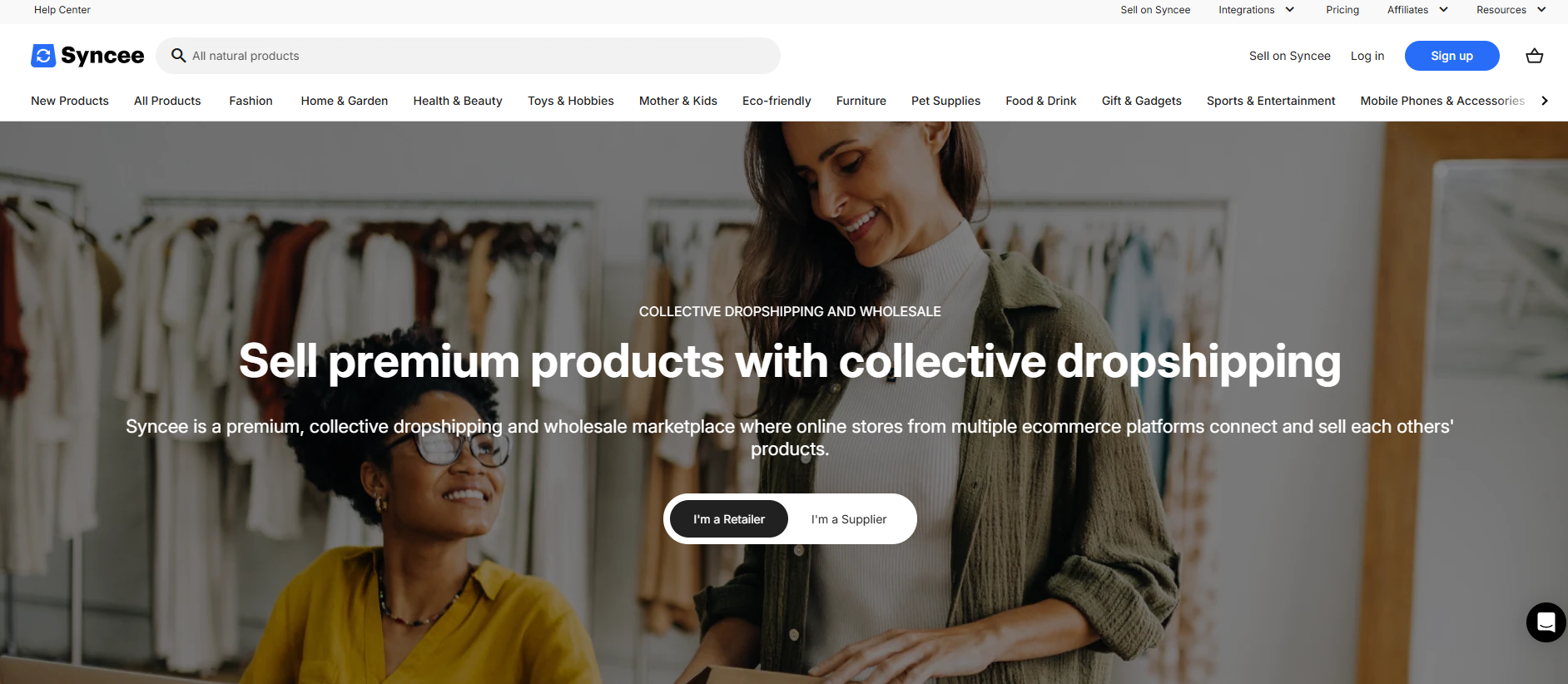
Syncee is not one cosmetics manufacturer.
It is a supplier marketplace.
That makes the platform useful for sellers who care about where the supplier is located as much as which products are available.
Syncee's current beauty marketplace includes suppliers in the United States, Canada, European Union, United Kingdom, and Australia. Its beauty categories cover skincare, cosmetics, wellness products, lip gloss, bath products, and other items.
The broader Syncee platform currently connects retailers with more than 12,000 brands.
Why Syncee works
A store focused on U.S. customers may want U.S.-based inventory.
A European store may prefer EU suppliers.
An Australian seller may want to avoid sending every small cosmetic order from another continent.
Syncee allows sellers to compare supplier options rather than relying on one central catalog.
It also provides automated product updates and order workflows.
What to consider
Because Syncee is a marketplace, there is no universal answer for:
-
MOQ
-
Private labeling
-
Ingredient documentation
-
Processing times
-
Returns
-
Packaging
-
Shipping
Those details depend on the individual supplier.
The platform helps with discovery and automation; it does not remove the need to vet the cosmetics supplier itself.
Best for
Established stores that want to diversify supplier locations or find more regionally appropriate beauty products.
7. Beauty Joint — Best for Dropshipping Existing Cosmetics Rather Than Building a Private Label
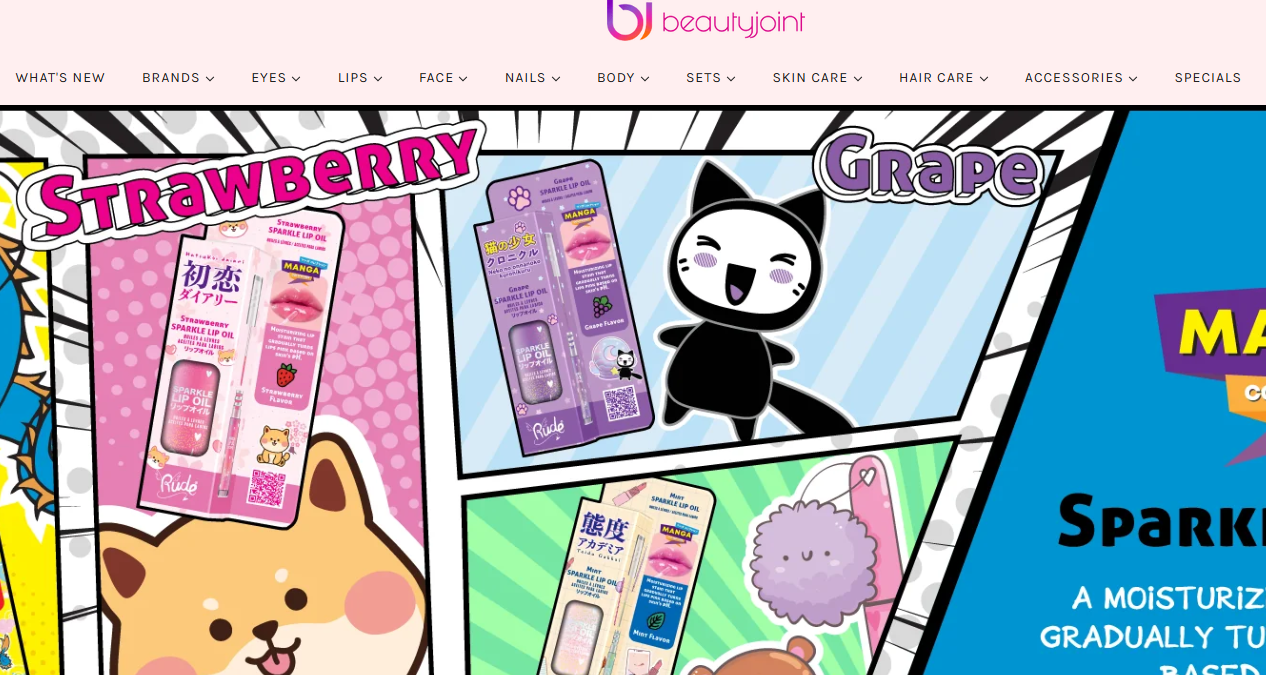
Beauty Joint follows a more traditional wholesale dropshipping model.
Instead of primarily creating products under the seller's own name, the company allows approved dropshippers to list products from its catalog and purchase them at wholesale prices after a customer orders.
Beauty Joint then ships the order directly to the customer's address.
Its product selection is focused heavily on makeup, beauty, and cosmetics, making it more relevant to the keyword than a general-purpose marketplace.
Current program structure
Beauty Joint currently charges a $25 one-time setup fee and a $15 monthly subscription fee for its dropshipping program.
Approved dropshipping customers receive product pricing at 30% below the listed retail price, according to the company's current program terms.
Orders submitted and paid correctly are typically shipped within one business day after payment is verified.
Why Beauty Joint can make sense
Not every entrepreneur wants to build a private-label cosmetics brand.
Some sellers would rather create a beauty retail store that carries multiple existing products.
That is where Beauty Joint fits more naturally.
The operational model is relatively straightforward: list products, generate the sale, purchase at the dropshipping rate, and let the supplier ship.
What to consider
The main limitation is brand ownership.
Selling an existing cosmetics product can generate revenue, but the product itself is not unique to your store.
That generally gives sellers less control over pricing and long-term differentiation than private labeling.
Best for
Beauty retailers that want to resell cosmetics without manufacturing their own formulas.
8. DR.HC Cosmetic Lab — Best for US-Made Private Label Cosmetics
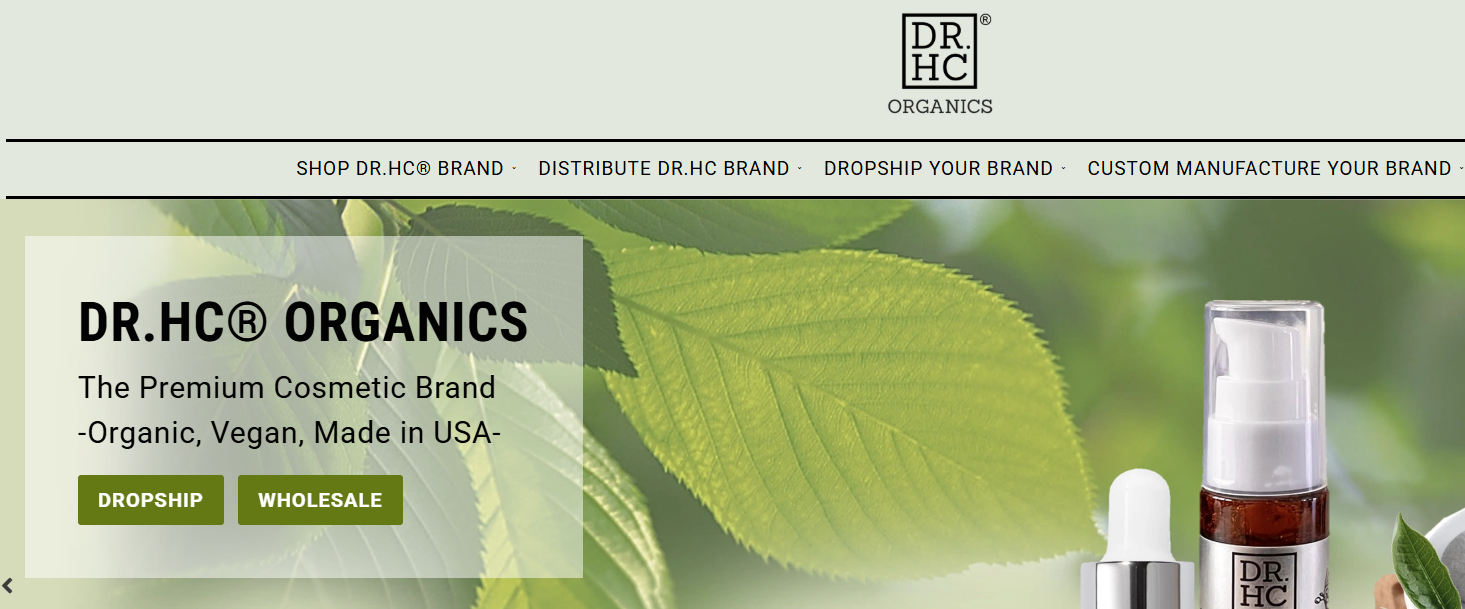
DR.HC Cosmetic Lab is a Silicon Valley-based cosmetics manufacturer with both existing-brand dropshipping and private-label programs.
For sellers who want their own brand, its YOURS private-label dropshipping program is the more relevant option.
The company currently advertises zero MOQ for private-label dropshipping. It manufactures the cosmetic under the seller's brand and ships directly to customers.
Its broader catalog includes skincare, makeup, hair and body care, bath products, and other beauty categories. The company currently lists more than 30 makeup products in its own-brand range.
Why DR.HC stands out
The most obvious differentiator is manufacturing location.
Products are made in the United States, which can be useful for brands that want a U.S.-manufactured positioning.
The company focuses heavily on natural, organic, vegan, and cruelty-free beauty positioning.
Its private-label program also allows brands to move from zero-MOQ dropshipping toward wholesale. The wholesale private-label model currently begins at an MOQ of 12 units for certain offerings.
What to consider
There are program and membership costs, so sellers should calculate economics before choosing it purely because the MOQ is low.
A low MOQ does not automatically mean a low total cost of operating the brand.
Best for
Clean-beauty businesses that value U.S. manufacturing and want to start with private-label dropshipping before moving into small wholesale runs.
9. Jubilee — Best for Shopify-First Private Label Makeup Testing
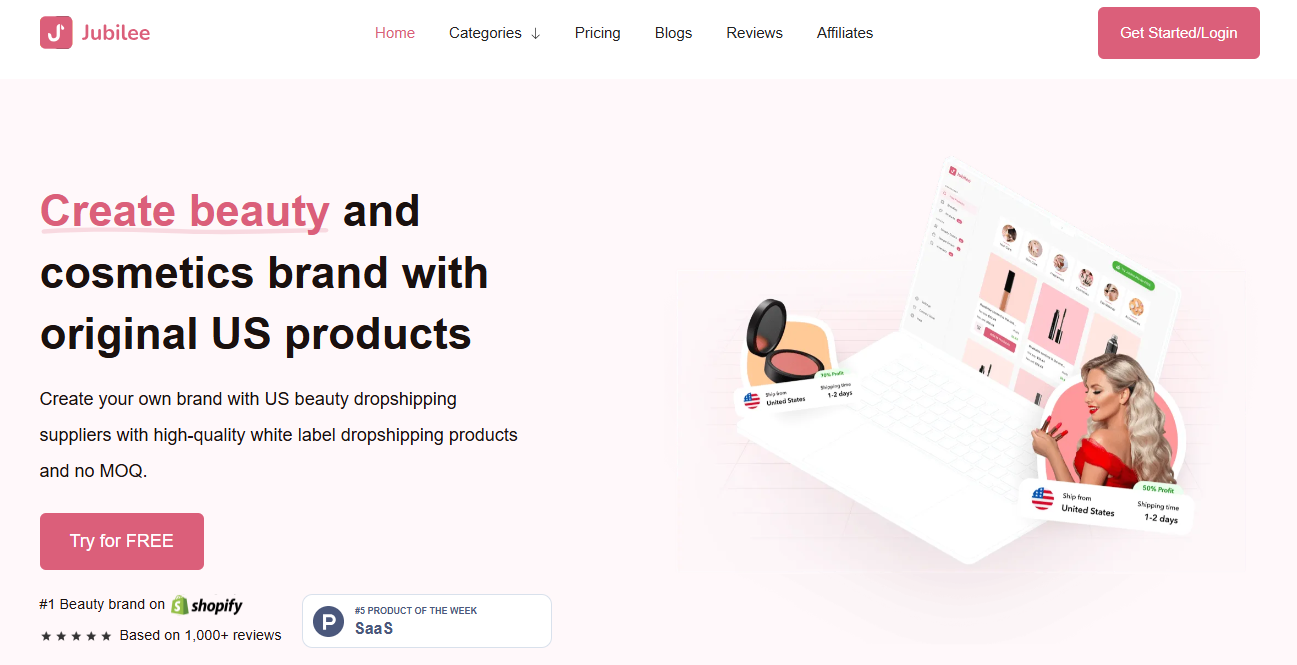
Jubilee is a private-label beauty application designed specifically for Shopify merchants.
Its Shopify App Store listing includes makeup categories such as lipstick, mascara, eyeliner, and foundation and allows sellers to add their brand name and logo to products.
The platform supports sample ordering and branded product listings, which makes it useful for testing how a private-label cosmetics concept looks before committing heavily to inventory.
Products are sourced from several locations, including the U.S. and Canada, according to the current app listing.
Why Jubilee is interesting
Its main advantage is convenience.
A Shopify seller can choose products, add branding, and push listings into the store without separately coordinating a cosmetics laboratory, graphic designer, and fulfillment provider.
That lowers the operational barrier for a first beauty launch.
What to consider
Jubilee currently has relatively mixed customer ratings in the Shopify App Store, with ratings around the mid-2-star range at the time of writing.
That does not automatically make the platform unsuitable, but it makes sampling and testing particularly important.
Do not launch 50 branded products simply because the software makes it easy.
Order samples, test packaging, check formula consistency, and verify shipping performance first.
Best for
Shopify merchants who want a simple way to experiment with private-label makeup before building a more customized supply chain.
10. AliExpress — Best for Low-Cost Makeup Discovery and Early Testing
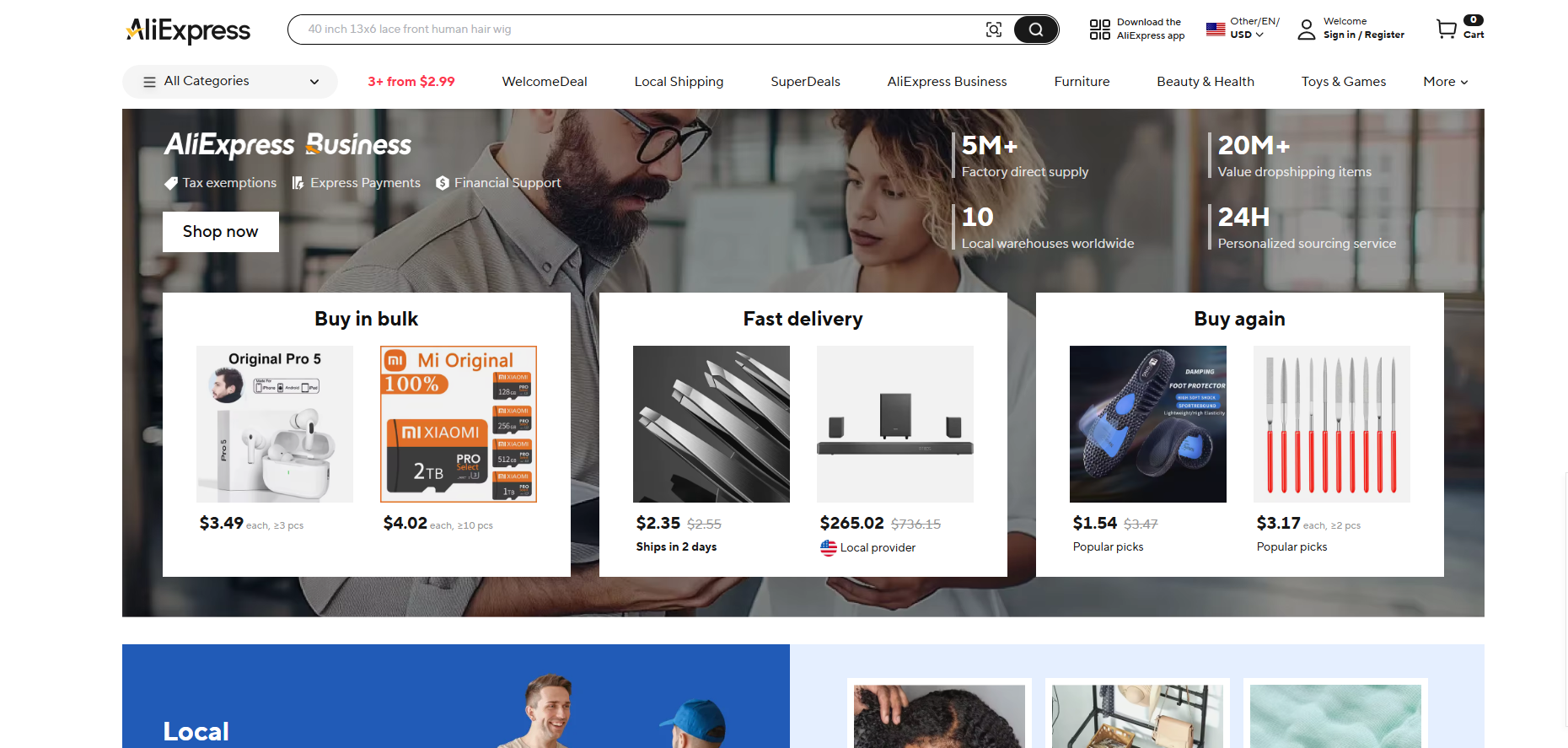
AliExpress remains relevant because of the enormous variety of makeup products available through independent sellers.
It is particularly useful for discovering products such as:
-
Brushes
-
Sponges
-
Makeup bags
-
Cosmetic organizers
-
Lip products
-
Eye makeup
-
Palettes
-
Beauty accessories
The platform's greatest strength is variety and low commitment.
The weakness is exactly the same thing.
Different sellers may have very different manufacturing sources, documentation, product consistency, shipping times, and quality control.
There is no single “AliExpress quality standard” that automatically applies to every makeup listing.
Where AliExpress makes sense
It is better viewed as an early product-discovery environment than as the final supply chain for a serious cosmetics brand.
A store might use it to identify an interesting makeup organizer, brush accessory, or visually compelling product.
If the product begins selling consistently, the next step should usually be to investigate a more controlled sourcing arrangement.
What to consider
Formula-based cosmetics require more care than ordinary accessories.
A seller should never assume that an ingredient list, cosmetic claim, or certification is valid simply because it appears in a marketplace listing.
Samples and supplier verification are essential.
Best for
Low-cost testing, product discovery, and makeup accessories rather than a long-term premium private-label strategy.
Which Makeup Dropshipping Supplier Is Best?
There is no single supplier that wins every category.
The right option depends on what kind of business you are actually building.
Best overall sourcing and scaling: CJdropshipping
Choose CJ if your priority is flexible sourcing, fulfillment, product improvement, packaging, warehousing, and a path from testing into larger supply-chain operations.
Best ready-to-brand private label: Blanka
Choose Blanka if you want a private-label cosmetics business without holding inventory.
Best clean beauty option: Selfnamed
Choose Selfnamed if the brand sits between skincare and makeup and clean formulas are central to the positioning.
Best deep makeup catalog: viaGlamour
Choose viaGlamour if you want a large makeup-focused assortment from a dedicated cosmetics laboratory.
Best for testing trending beauty products: Zendrop
Choose Zendrop when speed of product testing and automated fulfillment matter more than formula customization.
Best supplier marketplace: Syncee
Choose Syncee if regional supplier discovery is a priority.
Best for existing branded cosmetics: Beauty Joint
Choose Beauty Joint if you want to operate more like an online beauty retailer than a private-label manufacturer.
Best US-made private label: DR.HC
Choose DR.HC if U.S. manufacturing and clean-beauty positioning are central to the brand.
Private Label Makeup vs. Regular Makeup Dropshipping
One of the most important decisions is whether the store should sell existing products or create a branded line.
| Factor | Regular Makeup Dropshipping | Private Label Makeup |
|---|---|---|
| Startup complexity | Lower | Moderate |
| Inventory required | Usually no | Often no with dropshipping suppliers |
| Brand control | Limited | High |
| Product differentiation | Low | Higher |
| Packaging control | Limited | Stronger |
| Launch speed | Faster | Slightly slower |
| Long-term brand value | Lower | Higher |
| Price comparison | Easier | Harder |
| Formula ownership | No | Usually no unless custom formulated |
Private label should not be confused with custom formulation.
In most zero-MOQ private-label programs, several brands can use the same underlying formula and apply different branding.
Custom formulation means creating or modifying a formula specifically for the brand. It usually requires more development time, testing, money, and a higher MOQ.
For many new sellers, a sensible progression is:
Generic product testing → private label → custom formulation
rather than attempting full custom manufacturing before knowing whether customers want the product.
Makeup Products Worth Testing in 2026
The supplier matters, but product selection still determines whether the catalog feels focused.
1. Lip Oils and Lip Gloss
Lip products remain attractive because they are relatively easy to demonstrate and can generate repeat purchases.
Instead of launching 30 random shades, consider a tightly edited collection with a clear finish or color story.
2. Blush
Liquid and cream blush formats continue to work well in visual content because the application and color payoff can be demonstrated quickly.
Blush also avoids some of the sizing complexity of foundation.
3. Lip Liners
Lip liners are lightweight, easy to bundle with gloss or lipstick, and well suited to multi-product offers.
A “lip kit” can have more perceived value than either product alone.
4. Mascara
Mascara has strong repeat-purchase potential, but eye-area products should receive careful supplier and formula scrutiny.
5. Eyebrow Products
Brow pencils, gels, and related products fit naturally into repeat beauty routines.
6. Makeup Brushes
Brushes are particularly useful for sellers who want exposure to the beauty market without immediately relying entirely on cosmetic formulas.
A brush set can also raise average order value through bundling.
7. Cosmetic Bags and Organizers
These are not makeup formulas, but they can be excellent complementary products.
They have fewer ingredient concerns and are easy to demonstrate visually.
8. Foundation and Concealer
These can generate strong demand, but they are operationally harder.
Shade accuracy is critical.
A supplier offering six shades when customers expect a broad range may create a weak customer experience. Sample several shades and evaluate whether supplier photography accurately represents the actual product.
What to Check Before Selling Makeup
Cosmetics require more supplier due diligence than most general merchandise.
Check the ingredient list
In the United States, retail cosmetics generally need an ingredient declaration. FDA says ingredients must generally be listed using appropriate names and in descending order of predominance, subject to specific rules and exceptions.
If a supplier cannot provide a proper ingredient list, that is a warning sign.
Check labeling
U.S. cosmetic labels must include information such as product identity and net quantity on the principal display panel, while additional information such as the responsible business and ingredients may be required on the information panel.
Do not copy a supplier label blindly.
Private labeling puts your brand directly in front of the consumer, so labeling needs to be handled properly.
Do not claim a cosmetic is “FDA approved”
FDA does not pre-approve ordinary cosmetic labeling, and cosmetic product facility registration or listing is not FDA approval.
That wording is often misunderstood in beauty marketing.
Be careful with medical claims
A cosmetic can cross into drug regulation if marketing claims say the product treats disease or changes the structure or function of the body.
FDA specifically notes that claims about treating or preventing disease can cause a product to be regulated as a drug rather than only as a cosmetic.
“Creates a smoother-looking complexion” and “treats acne” are not the same type of claim.
Order samples
Never build a makeup store entirely from supplier photographs.
For a sample, inspect:
-
Packaging quality
-
Ingredient label
-
Color
-
Texture
-
Applicator
-
Odor
-
Leakage
-
Seal
-
Formula consistency
-
Shipping condition
For shade-based products, test more than one shade.
For lip and eye products, inspect the packaging carefully because leaks, damaged applicators, or weak closures can quickly create refund problems.
How to Move From Dropshipping Makeup to Building a Beauty Brand
The most durable beauty businesses usually become less dependent on generic listings over time.
The first stage is testing.
Use dropshipping to determine which product types, finishes, shades, and price points actually attract customers.
The second stage is concentration.
Stop adding random products and identify the small group responsible for most sales.
The third stage is sourcing improvement.
Find better pricing, stronger packaging, more reliable manufacturing, improved formulas, or faster fulfillment.
The fourth stage is branding.
Private labels, custom boxes, inserts, product naming, and consistent packaging can turn a commodity into a recognizable collection.
The fifth stage is inventory optimization.
When demand becomes predictable, stocking winning products can improve fulfillment speed and unit economics.
This is where a broad fulfillment provider such as CJdropshipping can become useful. CJ supports sourcing, custom packaging, ODM, bulk purchasing, and 3PL fulfillment, allowing sellers to move beyond simple one-order-at-a-time dropshipping as volume increases.
Dedicated cosmetics suppliers such as Blanka, Selfnamed, viaGlamour, and DR.HC provide another path: start with their private-label catalog and move toward bulk buying or more customized products once the business is validated.
Neither model is universally better.
The right path depends on whether the competitive advantage comes from product sourcing or formula and brand ownership.
Final Thoughts
The search for the top 10 makeup dropshipping suppliers should not end with a spreadsheet comparing unit prices.
Makeup is a trust category.
Customers put these products on their skin, eyes, and lips. They notice whether a shade matches the photo. They notice whether a lipstick arrives melted, whether a gloss leaks, whether an applicator feels cheap, and whether the product they reorder feels different from the first one.
That is why supplier consistency matters more here than in many dropshipping niches.
For sellers who want maximum sourcing flexibility, CJdropshipping provides a strong route from product testing to sourcing, packaging, inventory, and global fulfillment.
For private-label brands, Blanka, Selfnamed, viaGlamour, and DR.HC Cosmetic Lab are stronger candidates because they put branding directly on the cosmetics rather than only on the shipping package.
For faster product validation, Zendrop can simplify testing, while Syncee is useful when supplier location matters. Beauty Joint is better suited to reselling existing cosmetics, and platforms such as Jubilee can provide a lower-friction route into Shopify private labeling.
The broader market opportunity remains significant. The global cosmetics market is projected at approximately $349.4 billion in 2026, and major retailers continue to report solid beauty demand.
But market growth alone does not create a successful store.
A stronger approach is to begin with a focused assortment, order samples, verify product information, test demand, and then invest more heavily in the products that customers repeatedly choose.
For most sellers, the winning supplier is not simply the company that helps them launch fastest.
It is the one that can still support the business after the first winning makeup product becomes a real brand.