
For beginners entering ecommerce in 2026, finding the right product sourcing agent is one of the most important yet misunderstood steps. Many new sellers focus on store design or advertising but quickly run into problems caused by unreliable suppliers, inconsistent product quality, unclear pricing, or slow fulfillment.
A good sourcing agent does much more than “find products.” They help you reduce risk, control costs, ensure quality, and scale more smoothly once you find a winning product. This guide is written for entrepreneurs starting from zero who want to understand what product sourcing agents actually do, how to compare options realistically, and how to choose the right partner for long-term growth.
What Is a Product Sourcing Agent
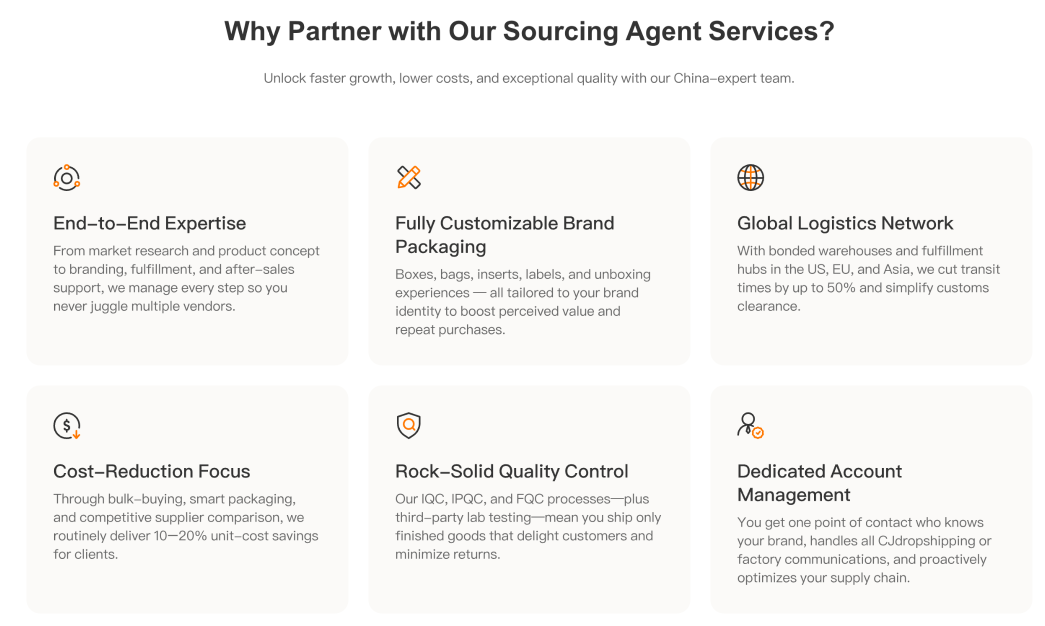
A product sourcing agent is a professional or service that helps sellers find reliable products and suppliers, manage communication with manufacturers, and coordinate the early stages of the supply chain. Their job is not only to locate products, but to reduce risk, improve consistency, and make sourcing more predictable.
For beginners, sourcing is often one of the most confusing parts of ecommerce. Many new sellers rely on public supplier platforms or contact factories directly, only to encounter problems such as inconsistent quality, unclear pricing, slow responses, or suppliers disappearing after a few orders. A product sourcing agent acts as an intermediary who understands both the supplier side and the seller’s business needs.
In practical terms, a product sourcing agent typically helps with:
-
Finding suitable manufacturers or suppliers
-
Verifying supplier reliability and production capability
-
Requesting and checking samples
-
Negotiating pricing and lead times
-
Coordinating quality checks before shipping
-
Supporting packaging or basic customization needs
In 2026, the role of a product sourcing agent has expanded beyond simple product matching. Many agents now work closely with fulfillment partners and logistics systems to ensure products can be delivered efficiently and at stable costs. This is especially important for dropshippers and small ecommerce brands that need flexibility rather than large upfront commitments.
For beginners, the main value of a product sourcing agent lies in experience. Instead of learning through costly mistakes, sellers benefit from established supplier networks and proven workflows. This helps avoid issues that usually appear later, such as sudden price increases, quality drops, or shipping delays.
It is also important to understand what a sourcing agent is not. A sourcing agent does not guarantee product success or market demand. Their role is to support execution, not replace product research or marketing. When used correctly, a product sourcing agent becomes a long-term operational partner that supports growth and stability.
For entrepreneurs starting from zero, working with the right product sourcing agent can significantly shorten the learning curve and create a stronger foundation for scaling an ecommerce business.
Why Product Sourcing Matters More in 2026
In 2026, product sourcing is no longer a background task in ecommerce. It has become a core factor that directly affects profitability, customer satisfaction, and the ability to scale. For beginners, understanding why sourcing matters early can prevent many expensive mistakes later.
One major reason sourcing has become more important is rising competition. More sellers are entering ecommerce with similar product ideas, which means small differences in quality, packaging, or delivery experience now have a much bigger impact on customer decisions. When multiple stores sell similar products, the seller with more reliable sourcing usually wins in the long run.
Customer expectations have also changed. Buyers today are less forgiving of defects, delays, or products that look different from listing images. Even for low-priced items, customers expect consistency. If sourcing is unstable, issues like color differences, weak materials, or missing accessories quickly lead to refunds and negative reviews. These problems often appear after the first few batches, which is why many beginners struggle to grow beyond initial sales.
Another critical factor in 2026 is cost pressure. Advertising costs are higher than in previous years, and traffic is more expensive to acquire. When it costs more to get each customer, poor sourcing becomes far more costly. A single defective shipment or delayed order can erase the profit from multiple successful sales. Reliable sourcing helps protect margins by reducing returns, reshipments, and customer service workload.
Supply chain volatility also plays a role. Raw material prices, labor costs, and shipping conditions fluctuate more frequently. Sellers who rely on unstable suppliers may see sudden price increases or stock shortages without warning. A professional product sourcing agent helps manage these risks by working with more stable manufacturers and planning alternatives when disruptions occur.
For beginners, sourcing also affects speed. Without sourcing support, new sellers often spend weeks communicating with suppliers, comparing quotes, and fixing misunderstandings. A good sourcing agent shortens this process by providing clear options, realistic timelines, and experience-based recommendations.
In 2026, sourcing is no longer just about finding the cheapest product. It is about building a supply chain that can support growth without constant firefighting. Sellers who treat sourcing as a strategic foundation rather than a one-time task are better positioned to scale steadily and build long-term trust with customers.
Common Problems Beginners Face Without a Sourcing Agent
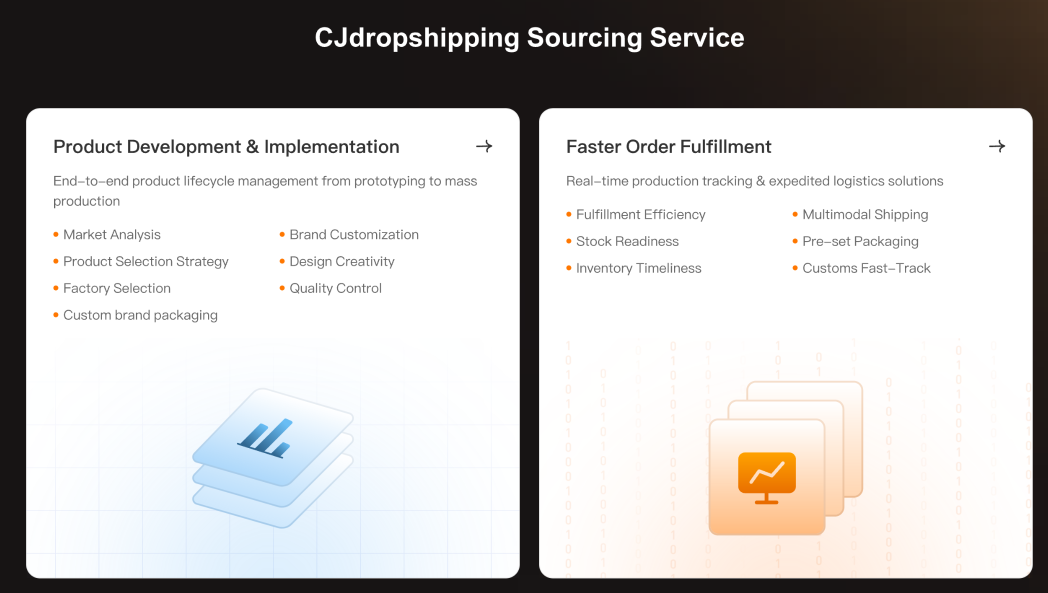
Many beginners start ecommerce without a product sourcing agent, believing they can manage suppliers on their own. While this approach may work briefly, a range of problems often appear as soon as orders become consistent. These issues rarely show up on day one, which is why they catch new sellers off guard.
Inconsistent Product Quality Across Orders
One of the most common problems is inconsistent quality. A product sample may look perfect, but later batches arrive with different materials, colors, or finishes. This happens when sellers rely on unstable suppliers or marketplaces where products are sourced from multiple factories without clear quality standards.
For beginners, this leads to customer complaints, refunds, and negative reviews that are difficult to recover from in the early stages of a store.
Unclear and Changing Pricing
Without a sourcing agent, pricing often changes without warning. Suppliers may increase costs due to material changes, labor adjustments, or order volume fluctuations. Beginners who price products based on old cost assumptions may suddenly find themselves selling at very thin margins or even at a loss.
A lack of clear, predictable pricing makes it difficult to plan promotions, advertising budgets, or long-term growth.
Slow or Ineffective Communication With Suppliers
Many beginners underestimate how much communication matters in sourcing. Language barriers, time zone differences, and unclear expectations often lead to misunderstandings.
Delayed replies or vague answers can slow down production, shipment, or issue resolution. When problems arise, sellers without a sourcing agent often struggle to get clear explanations or timely solutions from suppliers.
No Quality Control Before Shipping
Without professional inspection, defects are usually discovered by customers instead of sellers. This includes missing parts, damaged items, or products that do not match descriptions.
Returns and reshipments not only increase costs but also consume time and energy that beginners could otherwise spend on improving their store.
Poor Packaging and Higher Damage Rates
Many suppliers focus on production rather than packaging. Without guidance, products may be shipped with minimal protection, increasing the risk of damage during transit.
This problem is especially common for home decor, electronics, or fragile items. Beginners often realize too late that packaging quality directly affects refund rates and customer satisfaction.
Difficulty Scaling Winning Products
Finding a product that sells is only half the challenge. Scaling requires stable supply, consistent quality, and reliable lead times. Beginners without a sourcing agent often struggle when order volume increases, as suppliers may not be prepared to handle higher demand.
This leads to delayed shipments, stock shortages, or sudden quality drops exactly when momentum is building.
Limited Support for Customization or Branding
As stores grow, many beginners want to add simple branding elements such as logos, custom packaging, or inserts. Without a sourcing agent, coordinating these changes with factories can be complex and error-prone.
Missed details or production mistakes increase costs and slow down brand development.
Higher Long-Term Costs Despite Lower Short-Term Fees
While skipping a sourcing agent may seem cheaper initially, the long-term costs often outweigh the savings. Refunds, reshipments, wasted ad spend, and lost customer trust add up quickly.
A sourcing agent helps prevent these hidden costs by improving consistency and communication from the beginning.
How a Sourcing Agent Reduces These Risks
A professional product sourcing agent helps address these issues by verifying suppliers, stabilizing pricing, coordinating inspections, and acting as a reliable point of contact. This allows beginners to focus on marketing and customer experience rather than constantly fixing supply chain problems.
Solutions like CJdropshipping’s sourcing service are designed to reduce these beginner pain points by combining supplier vetting, quality checks, and fulfillment coordination in one workflow, making scaling more predictable and less stressful.
Types of Product Sourcing Agents Explained
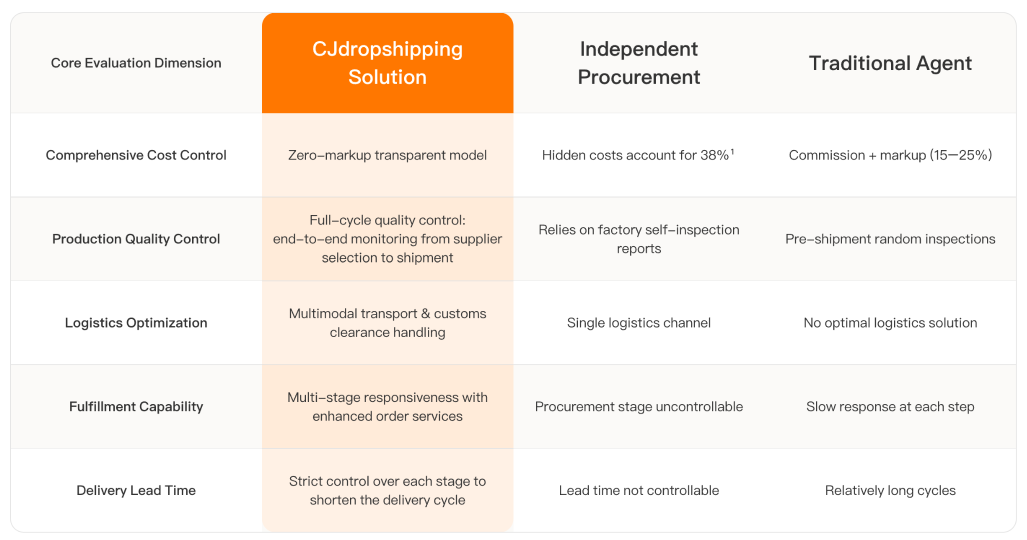
Not all product sourcing agents work the same way. In 2026, sourcing services have become more specialized, and choosing the wrong type can slow down your business or increase risk, especially for beginners. Understanding the main types of sourcing agents helps you select a solution that matches your experience level, budget, and growth goals.
Individual or Freelance Sourcing Agents
Individual sourcing agents usually work independently and manage supplier communication on your behalf. They often operate through messaging platforms and offer personalized service.
This option can be flexible and affordable for very small projects or one-off sourcing needs. However, service quality depends heavily on the individual’s experience and workload. If the agent becomes unavailable or overwhelmed, there is often no backup support.
For beginners, this model can be risky because quality inspection, pricing consistency, and scalability are not always guaranteed.
Best for:
-
Small test orders
-
Sellers with prior sourcing experience
-
Short-term or low-volume needs
Limitations:
-
Limited scalability
-
No standardized quality control
-
Heavy reliance on one person
Trading Companies and Traditional Sourcing Firms
Traditional sourcing companies usually work with established factories and manage larger production orders. They often provide structured processes, supplier verification, and formal contracts.
These firms are more suitable for brands with stable demand and higher order volumes. However, they typically require higher minimum order quantities and longer lead times, which can be challenging for beginners who are still testing products.
Costs are usually higher, and flexibility is lower compared to more modern sourcing models.
Best for:
-
Established brands
-
Bulk production orders
-
Long-term manufacturing partnerships
Limitations:
-
High minimum order requirements
-
Slower turnaround
-
Less beginner-friendly
Factory-Direct Sourcing
Some sellers choose to work directly with factories without a sourcing agent. This approach offers potential cost savings but requires strong negotiation skills, clear communication, and experience with production processes.
For beginners, factory-direct sourcing often leads to misunderstandings, inconsistent quality, and delays, especially when language barriers or cultural differences are involved.
This option is usually better suited for experienced sellers who already understand manufacturing workflows.
Best for:
-
Experienced sellers
-
High-volume, repeat orders
Limitations:
-
High communication effort
-
No intermediary quality control
-
Difficult for first-time sellers
Platform-Based Sourcing Services
Platform-based sourcing services integrate product sourcing into a broader ecommerce ecosystem. These services often combine supplier vetting, price negotiation, quality inspection, and fulfillment coordination.
This model has become increasingly popular in 2026 because it reduces complexity for beginners. Instead of managing multiple vendors, sellers can source products, prepare branding, and fulfill orders through a single system.
CJdropshipping’s sourcing service falls into this category. It supports beginners by helping source products from verified suppliers, manage samples, and connect sourcing directly to branding and fulfillment workflows. This makes it easier to move from testing to scaling without rebuilding the supply chain.
Best for:
-
Beginners and dropshippers
-
Sellers testing multiple products
-
Businesses planning to scale gradually
Limitations:
-
Requires learning the platform workflow
-
Not designed for extremely large custom manufacturing projects
Hybrid Sourcing Models
Some sellers eventually use a hybrid approach, combining different sourcing methods. For example, a seller may use platform-based sourcing for most products while working directly with factories for core items.
This model offers flexibility but adds complexity and is usually better suited for later stages once demand patterns are clear.
Choosing the Right Type as a Beginner
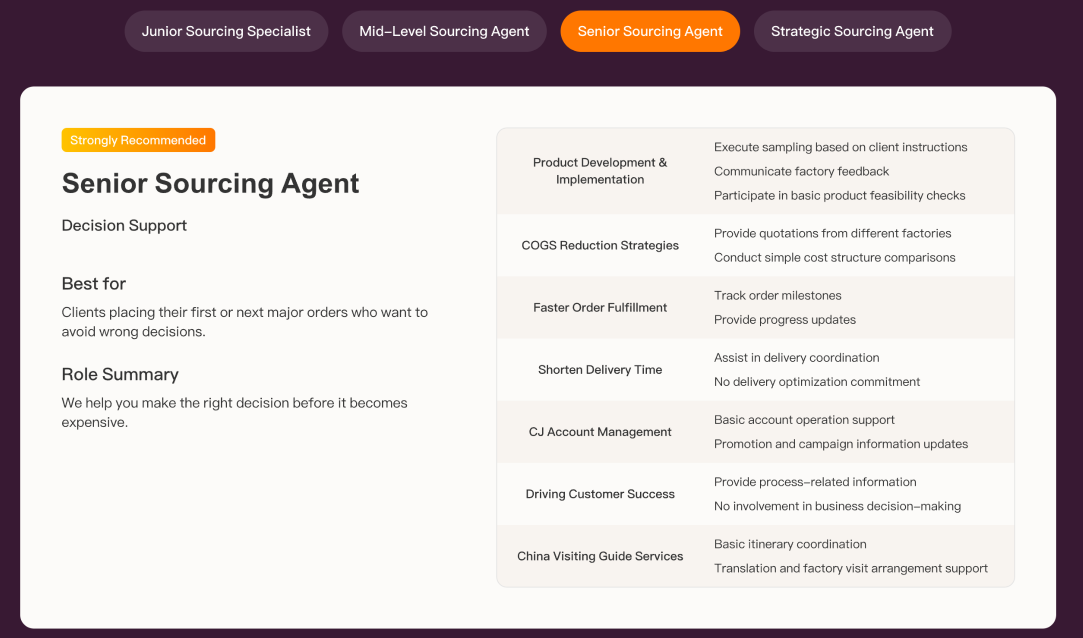
For beginners, the safest choice is usually a sourcing model that prioritizes transparency, support, and scalability over the lowest possible unit cost. Platform-based sourcing services often provide the best balance between flexibility and reliability at an early stage.
As your business grows, your sourcing strategy can evolve. The key is to start with a structure that reduces mistakes and supports learning, rather than one that requires deep sourcing expertise from day one.
Key Criteria to Evaluate a Product Sourcing Agent
Choosing the right product sourcing agent is not about finding the cheapest option. For beginners, it is about finding a partner who reduces uncertainty, prevents costly mistakes, and supports growth over time. The criteria below focus on what actually matters in real ecommerce operations.
Supplier Verification and Long-Term Stability
A reliable sourcing agent should work with verified suppliers and prioritize long-term cooperation. Stable suppliers are more likely to maintain consistent quality, pricing, and production timelines.
Beginners should be cautious of agents who switch factories frequently just to lower short-term costs. While cheaper prices may look attractive, unstable suppliers often lead to quality issues and delayed orders that hurt your business later.
Ask whether the agent has existing supplier relationships and how they handle supplier changes if issues arise.
Transparent and Predictable Pricing Structure
Clear pricing is essential for calculating real profit margins. A good sourcing agent provides itemized costs and explains what is included, such as product price, sourcing fees, inspection costs, and any customization charges.
If pricing feels vague or changes without explanation, it becomes difficult to plan promotions, advertising budgets, or scale confidently. Predictability is often more valuable than the lowest possible unit price.
Quality Inspection and Risk Control
Quality inspection is one of the most overlooked yet critical criteria. A sourcing agent should be able to check products before they are shipped, even if the inspection is basic.
This helps catch defects, missing parts, or packaging issues early. For beginners, preventing a single problematic batch can save weeks of customer service work and protect early store reviews.
Agents who offer inspection services demonstrate a focus on long-term reliability rather than quick transactions.
Communication Speed and Clarity
Fast and clear communication is a strong indicator of professionalism. When issues arise, delays in response often make small problems much worse.
A good sourcing agent provides clear answers, realistic timelines, and proactive updates. For beginners, this guidance is especially valuable because it reduces uncertainty and builds confidence in decision-making.
Consistent communication also reflects how well the agent coordinates with suppliers behind the scenes.
Ability to Support Branding and Customization
As stores grow, many beginners want to move beyond generic products. A sourcing agent who can support simple branding needs, such as custom packaging, logo placement, or inserts, adds long-term value.
Even small branding upgrades can significantly improve perceived product value and customer trust. Agents who understand branding workflows make it easier to transition from testing to brand building.
Integration With Fulfillment and Logistics
Sourcing does not exist in isolation. A sourcing agent who understands fulfillment and shipping realities helps prevent mismatches between product sourcing and delivery capability.
Agents who work closely with fulfillment systems can advise on packaging, warehouse placement, and shipping options. This coordination improves delivery speed and reduces unexpected costs.
Platform-based solutions like CJdropshipping are designed around this integration, connecting sourcing directly to branding and fulfillment so beginners do not have to manage each step separately.
Scalability and Ongoing Support
A sourcing agent should be able to grow with your business. This includes handling larger order volumes, managing multiple SKUs, and maintaining quality consistency as demand increases.
Ask how the agent supports scaling and whether their processes change as order volume grows. Scalability is not just about capacity, but about maintaining reliability under pressure.
Best Product Sourcing Agents in 2026

In 2026, product sourcing is a strategic capability, and the type of sourcing agent you choose can influence your product quality, pricing stability, and ability to scale. Below are the main sourcing agent options available today, categorized by how they serve sellers at different stages and needs.
Freelance and Independent Sourcing Agents
What they are: Individuals who act as intermediaries between you and manufacturers. They often work through messaging platforms or freelance marketplaces.
Who they’re for: Sellers with simple products and low order volumes who want flexibility and personalized communication.
Pros:
-
Flexible pricing based on work scope
-
Personal attention
-
Useful for one-off or niche items
Cons:
-
Quality depends on one person’s experience
-
Limited backup support or formal quality guarantees
-
Harder to scale when demand grows
Freelance agents can be useful when you are just starting, testing products, and want to avoid large commitments. However, they often lack standardized processes for quality control and fulfillment coordination.
Traditional Sourcing Companies
What they are: Established firms that help brands find suppliers, negotiate bulk pricing, and manage factory relationships.
Who they’re for: Businesses with stable demand and larger order volumes looking for long-term manufacturing partnerships.
Pros:
-
Structured supplier verification processes
-
Formal contracts and accountability
-
Can manage large production runs
Cons:
-
Often require higher minimum order quantities
-
Longer lead times
-
Less flexible for dropshipping or low-volume testing
These firms are often a good choice for established brands or sellers transitioning into private label production, but they are usually less agile for newcomers still testing product-market fit.
Platform-Integrated Sourcing Agents
What they are: Sourcing services embedded within ecommerce or supply-chain platforms that combine supplier vetting, negotiation, quality inspection, and logistics support.
Who they’re for: Dropshippers and ecommerce sellers who want a holistic solution without managing multiple vendors.
Pros:
-
Centralized workflow integrates sourcing with fulfillment
-
Quality verification and inspection support
-
Often includes sample coordination and basic customization options
Cons:
-
Requires learning the platform system
-
May not handle extremely high custom manufacturing needs
This category has become the most popular choice in 2026 for sellers who value simplicity and continuity from product sourcing to delivery.
Marketplace-Linked Sourcing Services
What they are: Services offered by major online marketplaces or ecommerce platforms that help sellers source products from vetted vendors within the platform ecosystem.
Who they’re for: Sellers who sell primarily on a specific marketplace and want sourcing closely aligned with fulfillment on that platform.
Pros:
-
Tight integration with marketplace infrastructure
-
Simplified onboarding
-
Often transparent pricing within the marketplace ecosystem
Cons:
-
Limited to vendor pools within the marketplace
-
Less flexibility for multi-channel stores
-
Customization and branding options may be limited
This option works well if your sales strategy is concentrated on one major marketplace and you don’t plan to diversify quickly.
CJdropshipping’s Sourcing Service
What it is: An integrated sourcing solution that helps sellers find reliable products, negotiate pricing, inspect quality, and then move seamlessly into warehousing and fulfillment.
Who it’s for: Beginners and intermediate sellers who want a one-platform workflow that covers sourcing, optional branding, and fulfillment support.
Pros:
-
Verified supplier network that reduces early mistakes
-
Product sample coordination and inspection guidance
-
Support for simple branding like packaging or inserts
-
Delivery options through domestic and overseas warehouses
-
Automated store integration reduces manual fulfillment work
Cons:
-
Requires initial setup to connect to store & fulfillment workflows
Because CJdropshipping’s sourcing is combined with warehouse and fulfillment systems, beginners can move from product discovery to delivery without juggling multiple vendors. This helps reduce early-stage complexity while building a more reliable supply chain foundation.

Hybrid and Custom Sourcing Solutions
What they are: Approaches that combine different sourcing models—for example, using a platform agent for most products while working directly with a factory for core SKUs.
Who they’re for: Sellers with mixed needs: some products tested at low volume and some that require specialized manufacturing.
Pros:
-
Flexibility to optimize costs and quality per product line
-
Better control over core items while testing others
Cons:
-
Higher operational complexity
-
Requires careful coordination and stronger project management
Hybrid sourcing is usually recommended once a store has consistent demand and a clearer view of product performance.
When You Should Upgrade Your Sourcing Strategy
Not every beginner needs a fully developed sourcing system from day one. In fact, upgrading too early can increase costs and complexity without delivering real benefits. The key is knowing when your current sourcing approach is no longer sufficient.
Below are the most common signs that it’s time to upgrade your product sourcing agent or sourcing strategy.
Your Products Are Generating Repeat Orders
One of the clearest signals is repeat sales of the same product. When customers are consistently ordering the same item, sourcing stability becomes more important than experimentation.
At this stage, inconsistent quality or sudden price changes can directly impact reviews and profitability. Upgrading your sourcing strategy helps lock in supplier reliability and pricing consistency.
Customer Complaints About Quality Begin to Increase
If you notice recurring feedback about defects, mismatched colors, missing parts, or poor packaging, your sourcing setup likely lacks quality control.
Upgrading to a sourcing agent that offers inspection and packaging guidance helps catch these issues before products reach customers. Preventing quality problems early is usually less expensive than handling refunds and reshipments later.
Pricing Becomes Unpredictable or Margins Shrink
When supplier prices fluctuate frequently, maintaining stable margins becomes difficult. This often happens when working with unverified suppliers or marketplace listings.
A professional sourcing agent can help negotiate clearer pricing structures or identify more stable manufacturers. This allows you to price products confidently and plan marketing spend more effectively.
Order Volume Starts Increasing Rapidly
Growth exposes weaknesses in sourcing. Suppliers who handled small volumes well may struggle to meet higher demand, leading to delays or inconsistent production.
Upgrading your sourcing strategy ensures that suppliers can handle larger volumes and that backup options exist if capacity issues arise. This prevents growth from turning into operational stress.
You Want to Introduce Branding or Customization
As your store matures, adding simple branding elements becomes a logical next step. This could include custom packaging, logo placement, or inserts.
Without sourcing support, coordinating these changes with suppliers can be time-consuming and error-prone. A sourcing agent who understands branding workflows simplifies this transition and reduces mistakes.
You Plan to Improve Delivery Speed or Fulfillment Options
If you’re moving products into overseas warehouses or offering faster shipping options, sourcing decisions must align with fulfillment requirements.
Upgrading sourcing ensures that products are compatible with warehouse storage, packaging standards, and shipping methods. This alignment reduces delays and unexpected costs.
You Spend More Time Fixing Supply Issues Than Growing Your Store
A major warning sign is when sourcing problems consume more time than marketing, content, or customer experience improvements.
At this point, upgrading sourcing is not an expense, but an investment in freeing up time and mental capacity to grow the business.
Final Thoughts
In 2026, choosing the right product sourcing agent is no longer a minor operational detail. It is a strategic decision that directly affects product quality, pricing stability, customer satisfaction, and your ability to scale without constant setbacks.
For beginners, the biggest risk is not paying too much for sourcing, but paying too little attention to it. Many early-stage sellers struggle not because their product ideas are wrong, but because unstable suppliers, unclear pricing, and poor quality control quietly erode trust and profit over time.
Throughout this guide, we’ve covered what a product sourcing agent does, why sourcing matters more than ever, the common mistakes beginners face, and how to evaluate different sourcing options realistically. The key takeaway is simple: good sourcing reduces uncertainty. It allows you to focus on growth, not damage control.
There is no single sourcing solution that fits everyone. The best choice depends on your current stage, order volume, and long-term goals. Beginners should prioritize transparency, communication, and scalability rather than chasing the lowest unit cost. A sourcing setup that feels slightly more structured early on often saves significant time and money later.
An integrated approach that combines sourcing, branding, and fulfillment can further reduce complexity. Solutions like CJdropshipping help beginners move from product discovery to delivery within one system, making it easier to upgrade sourcing gradually without rebuilding the entire supply chain.
In 2026, ecommerce rewards sellers who build solid foundations. With the right sourcing strategy in place, even first-time entrepreneurs can create a business that grows steadily, adapts to market changes, and earns long-term customer trust.