
The European Union’s new customs rule for low-value e-commerce imports has raised understandable concerns among online sellers.
Since the policy was announced, CJdropshipping has received questions from almost every type of merchant we work with, from small boutique store owners testing their first products to established brands processing thousands of European orders each month.
Will every parcel become €3 more expensive?
The most important message is simple: there is no need to panic.
Shipping will continue as normal. Based on our current assessment, the new EU duty is expected to add approximately €2 to the cost of each parcel on average.
CJdropshipping is already preparing direct-shipping, customs-data, product-compliance, and EU warehousing solutions for different types of sellers. Instead of offering one universal answer, we help merchants choose a strategy based on their products, order volume, average order value, SKU structure, and long-term plans.
#🎙 CEO Insight — Andy, CJdropshipping
CJdropshipping CEO Andy shares his perspective on the EU’s new €3 customs duty, explains what the change means for cross-border sellers, and introduces the solutions CJ is preparing to help merchants control costs and maintain a smooth customer experience. Watch Andy’s full explanation here.
 Andy - CJdropshipping CEO
What Is the EU’s New €3 Customs Duty?
From July 1, 2026, the European Union will remove the customs duty exemption that previously applied to most imported consignments with an intrinsic value not exceeding €150.
It will be replaced temporarily by a fixed customs duty of €3 per customs item.
The temporary measure is currently scheduled to apply until July 1, 2028. After that date, normal customs tariff rates are expected to apply under the EU’s reformed customs system, although the transitional period could be extended if the required customs infrastructure is not ready.
The rule applies to all sellers who sell goods to consumers in the European Union..
This means that many traditional dropshipping orders, marketplace orders, and direct-to-consumer shipments valued at €150 or less will fall within its scope.
However, the phrase “€3 per item” is easy to misunderstand.
It does not necessarily mean €3 for every physical unit in a parcel.
It also does not always mean a single €3 fee for the entire parcel.
The amount depends on how the goods are classified and declared to customs.
How the €3 Duty Is Actually Calculated
For customs purposes, an “item” may include one or more products in the same consignment when they share the same applicable tariff classification, commercial description, and, where required by the declaration, country of origin.
In simplified H7 declarations commonly used for eligible low-value e-commerce consignments, products are generally identified using a six-digit HS code. More detailed declaration types may require longer EU customs codes.
The €3 duty is normally calculated according to the number of qualifying customs declaration lines, rather than the number of physical units on each line.
Example 1: Several identical products
A parcel contains five identical T-shirts that can legitimately be declared together under the same tariff classification and product description.
The applicable temporary customs duty may be:
€3 in total
It is not automatically €3 multiplied by five.
Example 2: Different product categories
A parcel contains:
-
One T-shirt
-
One wristwatch
Because the products have different customs classifications, they will normally appear as separate customs items.
The applicable temporary customs duty may be:
€3 for the T-shirt category + €3 for the watch category = €6
Example 3: Similar products with different classifications
A parcel contains one silk blouse and two wool blouses.
Although all three products are blouses, the material difference may place them under different tariff subheadings.
If they require two separate declaration lines, the total temporary customs duty would be:
€6
Colors and sizes do not automatically create separate charges
Different colors or sizes of the same product may still share the same customs classification and commercial description. When customs rules permit them to be entered on the same declaration line, the quantity on that line does not multiply the €3 duty.
However, merchants should not assume that every product variation can always be grouped together. The correct treatment depends on the product description, material, use, tariff classification, origin information, and declaration type.
This is one reason accurate product data has become more important than ever.
The €3 Customs Duty Is Different From VAT and the Proposed Handling Fee
Several EU import charges are often discussed together, which can make the new policy appear more complicated than it is.
Merchants should separate three different concepts.
Import VAT
VAT already applies to imported e-commerce goods sold to EU consumers.
The Import One-Stop Shop, or IOSS, allows eligible sellers and platforms to collect VAT during checkout and report it through a simplified system for consignments not exceeding €150.
IOSS remains a VAT mechanism. It is not itself a customs-duty payment system.
The temporary €3 customs duty
The new €3 amount is a customs duty. It will apply from July 1, 2026 to qualifying low-value distance sales.
The duty is generally handled by the party responsible for the customs declaration, such as the seller, IOSS holder, special-arrangement operator, carrier, or customs representative, depending on the shipment structure.
The proposed EU handling fee
The EU is also developing a separate handling fee to help cover the administrative cost of processing large volumes of e-commerce imports.
This is not the same as the €3 customs duty.
The final amount and detailed implementation arrangements for the handling fee are separate from the temporary customs-duty rules. Merchants should therefore avoid treating every future EU import charge as part of one “€3 parcel fee.”
CJ will continue monitoring both policies and updating available logistics routes as the operational requirements become clearer.
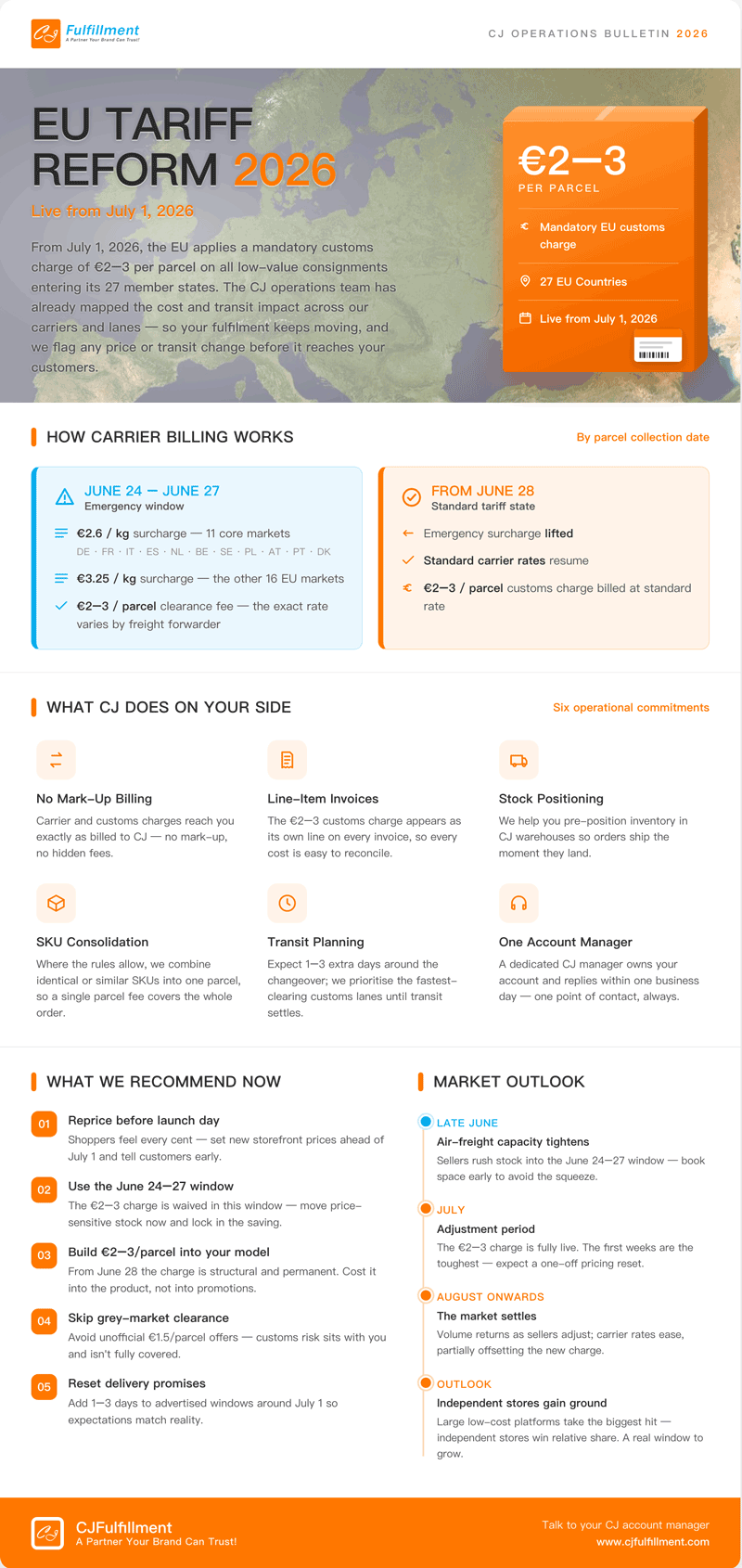
CJ’s Short-Term Solution: A Fully Tax-Inclusive European Shipping Channel
For merchants who want to continue shipping individual orders directly from China, CJ is integrating a new fully tax-inclusive B2C shipping solution with a logistics partner serving European destinations.
Under the planned service, the shipping quotation will incorporate the applicable VAT handling, €3 customs duty, customs-clearance process, and international delivery costs into one logistics solution.
For eligible shipments, sellers will be able to continue processing orders through CJ in a workflow similar to their existing direct-shipping operation.
There will be no need for each merchant to build an independent customs-clearance system or manually coordinate multiple service providers for every parcel.
The solution is designed to provide several practical advantages:
-
Customs costs included in the logistics quotation
-
No unexpected customs collection from the end customer
-
Integrated electronic customs data
-
Standardized product and order information
-
Centralized order processing through CJ
-
More predictable landed costs
-
Reduced customs-clearance complexity
-
Continued one-by-one fulfillment for dropshipping orders
Based on current partner estimates, the net increase in shipping rates for many eligible parcels may be approximately €1.50 to €2, rather than requiring sellers to add the entire headline amount to every order as a separate customer-facing charge.
Actual pricing will depend on the destination, parcel profile, number of customs items, product type, weight, route availability, and final logistics-partner terms.
This solution is especially relevant for:
-
New stores still testing demand
-
Sellers with many products but limited sales history
-
Stores that cannot forecast inventory accurately
-
Trend-driven product sellers
-
Merchants that do not want to purchase stock in advance
-
Businesses that need to preserve a low-risk dropshipping model
CJ’s Long-Term Solution: Fulfillment From EU Warehouses
For sellers with stable European demand, local inventory may provide a stronger long-term solution than individual cross-border shipments.
CJ has opened its own warehouse in Germany and is preparing additional warehouse capacity in Poland. CJ also works with partner warehouses across Europe and other major markets.
Merchants can import inventory in bulk, complete the applicable B2B customs-clearance process, release the goods into free circulation in the EU, and then fulfill individual orders locally.
Once properly imported and cleared into the EU before the consumer sale, the later local parcel is not treated as a low-value distance-sale import from outside the EU. It is therefore not charged the temporary €3 duty as a new cross-border low-value parcel.
Normal import VAT, customs duties, freight expenses, and clearance costs may apply when the inventory first enters the EU. The advantage is that those costs are handled at the bulk-import stage rather than repeatedly through individual international consumer parcels.
EU warehouse fulfillment can provide several benefits:
-
No temporary €3 low-value duty on each later local order
-
Faster delivery within major European markets
-
Lower last-mile uncertainty
-
Local returns handling
-
Product inspection
-
Relabeling and packaging services
-
Batch inventory management
-
More stable delivery performance
-
Easier support for branded packaging
-
A stronger customer experience
Which sellers should consider EU inventory?
Local stocking is generally best suited to merchants with:
-
A small or controlled number of SKUs
-
Predictable European sales
-
Consistent monthly order volume
-
Products with a longer selling lifecycle
-
Sufficient working capital
-
Products with manageable storage requirements
-
A need for faster local delivery
-
A growing branded business
It is particularly useful for single-product stores, established winning products, replenishable consumables, home products, accessories, and branded products with stable demand.
Which sellers may prefer direct shipping?
Direct fulfillment may remain more suitable for:
-
New product tests
-
Highly seasonal products
-
Trend-based products
-
Stores with hundreds of slow-moving SKUs
-
Apparel businesses with many colors and sizes
-
Sellers with unpredictable demand
-
Merchants that cannot purchase inventory in advance
A fashion store carrying many styles, sizes, and colors may face a much higher inventory risk than a store selling one proven home product.
CJ does not push every merchant toward bulk inventory. Our teams can compare direct shipping, private inventory, and EU warehouse fulfillment based on the seller’s actual order data.
Final Thoughts
Shipping to the EU will continue as normal. Based on our current assessment, the new duty may add about €2 per parcel on average. For most sellers, this is a manageable cost adjustment. CJdropshipping can help merchants review pricing, margins, shipping routes, and fulfillment options to maintain stable European operations.