
Amazon dropshipping offers a way to sell products online without purchasing large amounts of inventory or managing your own warehouse. Instead of storing and shipping every product yourself, you work with a supplier who fulfills customer orders on your behalf. However, building a successful Amazon dropshipping business involves more than finding inexpensive products and listing them for sale.
Amazon has specific requirements for third-party fulfillment, and sellers remain responsible for product quality, delivery performance, customer service, and returns. Understanding these responsibilities before launching can help you avoid costly mistakes.
This guide explains how Amazon dropshipping works in 2026, what Amazon allows, how to find reliable suppliers, and how to calculate your actual profit. It also explores how sourcing and fulfillment partners such as CJdropshipping can support different stages of your Amazon business.
What Is Amazon Dropshipping and How Does It Work?
Amazon dropshipping is a retail fulfillment model in which a seller offers products on Amazon while a third-party supplier stores and ships the merchandise.
Unlike traditional retail, dropshipping does not normally require you to purchase inventory in advance. You arrange for a supplier to fulfill an order after a customer purchases the product.
For example, imagine you operate an Amazon store selling home organization accessories.
You find a desk organizer from a wholesale supplier for $9. You list the product on Amazon for $29.99. When a customer places an order, you purchase the organizer from the supplier, who prepares and ships it to the customer.
Your revenue comes from the selling price, while your costs include the product, shipping, Amazon fees, advertising, and other operating expenses.
How the Amazon Dropshipping Process Works
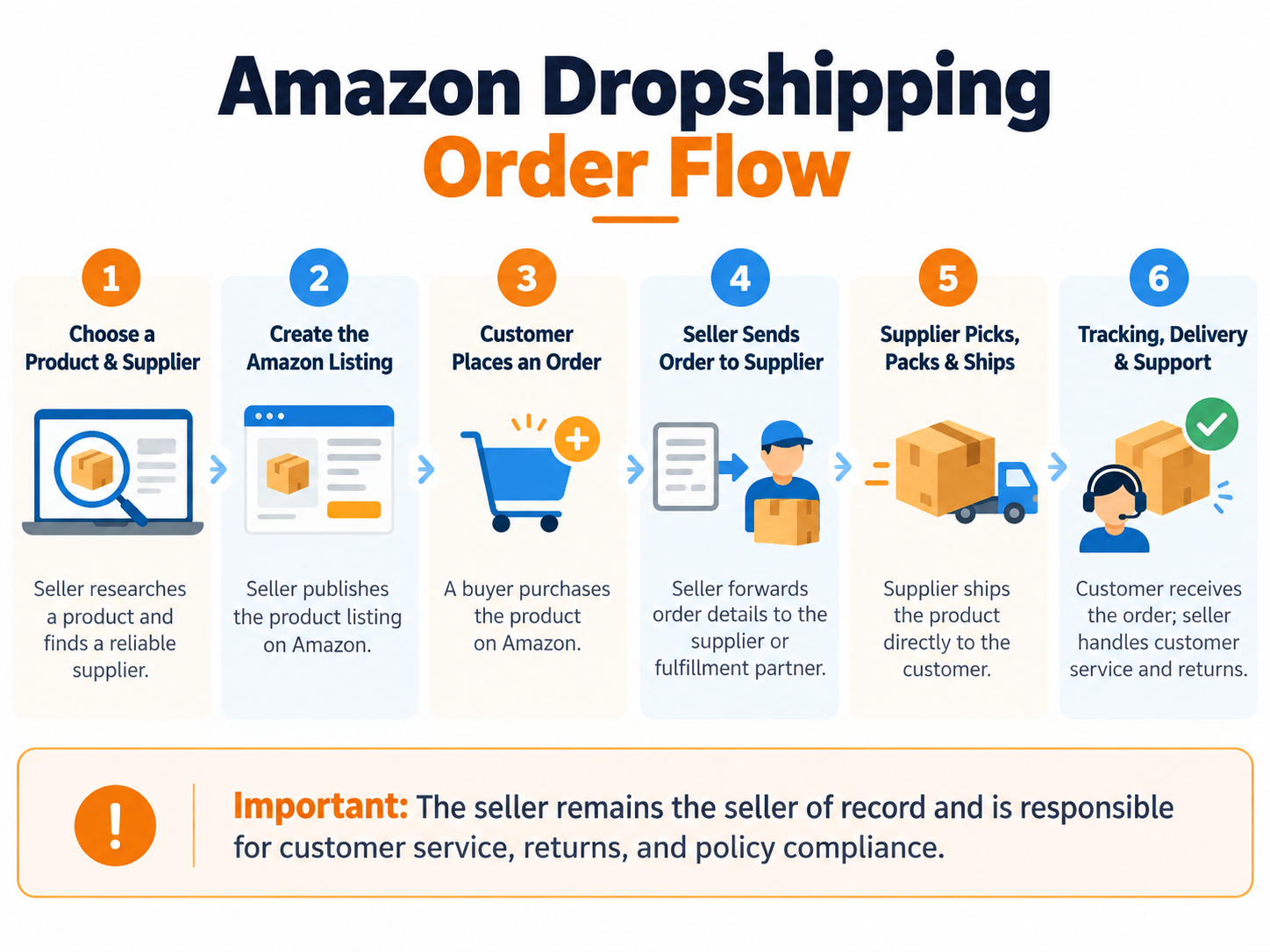
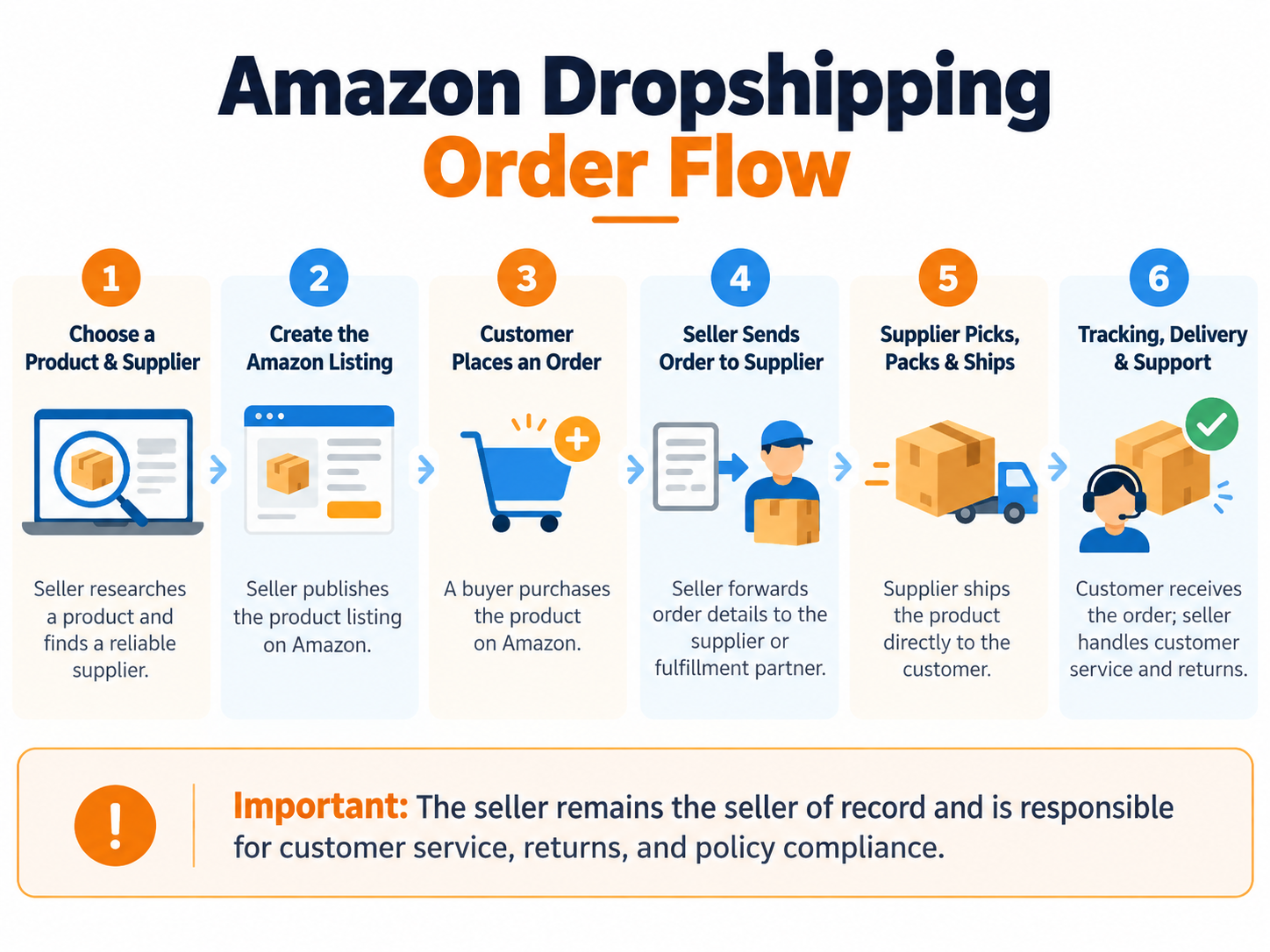
A typical order follows five steps:
-
Choose a supplier. Find a supplier that can provide suitable products and comply with Amazon's fulfillment requirements.
-
Create an Amazon listing. Publish an eligible product with accurate descriptions, images, pricing, and delivery information.
-
Receive a customer order. A buyer purchases the product through Amazon.
-
Arrange fulfillment. You send the order details to your supplier, who packs and ships the product under your approved seller-of-record arrangement.
-
Manage the customer experience. You provide tracking information, answer customer questions, and handle returns or refunds.
The main advantage is that you can test product demand without committing substantial capital to inventory.
However, outsourcing fulfillment does not transfer your responsibility to the supplier.
According to Amazon's official dropshipping guide, sellers can use third-party fulfillment services as long as they follow Amazon's policies.
Amazon Dropshipping vs. Traditional Ecommerce
Traditional ecommerce sellers usually purchase products before offering them for sale. They may store inventory themselves or send merchandise to a fulfillment provider.
Dropshipping changes when inventory is purchased and who physically handles the order.
| Factor | Amazon Dropshipping | Traditional Inventory Model |
|---|---|---|
| Upfront inventory | Usually not required | Generally required |
| Storage | Managed by supplier | Managed by seller or warehouse |
| Order fulfillment | Third-party supplier | Seller or fulfillment provider |
| Product quality control | More dependent on supplier | Greater direct control |
| Inventory availability | Depends on supplier stock | Depends on purchased stock |
| Financial risk | Lower inventory exposure | More capital tied to inventory |
| Customer responsibility | Seller | Seller |
Neither model guarantees profitability. The right choice depends on product demand, available capital, supplier reliability, and operational requirements.
Is Dropshipping Allowed on Amazon? Rules You Must Follow
Yes. Amazon allows dropshipping, but sellers must comply with its official Drop Shipping Policy.
The most important requirement is that you must be the seller of record.
In practical terms, customers must recognize your business as the seller responsible for the transaction, even when another company handles fulfillment.
1. You Must Be the Seller of Record
Amazon requires your business to be identified as the seller on relevant customer-facing materials.
This includes packing slips, invoices, and packaging where seller information appears.
Your supplier must not present itself or another retailer as the seller.
Before working with a supplier, confirm that the supplier understands this requirement and agrees to follow it.
2. Third-Party Seller Information Must Be Removed
Amazon prohibits shipments that identify another seller instead of your business.
For example, purchasing a product from another online retailer and having it delivered directly to an Amazon customer with that retailer's branding or paperwork can violate Amazon's policy.
Using an ordinary retail website as a fulfillment source without establishing an appropriate seller-of-record arrangement is therefore risky.
A compliant supplier should be able to discuss shipping documentation, packaging requirements, and fulfillment responsibilities before processing orders.
3. You Are Responsible for Returns
Even when a supplier ships the merchandise, you remain responsible for accepting and processing customer returns.
Consider what happens if:
-
A product arrives damaged.
-
The customer receives the wrong variation.
-
An item does not match its listing.
-
A package is delayed or lost.
-
A customer requests a refund.
Your supplier may assist with these situations, but the seller must manage the customer-facing process in accordance with Amazon's policies.
4. Your Products Must Meet Amazon's Selling Requirements
Not every product available from a supplier can automatically be listed on Amazon.
Some categories require approval. Certain brands may require authorization, and products must meet applicable safety, authenticity, labeling, and regulatory standards.
Amazon may request supplier invoices, product documentation, or evidence of authorization.
Before listing an item, check whether you are eligible to sell it in the intended marketplace.
5. You Must Meet Amazon's Delivery Expectations
Shipping performance is particularly important when fulfillment depends on an external supplier.
Amazon monitors seller performance through metrics such as:
-
Order Defect Rate
-
Late Shipment Rate
-
Pre-fulfillment Cancellation Rate
-
Valid Tracking Rate
These measures help Amazon assess whether sellers are delivering reliable customer experiences.
A supplier's advertised shipping speed is not sufficient on its own. You need to verify processing time, carrier reliability, tracking availability, and realistic delivery estimates.
Practical advice: Obtain written confirmation of your supplier's packaging, shipping, and returns procedures before processing Amazon orders.
For complete requirements, review Amazon's Drop Shipping Policy and Fulfilled by Merchant guidance.
How to Start Amazon Dropshipping in 2026: 7 Practical Steps
Starting an Amazon dropshipping business requires product research, supplier evaluation, account setup, and ongoing performance management.
The following process is designed to help beginners validate their business before attempting to scale.
Step 1: Create Your Amazon Seller Account
Start by registering through Amazon Seller Central.
Amazon offers two main selling plans in the United States.
| Selling Plan | Standard Fee | Suitable For |
|---|---|---|
| Individual | $0.99 per item sold | Sellers testing a small number of sales |
| Professional | $39.99 per month | Sellers who need additional selling tools |
Both plans are subject to applicable referral fees and potentially other charges.
Registration generally involves submitting business details, identity information, payment information, and tax details. Amazon may request additional verification.
Before choosing a plan, consider your expected monthly sales volume and whether you need advanced selling features.
Step 2: Research Products With Sustainable Demand
Product selection is one of the most important decisions in Amazon dropshipping.
A product may be trending online without offering sufficient demand or profit potential on Amazon.
Start with categories you understand, then examine whether customers have specific needs that existing products fail to address.
For example, consider a seller researching desk organization products.
Rather than choosing the cheapest desk organizer available, the seller could analyze customer reviews to identify repeated complaints about limited storage, unstable construction, or unsuitable dimensions.
These complaints can reveal opportunities for a better product.
Useful research methods include:
Amazon Best Sellers: Explore product categories and identify items with consistent customer interest.
Amazon Product Opportunity Explorer: Where available to your seller account, use marketplace data to examine demand and unmet customer needs.
Customer reviews: Read recent positive and negative reviews to understand purchasing motivations, quality concerns, and common returns.
Search results: Examine competing listings, prices, delivery promises, and product differentiation.
Avoid choosing products based solely on estimated sales volume.
A competitive product should offer a realistic combination of demand, available supply, acceptable costs, and a reason for customers to choose your listing.
Step 3: Check Product Eligibility and Competition
Before committing to a supplier, confirm that your Amazon account is eligible to sell the item.
Search for the product in Seller Central and check whether an approval request is required.
If you plan to sell an existing branded product, confirm that your supply arrangement and documentation meet the relevant requirements.
You should also examine the competitive environment.
Ask yourself:
-
How many established sellers offer similar products?
-
Can your supplier meet the delivery expectations shown in competing listings?
-
Are customers satisfied with existing alternatives?
-
Is there a meaningful product feature or quality improvement you can offer?
-
Can the product remain profitable at a competitive selling price?
If a listing already has numerous established competitors offering fast shipping and very low prices, an undifferentiated dropshipping offer may struggle.
Products with a clear customer use case and room for differentiation are generally more promising than products selected only because they are inexpensive.
Step 4: Find and Verify Your Supplier
A dependable supplier should support more than product purchasing.
For Amazon, the supplier must also be capable of meeting your fulfillment arrangement and seller-of-record requirements.
Evaluate product consistency, inventory accuracy, processing speed, shipping options, tracking, customer service, and returns handling.
Request a sample before selling whenever possible.
Check product dimensions, materials, functionality, packaging, and overall quality. Compare the physical item with the information you plan to publish on Amazon.
It is also worth placing a test order to an appropriate address to verify shipping documentation and packaging.
The goal is to identify problems before they affect actual customers.
Step 5: Calculate Your Profit Before Listing
A common beginner mistake is comparing the Amazon selling price with the supplier's product price and treating the difference as profit.
That calculation ignores most operating expenses.
A more useful approach is to estimate your contribution profit per order after direct expenses.
Include:
-
Product sourcing cost
-
Shipping and fulfillment
-
Amazon referral fees
-
Selling plan expenses
-
Advertising and promotional costs
-
Expected returns and refunds
-
Packaging or preparation charges
-
Applicable duties, taxes, and other operating expenses
We will examine a detailed example in the next section.
Before proceeding, calculate both your expected profit and how much unexpected cost your business can absorb.
Step 6: Create Your Listing and Set Up Fulfillment
Once product eligibility, supplier arrangements, and costs are confirmed, prepare your Amazon listing.
A useful listing should accurately explain the product rather than rely on exaggerated claims.
Focus on a clear title, product specifications, relevant search terms, informative images, and accurate variation details.
For example, a desk organizer listing should provide dimensions, material information, available colors, storage capacity, and what is included in the package.
Avoid claims that cannot be verified.
For typical dropshipping arrangements, orders are managed through Fulfilled by Merchant (FBM), also referred to as the Merchant Fulfilled Network.
Set your handling time and delivery promises according to verified supplier capabilities.
You also need a reliable process for transferring orders, receiving tracking information, updating Amazon, and resolving fulfillment problems.
Step 7: Test, Monitor, and Improve
Launching a product is the beginning of the evaluation process, not the end.
Start with a manageable number of products and orders so that operational problems remain easier to identify.
During the first few weeks, monitor:
| Metric | Why It Matters |
|---|---|
| Product page conversion | Indicates how effectively the offer turns visits into purchases |
| Contribution profit | Shows actual profitability before fixed overhead |
| Supplier processing time | Helps identify fulfillment delays |
| Tracking performance | Supports shipment visibility and account health |
| Return rate | May reveal quality or listing problems |
| Customer feedback | Highlights opportunities for improvement |
| Inventory availability | Helps prevent unexpected cancellations |
If customers frequently ask about product dimensions, improve the listing.
If shipping delays occur, investigate whether processing time, carrier selection, or inventory location is responsible.
If the product generates sales but little profit, review sourcing expenses and advertising performance before spending more.
The purpose of an initial test is to establish repeatable, profitable operations.

How Much Does Amazon Dropshipping Cost, and Is It Profitable?
Amazon dropshipping can have lower startup inventory requirements than traditional retail, but it is not a cost-free business.
Your expenses depend on the products you sell, the fulfillment model, marketplace fees, and the marketing methods you use.
Understanding Amazon Selling Fees
Amazon generally charges selling plan fees and referral fees.
Referral fees vary by product category and may include a minimum charge.
For example, some categories carry a 15% referral fee, while others use different percentages or tiered rates.
You should confirm the applicable fee for your product through Amazon's current pricing page.
Additional expenses may include advertising, returns, shipping, software, or other services.
Example: Calculating Profit on a Dropshipping Product
Consider an illustrative home organization product sold for $29.99.
| Expense | Amount |
|---|---|
| Selling price | $29.99 |
| Product sourcing | $9.00 |
| Shipping and fulfillment | $5.50 |
| Amazon referral fee (assumed 15%) | $4.50 |
| Advertising allocation | $3.00 |
| Returns allowance | $1.00 |
| Other variable expenses | $0.50 |
| Estimated contribution profit | $6.49 |
The estimated contribution margin is approximately 21.6%.
This means the seller retains about $6.49 per order before monthly subscriptions, other fixed overhead, income taxes, and any costs not included in the example.
These numbers are illustrative, not industry averages or guaranteed results.
Actual referral fees, shipping rates, advertising costs, and return expenses may differ considerably.
Why Revenue Does Not Equal Profit
Imagine this product generates 300 orders in one month.
At $29.99 per unit, total sales would be $8,997.
At the estimated $6.49 contribution profit per order, the seller would generate approximately $1,947 before fixed overhead and other excluded costs.
Now imagine shipping costs increase by $2 per order.
That additional expense would reduce monthly contribution profit by $600.
Small cost changes can have a significant effect on businesses operating with limited margins.
This is why supplier pricing, packaging dimensions, shipping rates, and return rates deserve as much attention as sales growth.
Include Cash Flow in Your Planning
Dropshipping reduces the need to purchase inventory in advance, but sellers may still need working capital.
You may have to pay your supplier before Amazon makes the corresponding sales proceeds available for withdrawal.
Advertising expenses, refunds, and replacement orders can create additional short-term cash requirements.
A business can show a positive margin on paper while experiencing cash flow pressure.
Maintain enough liquidity to fulfill orders and manage refunds without relying on immediate marketplace payouts.
How to Improve Amazon Dropshipping Profitability
Improving profitability usually involves more than raising selling prices.
Consider negotiating better sourcing terms, selecting appropriately sized packaging, reducing fulfillment errors, and improving product quality.
Review advertising at the individual product level. An increase in sales is not beneficial if advertising consumes the entire contribution margin.
As demand becomes more predictable, compare the economics of per-order dropshipping with bulk purchasing or local inventory.
A product that is economical to test through dropshipping may eventually be more profitable through another fulfillment arrangement.
How to Choose Reliable Amazon Dropshipping Suppliers

Your supplier directly influences many aspects of your Amazon business, even though customers may never interact with that company.
A sourcing decision should therefore be based on operational reliability rather than price alone.
What to Look for in a Supplier
Product quality and consistency
Ask about material specifications, manufacturing sources, inspection procedures, and how the supplier handles defects.
A low product price becomes expensive when customers frequently request replacements or refunds.
Inventory accuracy
Confirm how stock availability is communicated and how often inventory information is updated.
If a supplier regularly accepts orders for unavailable products, your cancellation rate may increase.
Reliable processing and shipping
Ask for realistic order processing times and available shipping methods for your target market.
Where possible, evaluate performance using actual test orders rather than advertised delivery estimates.
Amazon policy compatibility
The supplier must be able to support an arrangement in which your business is identified as the seller of record.
Discuss packing slips, invoices, external packaging, and any materials included with the shipment.
Clear returns and dispute procedures
Establish who receives returned products, who pays return transportation, and how damaged or incorrect orders are resolved.
Responsive communication
Good suppliers should provide timely answers about stock, order status, product specifications, and unexpected delays.
Questions to Ask Before Choosing a Supplier
Before placing your first Amazon order, ask the supplier:
-
Can you fulfill orders while identifying our business as the seller of record?
-
Can you prevent third-party seller information from appearing on customer-facing packaging and documentation?
-
What is your actual processing time for in-stock products?
-
Which carriers and tracking services are available?
-
How do you communicate inventory shortages?
-
What happens when an order is lost, damaged, or delivered incorrectly?
-
Can you provide product samples and relevant compliance documents?
-
Can your operation support higher order volumes without increasing delays?
Record the answers and confirm important requirements in writing.
An experienced supplier should be willing to explain what its services can and cannot support.
Build a Supplier Evaluation Scorecard
You can make supplier selection more objective by using a simple scorecard.
| Evaluation Area | Suggested Weight |
|---|---|
| Amazon policy compatibility | Pass/fail requirement |
| Product quality | 25% |
| Fulfillment reliability | 25% |
| Shipping and tracking | 20% |
| Total landed cost | 15% |
| Communication and support | 15% |
First, eliminate suppliers that cannot satisfy Amazon's policies.
Then score the remaining suppliers against the weighted operational criteria.
The weights are a suggested framework, not an Amazon requirement.
A supplier offering slightly higher product prices may be more valuable if it consistently reduces delivery problems, returns, and customer complaints.
How CJdropshipping Can Support Amazon Sellers
Finding products is only one part of running an Amazon business. Sellers also need dependable sourcing, inventory coordination, shipping support, and a practical way to improve product quality as demand grows.
CJdropshipping provides supply chain services that Amazon sellers can explore for different fulfillment needs.
Rather than treating every Amazon business the same way, sellers can evaluate CJ's services based on whether they are testing products, replenishing inventory, or developing their own brands.
Product Sourcing and Supplier Coordination
Amazon sellers often begin with a product idea but struggle to identify a suitable manufacturer or supplier.
CJdropshipping provides product sourcing services that help sellers explore available products, communicate sourcing requirements, and compare potential supply options.
Sellers can search for products or submit sourcing requests for specific items.
For example, if you identify demand for a home organization accessory, you can discuss specifications, materials, quantity requirements, and pricing with CJ.
This approach is particularly useful when you want to move beyond selecting generic products solely on price.
However, sellers must independently verify Amazon listing eligibility, brand authorization, product compliance, and documentation requirements.
Fulfillment Support for Amazon FBM Sellers
For eligible merchant-fulfilled orders, CJ may be able to support product sourcing, storage, order handling, shipping coordination, and tracking.
The appropriate workflow depends on the products, destination, and agreed fulfillment arrangement.
Importantly, Amazon sellers should not assume that CJdropshipping provides direct Amazon store authorization or automatic order synchronization.
Manual order placement and supported file-based workflows may be available, while other integration options should be confirmed with CJ.
Before using CJ for Amazon FBM orders, discuss packaging documentation, seller-of-record identification, shipping requirements, and returns handling.
A fulfillment partner can support these operations, but the Amazon seller remains responsible for ensuring policy compliance.
Inventory Planning and Amazon FBA Support
Dropshipping is useful for reducing inventory exposure during product testing.
Once a product develops consistent demand, purchasing inventory in bulk may become more economical.
CJdropshipping can help Amazon sellers explore product sourcing, inventory planning, and shipping arrangements for replenishing Amazon FBA inventory.
Depending on the product and service agreement, sellers may also discuss packaging, preparation, and labeling requirements.
For example, an Amazon seller could test customer interest using an appropriate merchant-fulfilled arrangement.
After identifying sustained demand, the seller could evaluate a bulk sourcing plan and arrange inventory shipments to designated Amazon fulfillment centers.
Available services should be confirmed before purchasing inventory or creating shipment plans.
Product Customization and Brand Development
As an Amazon business grows, competing exclusively on price can become difficult.
Product differentiation offers another way to build value.
CJdropshipping provides access to customization services that may include product modifications, private-label options, and custom packaging.
For example, a seller may begin by offering a standard storage organizer, then explore improvements to its dimensions, materials, or design based on customer feedback.
Branding options depend on supplier capabilities, quantities, and product requirements.
For Amazon sellers, customization must also align with applicable listing, intellectual property, packaging, and brand policies.
When Does Working With CJdropshipping Make Sense?
CJ may be particularly useful when you need a sourcing partner to coordinate manufacturers, explore better purchasing terms, manage inventory planning, or support more complex fulfillment requirements.
The value is not limited to traditional per-order dropshipping.
Sellers can also evaluate CJ for sourcing products intended for FBA, coordinating bulk shipments, or developing customized product lines.
The most effective approach is to discuss your target marketplace, product category, expected volume, and fulfillment requirements before committing to a solution.
Explore CJdropshipping's Amazon Sourcing and Fulfillment Solutions to find an arrangement that fits your business.
Amazon Dropshipping vs. FBA: Which Is Better for Your Business?
Amazon sellers are not limited to a single fulfillment model.
Understanding the differences between dropshipping, Fulfilled by Merchant (FBM), and Fulfillment by Amazon (FBA) can help you make better inventory decisions.
Amazon Dropshipping Through FBM
Under a compliant dropshipping arrangement, a third-party supplier fulfills customer orders while you remain the seller of record.
This approach can reduce upfront inventory requirements.
However, you remain responsible for delivery performance and customer service, and your supplier must satisfy Amazon's dropshipping requirements.
Not every FBM seller is a dropshipper. Some FBM businesses hold inventory and fulfill orders themselves or through third-party warehouses.
Fulfillment by Amazon (FBA)
With FBA, sellers generally purchase or otherwise arrange inventory and send it to Amazon fulfillment centers.
Amazon then handles eligible fulfillment activities, including order picking, packing, delivery, and certain customer service and returns functions.
FBA may offer access to Prime-eligible fulfillment, but it introduces inventory-related costs and operational requirements.
Comparing the Two Models
| Factor | Dropshipping Through FBM | Amazon FBA |
|---|---|---|
| Inventory purchase | Usually after a customer order | Generally before customer orders |
| Storage location | Supplier or third-party facility | Amazon fulfillment center |
| Fulfillment management | Seller and supplier | Amazon |
| Upfront capital | Usually lower | Usually higher |
| Inventory risk | Lower unsold stock exposure | Higher inventory commitment |
| Delivery performance | Depends on fulfillment arrangement | Uses Amazon's fulfillment network |
| Prime eligibility | Not automatic | Eligible FBA listings can offer Prime |
| Best fit | Demand testing and flexible sourcing | Predictable demand and inventory-led growth |
A Practical Hybrid Strategy
For some businesses, the most effective strategy is to combine fulfillment methods.
Suppose you identify five potential products.
Rather than purchasing hundreds of units of each product, you test demand using an eligible low-inventory fulfillment arrangement.
After collecting sufficient sales and operational data, you discover that two products consistently generate profitable orders.
You could then investigate bulk purchasing for those products and compare FBA costs with continuing to fulfill orders through FBM.
The remaining products may stay in a low-inventory model or be discontinued based on performance.
This approach allows inventory commitments to follow evidence of demand.
However, moving a product to FBA is not automatically more profitable. You must compare purchasing costs, inbound transportation, preparation, storage, fulfillment fees, and expected sales velocity.
Use Amazon's Revenue Calculator to help evaluate fulfillment economics.
Frequently Asked Questions
1. Is Amazon dropshipping legal in 2026?
Yes. Dropshipping is a legitimate fulfillment model, and Amazon permits it when sellers comply with Amazon's Drop Shipping Policy and applicable laws.
Sellers must remain the seller of record, meet customer service responsibilities, and ensure shipments do not improperly identify another seller.
2. Can I start Amazon dropshipping without inventory?
Yes. The traditional dropshipping model allows sellers to purchase products after receiving customer orders rather than holding their own inventory.
However, you still need funds for supplier payments, selling fees, product samples, potential advertising, and other operating expenses.
Not holding inventory does not mean operating without financial risk.
3. Can I use CJdropshipping for Amazon orders?
CJdropshipping can help Amazon sellers explore product sourcing, FBA inventory support, and eligible merchant-fulfilled arrangements.
Amazon order workflows should be discussed directly with CJ. Sellers should not assume direct Amazon store integration or automatic order synchronization.
Any third-party fulfillment arrangement must comply with Amazon's seller-of-record, packaging, and customer service requirements.
4. Is Amazon FBA better than dropshipping?
Neither model is universally better.
Dropshipping can reduce upfront inventory commitments and support product testing.
FBA may be attractive for products with predictable demand, particularly when faster fulfillment and inventory-based purchasing provide an economic advantage.
Compare the total costs, expected sales volume, operational responsibilities, and inventory risks before deciding.
5. How much money can you make with Amazon dropshipping?
There is no guaranteed income.
Profit depends on product margins, marketplace fees, shipping, advertising, returns, supplier performance, and order volume.
A seller generating $10,000 in revenue may earn relatively little after expenses, while another business with stronger margins and lower costs may perform better at a similar sales level.
Focus on sustainable profit per order rather than revenue alone.
Final Thoughts: Build an Amazon Business That Can Grow
Amazon dropshipping can provide an accessible way to enter ecommerce without making a large upfront inventory investment. Yet the businesses most likely to develop sustainable operations are those that treat dropshipping as a structured retail model rather than an effortless source of income.
Product research matters, but so do supplier agreements, accurate listings, realistic delivery promises, returns management, and financial planning.
Start by understanding Amazon's policies. Identify products that solve genuine customer problems, validate your suppliers, and calculate realistic profit margins before expanding.
As your business grows, revisit your sourcing and fulfillment strategy. Products that begin with a low-inventory model may eventually benefit from bulk purchasing, customized branding, or Amazon FBA.
With the right operational approach and reliable supply chain partners, Amazon dropshipping can become a practical starting point for building a more established ecommerce business.
Looking for sourcing and fulfillment support? Explore CJdropshipping's solutions for Amazon sellers and discuss the products, inventory plans, and shipping requirements of your business.