
Dropshipping in 2026 is not the same business model people talked about five years ago.
A few years back, many sellers could pick a trending product from a marketplace, upload it to Shopify, run a few ads, and still get sales. That simple model still exists, but it is much harder to scale. Customers are more experienced now. They compare delivery times, read reviews, check product photos carefully, and expect tracking information to update quickly. If a store looks cheap, ships slowly, or gives unclear delivery updates, buyers leave.
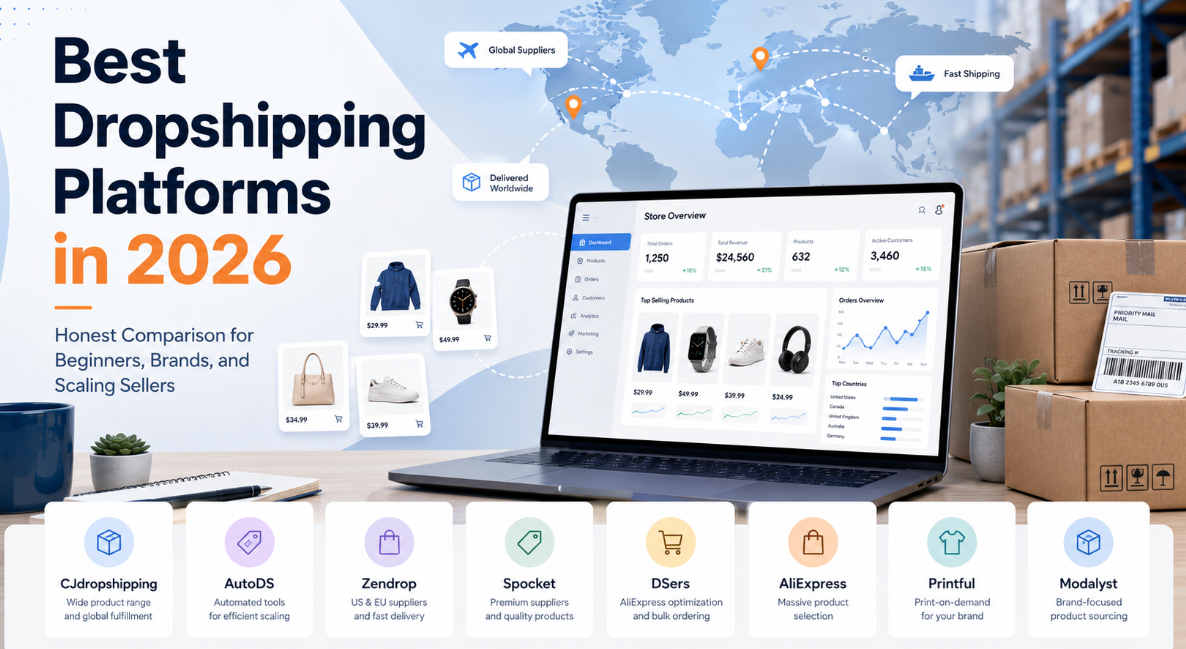
The market is still full of opportunity, but the rules have changed.
According to the U.S. Census Bureau, U.S. ecommerce sales reached an estimated $1,233.7 billion in 2025, up 5.4% from 2024, and ecommerce accounted for 16.4% of total retail sales. That means online shopping is still growing, but competition is also becoming more serious. Sellers are not only competing on product price anymore. They are competing on speed, trust, presentation, and fulfillment quality.
That is why choosing the right dropshipping platform matters.
A dropshipping platform is not just a place to find products. A strong platform should help you source products, connect your store, sync inventory, process orders, update tracking, manage shipping, support branding, and reduce operational mistakes. For beginners, the right platform can make the first store much easier to launch. For scaling sellers, it can decide whether growth feels smooth or chaotic.
This guide compares the best dropshipping platforms in 2026 from a practical seller’s point of view. It looks at what each platform is good at, where it may fall short, and which type of seller should consider it.
What Is a Dropshipping Platform in 2026?
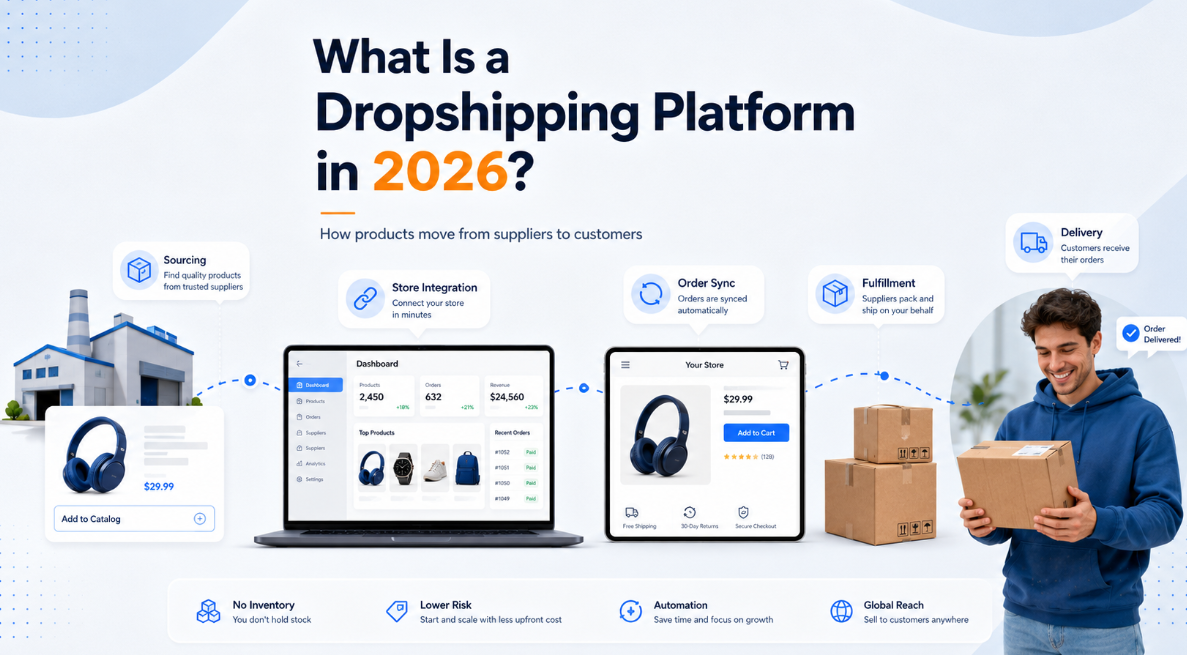
A dropshipping platform is a tool or service that helps online sellers sell products without holding inventory themselves. When a customer places an order, the seller forwards that order to a supplier or fulfillment partner. The supplier then ships the product directly to the customer.
That is the basic idea. But in 2026, a good dropshipping platform does much more than that.
Modern dropshipping platforms can support product sourcing, product listing, inventory syncing, order fulfillment, warehouse storage, shipping route selection, tracking updates, print-on-demand, custom packaging, private labeling, and even product research. Some platforms focus mainly on automation. Some focus on supplier access. Some focus on print-on-demand. Others act more like end-to-end supply chain partners.
It is also important to separate ecommerce platforms from dropshipping platforms.
Shopify, WooCommerce, Wix, and BigCommerce are ecommerce platforms. They help you build and run your online store. CJdropshipping, AutoDS, Zendrop, Spocket, DSers, AliExpress, Printful, and Modalyst are dropshipping-related platforms. They help you find products, connect suppliers, automate fulfillment, or manage sourcing.
A serious dropshipping business usually needs both. You need a store platform to sell, and you need a dropshipping platform to supply and fulfill orders.
The mistake many beginners make is choosing a platform only because it has cheap products. Cheap products can help with testing, but they do not guarantee a profitable business. A product that costs $2 less is not a real advantage if it arrives late, breaks easily, or creates refund requests.
In 2026, a good dropshipping platform should help sellers answer these questions:
Can I find products that fit my niche?
Can I trust the supplier quality?
Can I process orders without too much manual work?
Can the platform update inventory and tracking automatically?
Can I ship to my target countries within a reasonable timeframe?
Can I build a branded experience instead of looking like a generic reseller?
Can the platform support me when order volume grows?
These questions matter more than simply asking, “Which platform has the cheapest product?”
Why Most Sellers Fail With the Wrong Platform
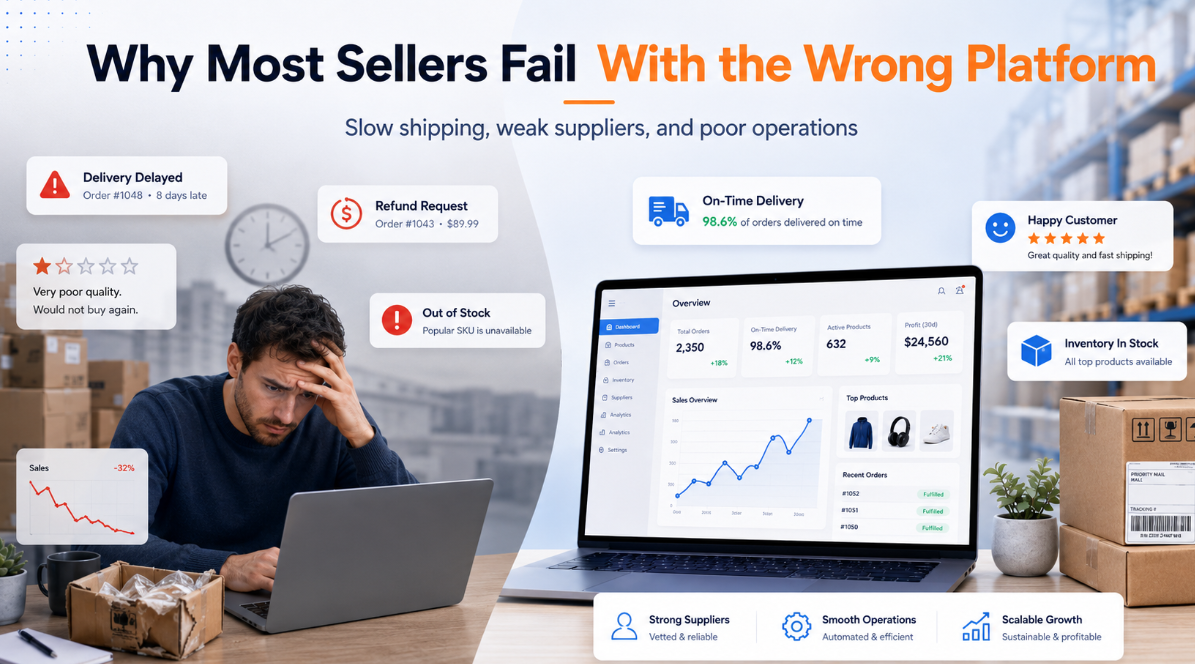
Many dropshipping stores do not fail because the product idea is terrible. They fail because the backend is weak.
A seller may find a product that gets clicks. The ad may perform well. The store may even get early orders. But after that, the real test begins. If fulfillment is slow, inventory is unstable, tracking does not update, or the product quality is inconsistent, the store quickly runs into problems.
Slow Shipping Damages Trust
Customers do not always need every order in two days, but they do expect the delivery promise to be realistic. One of the biggest changes in ecommerce is that delivery transparency is now part of the buying experience. Research on 2026 ecommerce customer expectations points out that consistency and predictability can matter as much as raw speed. Customers want to know when an order will arrive and they want that estimate to be reliable.
For dropshipping sellers, this is a major issue. If your product page says delivery takes 7 to 12 days but the order arrives in 25 days, the customer experience breaks. This can lead to refund requests, chargebacks, negative reviews, and poor repeat purchase rates.
Poor Supplier Communication Creates Scaling Problems
At a small order volume, many problems are invisible. If you only sell five units a day, you can manually check orders, message suppliers, and fix problems one by one.
At 100 orders a day, that approach breaks.
You need suppliers or platforms that can support stable inventory, clear processing times, reliable logistics, and quick issue resolution. If your supplier disappears for two days during a product spike, you may lose more money from delayed orders than you saved from low product costs.
Cheap Products Can Become Expensive
Beginners often choose products by cost first. That is understandable. When your budget is limited, every dollar matters.
But cheap products are not always profitable products.
A low-cost item can become expensive if it has a high defect rate, poor packaging, slow shipping, unclear tracking, or weak product photos. It can also hurt your ad account performance because customers who do not trust the product page are less likely to convert.
Real profit is not only product price minus selling price. It also includes ad costs, payment fees, refunds, reshipping, customer service time, and the cost of lost trust.
Most Beginners Focus on Product Importing Instead of Fulfillment
Product importing is only the first step. It helps you add products to your store. But after the sale, fulfillment becomes the heart of the business.
A reliable dropshipping platform should help sellers manage the full order cycle:
Product found
Product listed
Customer orders
Inventory confirmed
Order processed
Product packed
Shipping label generated
Tracking updated
Customer informed
Issue handled if something goes wrong
The more steps a platform can support, the less operational pressure falls on the seller.
What Actually Matters When Choosing a Dropshipping Platform
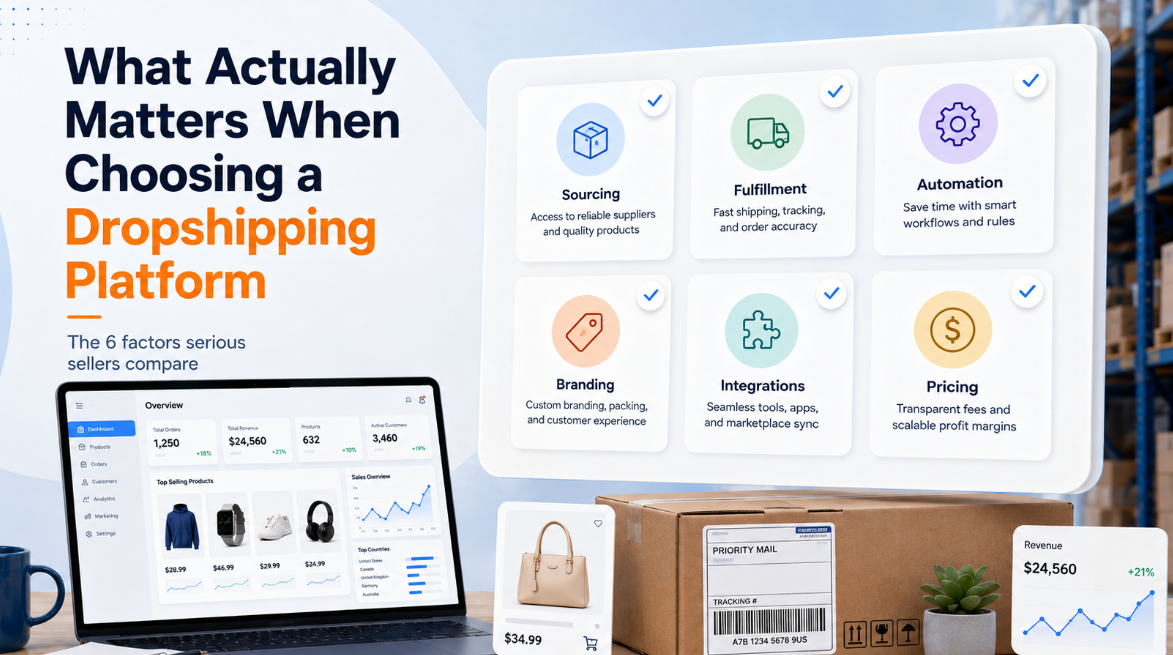
There is no single “best” dropshipping platform for everyone. A beginner testing products on a small budget does not need the same platform as a brand doing 500 orders a day. A TikTok Shop seller does not have the same needs as a print-on-demand artist. A Shopify general store does not operate like an Amazon-focused seller.
Still, there are several factors every seller should evaluate.
Product Sourcing Capability
Good sourcing means more than browsing a catalog.
A strong platform should help you find products that match your niche, price range, quality expectations, and target country. Some platforms only let you choose from existing supplier listings. Others can help source products based on images, links, or custom requirements.
If you plan to build a long-term store, sourcing flexibility becomes very important. You may need better product versions, custom colors, packaging changes, replacement suppliers, or bulk inventory options.
Fulfillment Infrastructure
Fulfillment is where many dropshipping businesses win or lose.
Look at whether the platform supports order processing, warehouse storage, quality checks, shipping options, tracking updates, and after-sales support. Also check whether it has warehouses in regions that matter to your customers, such as the United States, Europe, or other major markets.
Fast delivery is useful, but reliable delivery is even more important.
Automation and System Stability
Automation saves time and reduces human error.
For dropshipping, automation may include product importing, price updates, stock monitoring, order syncing, fulfillment requests, tracking number updates, and shipping notifications.
CJdropshipping, for example, positions itself strongly around all-in-one dropshipping automation and support for sellers from beginner to advanced levels.
But automation should not be judged only by the number of features. The real question is whether those features reduce daily work without creating confusion.
Branding Support
The old dropshipping model was mostly about selling generic products. The newer model is more brand-focused.
Branding support may include custom packaging, thank-you cards, private labeling, logo printing, product customization, branded invoices, or print-on-demand. These features help sellers create a store that feels more trustworthy and less like a random product page.
This matters because customers are more cautious now. If your store has a clear niche, consistent visuals, and better product presentation, you have a stronger chance of converting visitors into buyers.
Platform Integrations
A dropshipping platform should connect well with the store or marketplace you use.
Common integrations include Shopify, WooCommerce, Wix, TikTok Shop, Etsy, eBay, and Amazon. Not every platform supports every channel, and support quality can vary.
Before choosing a platform, check whether it works smoothly with your main sales channel. If you sell on Shopify, the app ecosystem matters. If you sell on TikTok Shop, fulfillment and compliance may matter more. If you sell POD products on Etsy, product mockups and production quality are more important.
Pricing Transparency
Some platforms are free to start, while others charge monthly fees. Some make money from product margins, some from subscriptions, and some from premium services.
Do not compare platforms only by monthly price. A low monthly fee may still be expensive if product costs are high. A free platform may still cost more if shipping is unstable or manual work takes too much time.
Look at the whole cost:
Product price
Shipping cost
Platform subscription
App fees
Transaction fees
Fulfillment fees
Storage fees
Branding fees
Refund costs
The cheapest platform on paper is not always the most profitable one.
Best Dropshipping Platforms in 2026
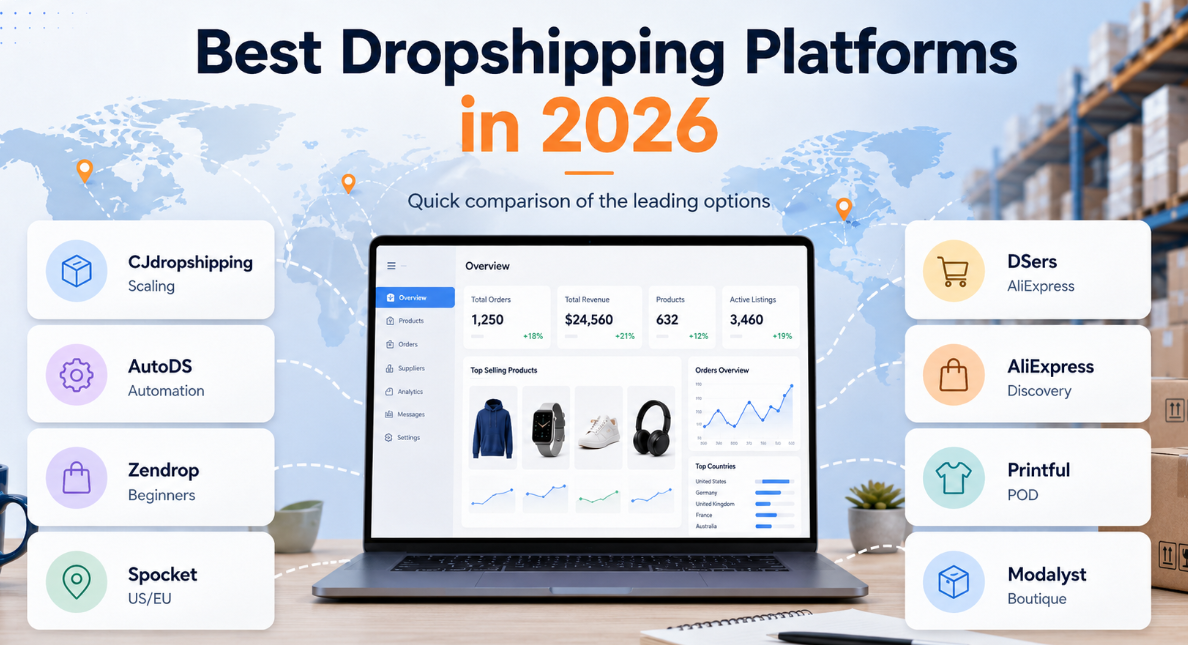
1. CJdropshipping: Best Overall Dropshipping Platform for Scaling Sellers
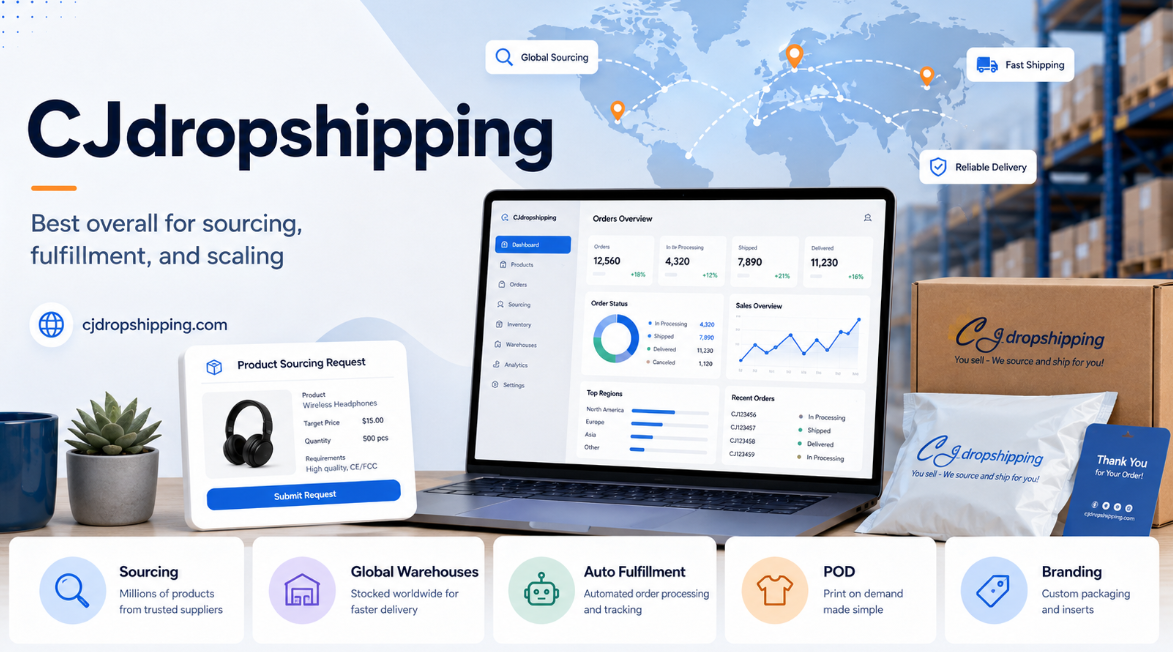
Website: https://cjdropshipping.com/
CJdropshipping is one of the most complete dropshipping platforms for sellers who want more than simple product importing. It combines product sourcing, supplier access, automatic fulfillment, global warehousing, print-on-demand, custom packaging, product listing support, and logistics services in one ecosystem.
CJ’s official website describes the platform as a dropshipping solution for dropshipping businesses, POD sellers, and DTC brands, with sourcing agents, manufacturers, and fulfillment centers connected into the workflow. Its Shopify app also highlights product sourcing, order fulfillment, global warehouses, quality inspection, and delivery support.
Why CJdropshipping Stands Out
CJdropshipping is especially useful for sellers who want to move from basic product testing to more serious operations. Many sellers start dropshipping by finding products on marketplaces. That works for early testing, but it can become limiting when the store starts growing.
At that point, sellers often need better sourcing, faster processing, packaging support, quality checks, and warehouse options. CJ is built for that stage.
One of CJ’s biggest advantages is its sourcing capability. Sellers can search for existing products or submit sourcing requests when they want CJ to help find a product from suppliers. This is useful when you find a product idea from TikTok, Amazon, AliExpress, Temu, or competitor stores and want a more stable supply option.
CJ also supports automatic order fulfillment. When connected with platforms like Shopify, WooCommerce, or TikTok Shop, orders can be synced and processed through CJ. This reduces manual work and makes it easier to handle larger order volumes.
Another important strength is branding. CJ supports services such as POD, custom packaging, private label options, product inserts, and other branding solutions. For sellers who want to build a real brand rather than a short-term product store, this is a meaningful advantage.
Best For
CJdropshipping is best for sellers who want a long-term fulfillment and sourcing partner. It works well for Shopify sellers, TikTok Shop sellers, niche store owners, and ecommerce brands that want to improve their supply chain.
It is also a strong option for sellers who are tired of unstable marketplace suppliers and want more control over sourcing, product quality, and fulfillment.
Potential Limitations
CJ has many features, which is good for scaling sellers, but complete beginners may need some time to understand the dashboard and workflow. It is not just a simple “click and import” app. It is closer to a supply chain platform.
For beginners who only want to test one or two products casually, a simpler tool may feel easier at first. But for sellers who plan to grow, CJ offers more room to scale.
Practical Verdict
CJdropshipping is one of the strongest choices in 2026 if your goal is to build a more serious dropshipping business. It is not only about finding products. It is about sourcing, fulfillment, branding, logistics, and long-term operations.
2. AutoDS: Best for Dropshipping Automation
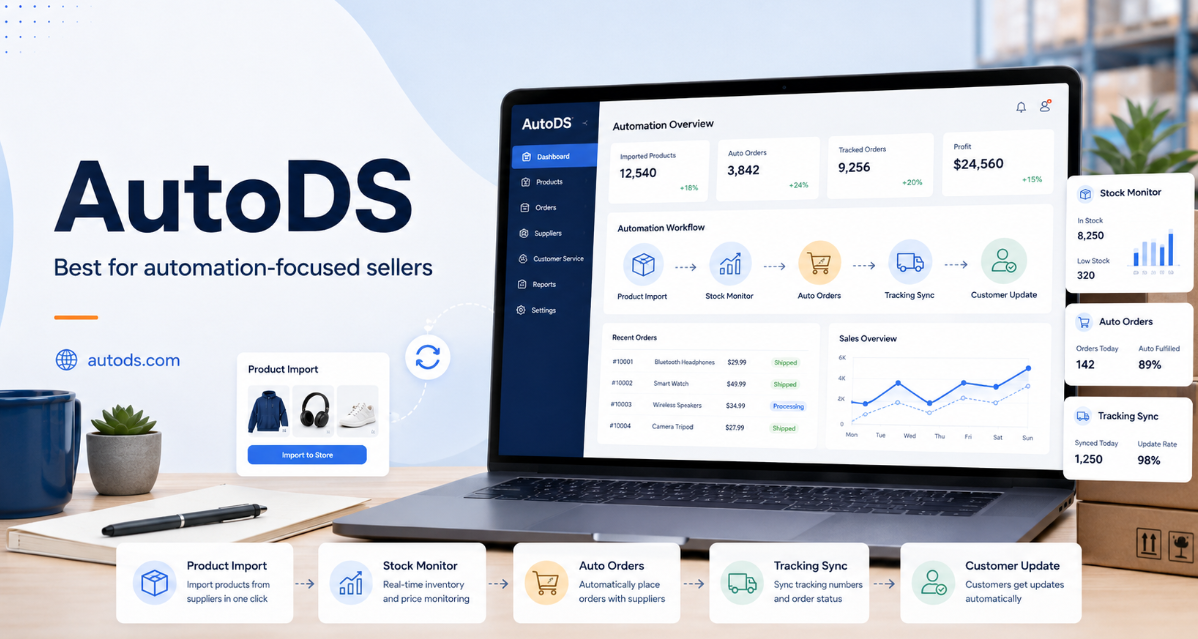
Website: https://www.autods.com/
AutoDS is built around automation. Its main value is helping sellers reduce repetitive work, such as product importing, price monitoring, stock tracking, order processing, and fulfillment workflows.
AutoDS describes itself as an all-in-one automation platform with tools and learning resources for dropshippers from beginner to expert level. Its help center also describes Fulfilled by AutoDS as a hands-free fulfillment option designed to reduce manual work, improve processing, and support scaling.
Why AutoDS Stands Out
AutoDS is attractive because dropshipping can become repetitive very quickly. Uploading products, updating prices, checking inventory, processing orders, and copying tracking numbers can take hours every week.
Automation helps sellers protect their time.
For sellers managing many products or multiple stores, AutoDS can make daily operations much easier. Its product importing and monitoring tools are useful for people who test many products and need fast updates.
AutoDS also supports different suppliers, which gives sellers more flexibility. Instead of being tied to one supplier source, sellers can use automation across different product channels.
Best For
AutoDS is best for sellers who care most about workflow automation. It is useful for Shopify sellers, eBay sellers, and people who test many products.
It can also work well for solo operators who do not have a team and need software to handle repetitive tasks.
Potential Limitations
AutoDS is strong in automation, but sellers should still pay close attention to supplier quality. Automation can process orders faster, but it does not automatically turn a weak product or poor supplier into a strong business.
If your main challenge is finding better suppliers, building a branded product, or improving fulfillment control, you may need a more sourcing-focused or fulfillment-focused platform.
Practical Verdict
AutoDS is a strong choice for sellers who want to save time and automate daily dropshipping tasks. It is especially useful for product testing and multi-product operations. But sellers still need to evaluate supplier quality, delivery times, and product consistency carefully.
3. Zendrop: Best Beginner-Friendly Platform for Shopify Sellers
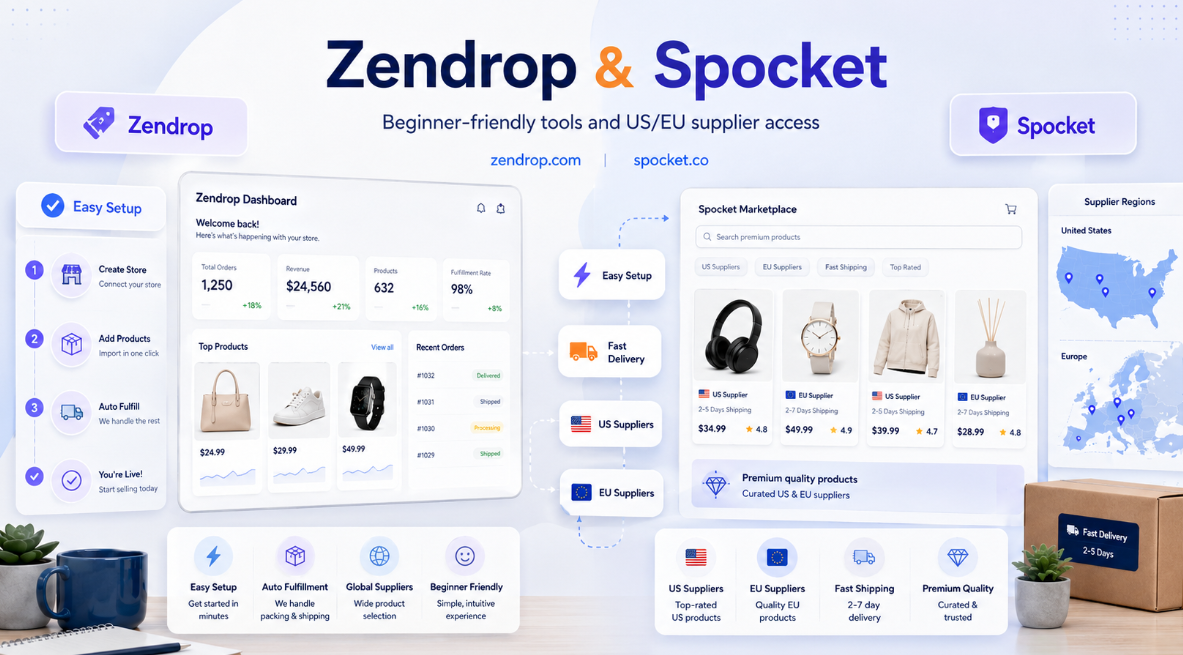
Website: https://www.zendrop.com/
Zendrop is a popular dropshipping platform known for its beginner-friendly interface, product discovery tools, and Shopify-focused workflow. It positions itself as an all-in-one platform for launching and scaling dropshipping stores, with auto fulfillment, product access, fast shipping, and related seller tools.
Zendrop’s dropshipping software page also highlights sourcing, fulfillment, print-on-demand, 3PL, custom branding, and warehouse support in the U.S. and China.
Why Zendrop Stands Out
Zendrop is designed to make dropshipping feel less complicated for new sellers. The interface is clean, the onboarding is simple, and the platform gives beginners a more guided experience than many traditional supplier marketplaces.
For first-time Shopify sellers, this can be helpful. Many beginners do not fail because they are lazy. They fail because the setup process feels overwhelming. Zendrop reduces some of that friction.
The platform also offers product discovery and fulfillment features, which makes it easier for sellers to move from product selection to store launch.
Best For
Zendrop is best for beginner Shopify sellers who want a cleaner, more guided experience. It can be a good starting point for people who want to launch quickly and avoid dealing with too many supplier details in the beginning.
It is also suitable for sellers who want a balance between simplicity and fulfillment support.
Potential Limitations
Zendrop may not offer the same depth of sourcing flexibility as platforms that are heavily built around custom sourcing and supplier negotiation. For sellers who want deep supply chain control, complex branding, or highly customized products, it may feel less flexible at later stages.
The platform is strong for getting started, but sellers should still evaluate product costs, margins, and shipping performance before scaling.
Practical Verdict
Zendrop is a good option for beginners who want a simple path into dropshipping. It is not necessarily the deepest supply chain solution, but it does a good job of reducing complexity for new sellers.
4. Spocket: Best for US and EU Supplier Access
Website: https://www.spocket.co/
Spocket focuses on helping sellers access suppliers from the United States, Europe, and other regions. Its official website emphasizes US and EU suppliers, curated product sourcing, order management, tracking, and automation tools. The Shopify App Store page also highlights verified suppliers from regions including the U.S., EU, Canada, Australia, and Brazil, as well as branded invoices and supplier communication features.
Why Spocket Stands Out
Spocket appeals to sellers who care about local supplier positioning. For stores targeting the U.S. or Europe, domestic or regional suppliers can help improve perceived shipping speed and product quality.
This can be especially useful for niche stores that want to look more premium. For example, a home decor store, beauty store, pet product store, or lifestyle boutique may benefit from products that feel less generic and ship from closer regions.
Spocket’s product catalog is also more curated than a large open marketplace. That can save time for sellers who do not want to sort through thousands of low-quality listings.
Best For
Spocket is best for sellers targeting U.S. and European customers who want faster local shipping options and a more premium product feel.
It can also be useful for sellers who want to avoid the traditional long shipping times often associated with marketplace-based dropshipping.
Potential Limitations
The main limitation is cost. Products from U.S. and EU suppliers are often more expensive than products sourced directly from China or other manufacturing hubs. That can reduce margins if sellers do not position their products properly.
Spocket is also not always the best choice for sellers who need huge product variety or custom sourcing flexibility.
Practical Verdict
Spocket is a good platform for stores that want local supplier positioning and better product presentation. It is not always the cheapest option, but it can make sense for sellers who want a more premium customer experience.
5. DSers: Best for AliExpress-Based Dropshipping
Website: https://www.dsers.com/
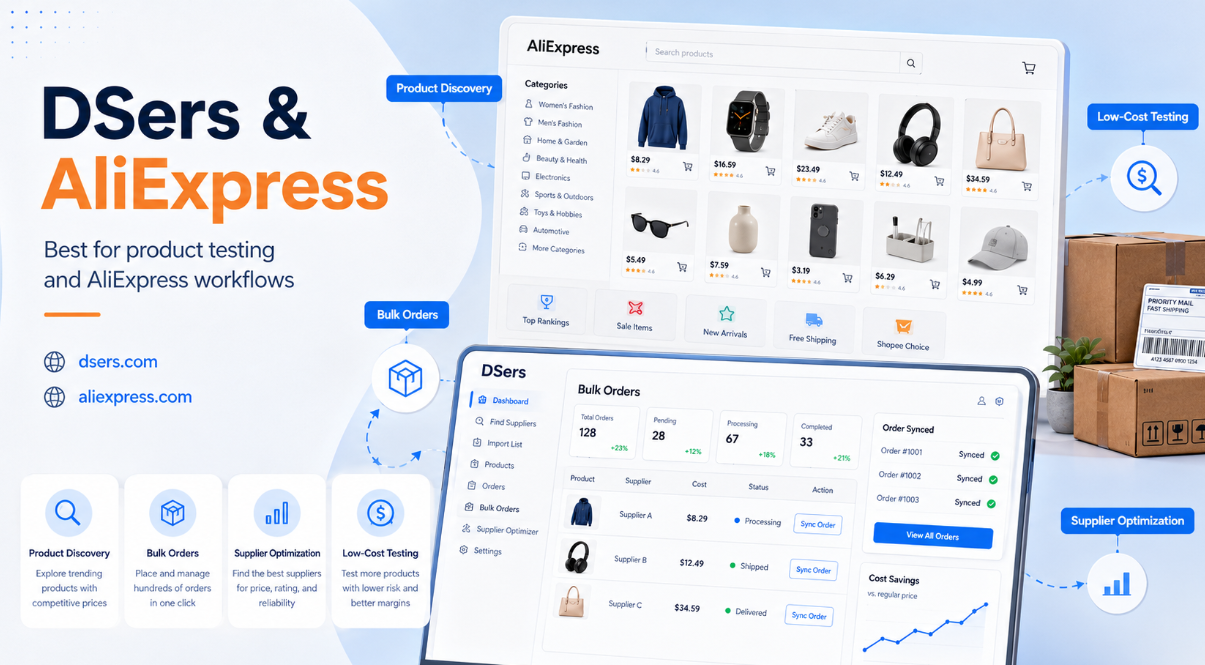
DSers is widely known as an AliExpress dropshipping tool. Its official website describes it as an AliExpress dropshipping tool that helps sellers streamline the supply chain, optimize supplier selection, and manage dropshipping operations. Its Shopify App Store listing describes DSers as an AliExpress, 1688, Alibaba, and TikTok dropshipping solution with AI-powered automation, product listing, bulk ordering, tracking, and supplier optimization.
Why DSers Stands Out
DSers is useful for sellers who still rely heavily on AliExpress. AliExpress has a huge product catalog, and many beginners use it to test products because it is accessible and easy to browse.
DSers helps make that process more organized. Instead of manually placing AliExpress orders one by one, sellers can use DSers to manage suppliers, process orders in bulk, and connect products to ecommerce stores.
The supplier optimization function is also helpful. Many products on AliExpress are sold by multiple suppliers, and choosing the wrong supplier can lead to poor delivery times or quality issues. Tools that help compare supplier options can reduce risk.
Best For
DSers is best for AliExpress-focused sellers, especially beginners who want a simple way to import and manage products from AliExpress.
It is also useful for sellers who are still in the product testing stage and do not yet need advanced branding or warehouse support.
Potential Limitations
DSers depends heavily on the supplier ecosystem behind it. If the supplier quality is inconsistent, DSers can help manage the workflow, but it cannot fully control product quality.
Branding options are also more limited compared with platforms built around custom packaging, warehousing, and private label support.
Practical Verdict
DSers is one of the best tools for AliExpress dropshipping. It is practical, accessible, and useful for beginners. But sellers who want to build a brand or scale with better fulfillment control may eventually need a stronger supply chain solution.
6. AliExpress: Best for Product Discovery and Low-Cost Testing
Website: https://www.aliexpress.com/
AliExpress is not a dropshipping platform in the same way as CJdropshipping, AutoDS, or Zendrop. It is a large online marketplace where independent sellers list products. Dropshippers have used AliExpress for years because it offers huge product variety, low entry costs, and easy product discovery.
Many tools, including DSers, are built around AliExpress workflows. The AliExpress Dropshipping Center is often discussed as a product research tool that helps sellers look at product data, supplier options, and market signals, although access and availability can vary by region and account.
Why AliExpress Still Matters
AliExpress remains useful because it is one of the easiest places to discover products. If you want to explore a niche, compare product styles, check pricing ranges, or find early product ideas, AliExpress can be valuable.
It is also beginner-friendly because sellers do not need large upfront capital. You can browse products, test ideas, and learn how demand behaves before making larger sourcing decisions.
For many beginners, AliExpress is the first step into dropshipping.
Best For
AliExpress is best for product research, low-budget testing, and early-stage niche exploration.
It can also be useful when you want to compare product variations or understand what suppliers are already offering in a category.
Potential Limitations
AliExpress has clear limitations for serious scaling.
Shipping times can vary widely. Product quality can be inconsistent. Supplier communication is not always reliable. Packaging is usually generic. Branding support is limited. If you are trying to build a real brand, AliExpress alone may not be enough.
Another issue is control. Since AliExpress is a marketplace, each supplier operates differently. One supplier may be reliable, while another may ship slowly or provide poor product quality.
Practical Verdict
AliExpress is still useful in 2026, but sellers should treat it mainly as a discovery and testing tool, not necessarily as the best long-term fulfillment foundation. Once a product proves demand, it often makes sense to move toward a more reliable sourcing and fulfillment partner.
7. Printful: Best for Print-on-Demand Dropshipping
Website: https://www.printful.com/
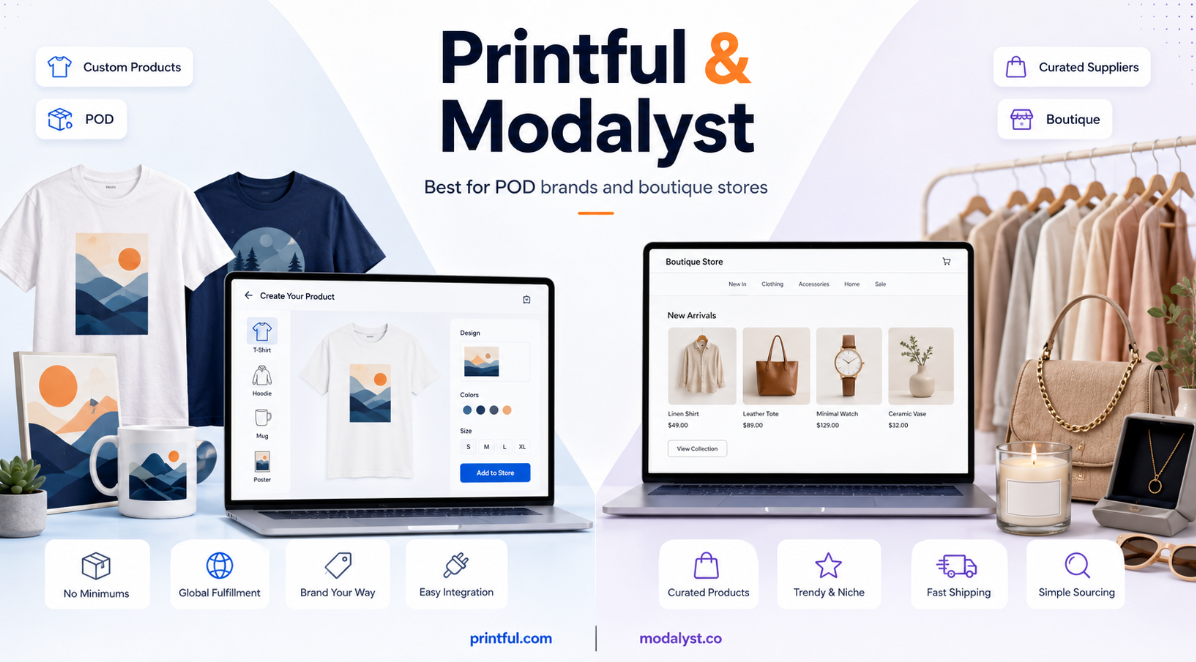
Printful is one of the best-known print-on-demand platforms. It allows sellers to create and sell custom products without holding inventory. Printful’s official website highlights print-on-demand dropshipping, store connections, custom product creation, and selling without inventory.
Its print-on-demand page states that it offers hundreds of customizable products, no order minimums, worldwide shipping, quality control, and production after an order is placed.
Why Printful Stands Out
Printful is different from general dropshipping platforms because it focuses on custom products. Instead of selling the same generic product as many other sellers, you can upload your own designs and sell products like t-shirts, hoodies, mugs, posters, bags, hats, and home decor.
This makes Printful a strong option for creators, influencers, artists, niche communities, and brand builders.
The biggest advantage is differentiation. A generic product can be copied easily. A design-based product is harder to copy if the brand identity, audience, and creative direction are strong.
Printful also handles printing, packing, and shipping, so sellers do not need to manage production themselves.
Best For
Printful is best for print-on-demand stores, creator brands, merch stores, artists, niche apparel brands, and personalized gift businesses.
It is also suitable for sellers who care more about brand identity than chasing short-term viral products.
Potential Limitations
The biggest challenge with POD is margin. Print-on-demand products often cost more per unit than bulk-produced products. That means sellers need strong branding, good designs, and smart pricing.
Another challenge is competition. Many people can create t-shirts or mugs, but not everyone can build a brand that people care about. The product itself is only part of the business. The story, audience, and design quality matter just as much.
Practical Verdict
Printful is one of the best dropshipping platforms for custom products and print-on-demand brands. It is not ideal for sellers who want the lowest product cost, but it is excellent for sellers who want creative control and brand differentiation.
8. Modalyst: Best for Curated Suppliers and Fashion-Oriented Stores
Website: https://www.modalyst.co/
Modalyst is a dropshipping platform that connects sellers with suppliers, including U.S. suppliers and AliExpress-related supplier access. Its website states that Modalyst features thousands of U.S. dropshipping suppliers and suppliers from around the world, including AliExpress.
Modalyst is often used by sellers who want curated product access, fashion products, accessories, and boutique-style inventory.
Why Modalyst Stands Out
Modalyst can be useful for sellers who want a more curated supplier experience than browsing a massive open marketplace. It has historically been popular among Wix users and boutique ecommerce sellers.
For fashion, accessories, and lifestyle stores, product presentation matters. Sellers need products that look good, fit a niche, and match a store’s visual direction. Modalyst can help with that kind of product discovery.
It is also useful for sellers who want access to both local and international suppliers in one place.
Best For
Modalyst is best for fashion stores, boutique ecommerce brands, Wix sellers, and lifestyle product stores that want curated products.
It can also work for sellers who do not need deep custom sourcing but want a cleaner supplier browsing experience.
Potential Limitations
Modalyst may not be the best option for sellers who need advanced fulfillment infrastructure, deep product customization, or large-scale warehousing support.
It is more suitable for product discovery and supplier access than full supply chain control.
Practical Verdict
Modalyst is a solid option for boutique-style stores, especially in fashion and lifestyle categories. It is not the strongest choice for every dropshipping model, but it can be useful for sellers who care about curated products and visual branding.
Comparison Table: Features, Fulfillment, and Scaling
| Platform | Website | Best For | Main Strength | Branding Support | Automation | Scaling Potential |
|---|---|---|---|---|---|---|
| CJdropshipping | https://cjdropshipping.com/ | Scaling sellers and long-term brands | Sourcing, fulfillment, warehouses, branding | Strong | Strong | Very strong |
| AutoDS | https://www.autods.com/ | Automation-focused sellers | Product importing, monitoring, workflow automation | Medium | Very strong | Strong |
| Zendrop | https://www.zendrop.com/ | Beginner Shopify sellers | Simple onboarding and fulfillment tools | Medium | Strong | Medium to strong |
| Spocket | https://www.spocket.co/ | U.S. and EU-focused stores | Local supplier access | Medium | Medium | Medium |
| DSers | https://www.dsers.com/ | AliExpress sellers | Bulk orders and supplier optimization | Low to medium | Strong | Medium |
| AliExpress | https://www.aliexpress.com/ | Product discovery and cheap testing | Huge product variety | Low | Low without third-party tools | Low to medium |
| Printful | https://www.printful.com/ | POD and creator brands | Custom products and print-on-demand | Strong | Medium | Strong for POD |
| Modalyst | https://www.modalyst.co/ | Boutique and fashion stores | Curated supplier access | Medium | Medium | Medium |
Which Platform Is Best for Different Types of Sellers?
Best for Complete Beginners
Best choices: Zendrop, DSers, CJdropshipping
If you are a complete beginner, your first goal is not to build the most complex system. Your first goal is to understand the business model, test products, learn store setup, process orders correctly, and avoid major mistakes.
Zendrop is beginner-friendly because the platform is simple and guided. DSers is useful if you want to start with AliExpress products. CJdropshipping is also good for beginners who want a platform they can grow with, especially if they want sourcing and fulfillment support beyond simple product importing.
Best for Scaling Shopify Brands
Best choice: CJdropshipping
For scaling sellers, the biggest concern is not only finding products. It is keeping fulfillment stable while order volume increases.
CJdropshipping is strong here because it offers sourcing, fulfillment, warehouse support, packaging options, POD, and integration with major ecommerce platforms. This makes it suitable for sellers who want to move from testing to brand building.
Best for Automation-Focused Sellers
Best choice: AutoDS
If your main pain point is repetitive work, AutoDS is one of the strongest choices. It helps automate product importing, monitoring, pricing, order processing, and tracking workflows.
This is especially useful for sellers who run multiple stores or test many products.
Best for U.S. and EU Supplier Access
Best choice: Spocket
Spocket is useful for sellers who want local supplier access and faster regional shipping options. It works especially well for stores targeting U.S. or European customers with a more premium positioning.
Best for AliExpress Dropshipping
Best choice: DSers
DSers is built for sellers who use AliExpress as their main product source. It helps organize orders, compare suppliers, and reduce manual work.
AliExpress itself is useful for product research, but DSers makes the workflow more manageable.
Best for Product Discovery
Best choice: AliExpress
AliExpress is still useful for discovering product ideas. The catalog is huge, and sellers can use it to compare prices, product styles, supplier listings, and niche opportunities.
However, it should not always be treated as the final supply chain solution for scaling.
Best for POD and Personalized Products
Best choice: Printful
Printful is the strongest option on this list for print-on-demand. If you want to sell custom apparel, accessories, mugs, posters, or merch, Printful is a reliable choice.
Best for Boutique and Fashion Stores
Best choice: Modalyst
Modalyst can be useful for fashion, accessories, and lifestyle stores that want curated products and a cleaner supplier experience.
How Modern Dropshipping Is Changing in 2026
Branding Is Replacing Generic Product Selling
Generic product stores are harder to scale now. Customers have seen too many similar ads and similar product pages.
Stores that build trust are doing better. That does not always mean you need a famous brand. It means your store should have a clear niche, consistent design, better product photos, helpful descriptions, and a reason for customers to buy from you instead of a random marketplace.
This is why platforms with branding support are becoming more important.
Fulfillment Is Becoming a Competitive Advantage
Delivery is no longer just a backend issue. It affects conversion, reviews, repeat purchases, and customer support costs.
Retail and ecommerce research for 2026 shows that delivery and returns are becoming a competitive surface, with customers expecting more control and fewer surprises after purchase.
For dropshipping sellers, this means fulfillment quality can no longer be ignored. A good ad can get attention, but fulfillment decides whether customers trust the store after buying.
TikTok Shop and Social Commerce Are Changing Product Cycles
Social commerce moves fast. A product can go viral in a few days, but the trend can also fade quickly.
Shopify’s 2026 retail innovation coverage notes that shoppers are increasingly comfortable with “retailtainment” formats such as TikTok Shop, where sales are forecast to pass $20 billion in 2026.
For dropshippers, this creates both opportunity and pressure. Sellers need platforms that can react quickly, source products fast, and keep fulfillment stable when demand spikes.
Sellers Are Becoming More Operationally Mature
The old mindset was “find a winning product.” The new mindset is “build a reliable sales and fulfillment system.”
That includes product research, creative testing, supplier evaluation, inventory planning, shipping strategy, customer service, and brand positioning.
The sellers who survive in 2026 are usually not the ones chasing the cheapest product. They are the ones building a better operation.
Red Flags to Avoid Before Choosing a Supplier Platform
Unrealistic Shipping Claims
Be careful when a platform promises very fast shipping without explaining where products are stored, which shipping line is used, or which countries are supported.
Fast shipping is good. Unrealistic shipping promises are dangerous.
No Quality Control Process
If you plan to scale a product, ask how quality issues are handled. Can the platform inspect products? Can it provide samples? Can it help replace suppliers if quality drops?
Without quality control, you are trusting the supplier blindly.
No Clear Tracking Updates
Tracking is one of the most common customer support issues in dropshipping. If customers cannot see where their order is, they get nervous.
Choose platforms that can provide stable tracking updates and sync them with your store.
Weak Customer Support
When you have only a few orders, support may not feel important. When you have hundreds of orders, support becomes critical.
A good platform should help solve fulfillment, inventory, delivery, and product issues quickly.
No Branding Options
If a platform only lets you sell generic products with generic packaging, it may be fine for testing. But it may not support long-term brand growth.
If your goal is to build a real ecommerce business, check whether the platform supports packaging, inserts, POD, private labels, or product customization.
Overdependence on One Supplier
Depending on one supplier is risky. Stock can run out, prices can change, quality can drop, or shipping lines can become unstable.
A good platform should give you flexibility, backup options, or sourcing support.
Final Verdict: Which Dropshipping Platform Is Best?
There is no single best dropshipping platform for every seller. The right choice depends on your business stage, product type, sales channel, budget, and long-term goals.
If you want the strongest overall platform for sourcing, fulfillment, branding, and scaling, CJdropshipping is one of the best choices in 2026.
If you care most about automation and reducing manual work, AutoDS is a strong option.
If you are a beginner Shopify seller and want a simple guided workflow, Zendrop is worth considering.
If your store targets the U.S. or Europe and you want local supplier access, Spocket can be a good fit.
If you want to use AliExpress for product testing, DSers is the most practical tool to manage that workflow.
If you want massive product discovery at a low entry cost, AliExpress still has value, but it should be used carefully.
If your business is based on custom designs or creator products, Printful is one of the best POD choices.
If you run a boutique or fashion-focused store, Modalyst can help with curated supplier access.
The smartest approach is not to ask, “Which platform is the most popular?” A better question is:
Which platform fits the way I want to build my business?
For short-term product testing, low-cost marketplaces and automation tools can be enough. For long-term growth, sellers usually need better sourcing, fulfillment, branding, and operational support.
Dropshipping is still profitable in 2026, but only for sellers who treat it like a real ecommerce business.
Q&A for Beginners
What is the best dropshipping platform in 2026?
CJdropshipping is one of the best overall choices for sellers who want sourcing, fulfillment, branding, automation, and scaling support in one platform. However, the best option depends on your business model. AutoDS is better for automation, Printful is better for POD, and Spocket is better for U.S. and EU supplier access.
Is dropshipping still profitable in 2026?
Yes, dropshipping can still be profitable in 2026, but it is more competitive than before. Sellers need better product selection, reliable fulfillment, strong branding, and clear customer communication. The old model of selling random cheap products with long shipping times is much harder to sustain.
What is better than AliExpress for dropshipping?
For long-term operations, platforms like CJdropshipping, Zendrop, Spocket, and AutoDS may offer better workflows than using AliExpress alone. AliExpress is still useful for product discovery and early testing, but sellers often need stronger fulfillment and sourcing support when scaling.
Which dropshipping platform is best for TikTok Shop sellers?
CJdropshipping is a strong option for TikTok Shop sellers because it supports sourcing, fulfillment, product listing, and operational workflows that can help with fast-moving product trends. TikTok Shop sellers should pay special attention to inventory stability, delivery speed, and platform compliance.
Can beginners use CJdropshipping?
Yes. Beginners can use CJdropshipping, especially if they want a platform they can grow with. However, because CJ offers many features, new users may need some time to understand sourcing, product listing, order syncing, and fulfillment settings.
Is AutoDS better than CJdropshipping?
They serve different needs. AutoDS is stronger as an automation tool for importing, monitoring, and managing dropshipping workflows. CJdropshipping is stronger as a sourcing and fulfillment platform with branding, warehousing, and supply chain support. Some sellers may even use automation tools and fulfillment platforms together.
Can I use multiple dropshipping platforms at the same time?
Yes. Many sellers use more than one platform. For example, a seller may use AliExpress for product research, DSers for AliExpress order management, CJdropshipping for sourcing and fulfillment, and Printful for POD products. The key is to keep operations organized so inventory, orders, and tracking do not become confusing.