
Etsy dropshipping is often explained too simply.
Find a product, list it on Etsy, wait for a customer to order, and let a supplier ship the product directly to the buyer.
That description misses the most important part of selling on Etsy in 2026: Etsy does not generally allow traditional dropshipping of ready-made products.
Etsy's current policy defines dropshipping as selling a ready-made product that a third-party supplier ships directly to the customer without alteration or customization by the seller. Etsy says this model is not allowed, with a limited exception for qualifying Craft and Party Supplies. It also prohibits reselling commercially available products that the seller did not make or design, subject to specific categories such as qualifying craft supplies and vintage goods.
That does not mean an Etsy seller has to manufacture everything personally.
Etsy allows sellers to work with production partners, including print-on-demand companies, apparel producers, printers, engravers, cut-and-sew manufacturers and certain contract manufacturers. The key condition is that the product must be based on the seller's original design or, where Etsy permits it, customization requested by the buyer.
That distinction changes how you should approach Etsy dropshipping.
The winning model is not:
Supplier product → Etsy listing → customer → supplier
It is closer to:
Seller creates value → customer orders on Etsy → production partner produces or customizes → partner ships → seller remains responsible for the customer experience
That final point is especially important.
Outsourcing production does not mean outsourcing your relationship with the buyer.
The customer purchased from your Etsy shop. If the supplier prints the wrong name, ships late, sends the wrong size or produces a poor-quality item, the buyer still contacts you. Your shop receives the review. Your order statistics are affected. A case is opened against your transaction, not against the factory that printed the product.
Understanding that relationship is what separates a workable Etsy fulfillment business from a fragile dropshipping operation.
Etsy remains a significant marketplace. In its Q2 2026 reporting, the company said Etsy had approximately 87 million active buyers on a trailing-12-month basis, while its filing reported about 5.7 million active sellers. Etsy marketplace gross merchandise sales also continued year-over-year growth during the quarter.
The opportunity is real. But the rules, customer expectations and operational responsibilities are very different from running a generic Shopify dropshipping store.
This guide explains how Etsy dropshipping actually works in 2026, what is allowed, how production partners fit into the model, how to handle customers when someone else fulfills your products, and what to look for before trusting a supplier with your Etsy reputation.
Is Dropshipping Allowed on Etsy in 2026?
The short answer is:
Traditional dropshipping is generally not allowed. Production-partner fulfillment can be allowed.
Those are not the same thing.
Consider two sellers.
Seller A finds a ready-made necklace from a wholesale marketplace. The necklace has already been designed and manufactured. Seller A uploads the supplier's product to Etsy, changes the description and asks the wholesaler to ship each order directly to the customer.
That is traditional reselling or dropshipping.
Etsy's current rules generally prohibit it.
Seller B creates an original graphic. A print-on-demand company prints that graphic onto a sweatshirt when a customer orders it and sends the finished sweatshirt directly to the buyer.
That can fit Etsy's production-partner model because the seller contributed the original design and the production company is carrying out the physical manufacturing.
The shipping method is not what determines compliance.
The question is:
What did the seller actually contribute to the product?
What Etsy Allows and What It Does Not
A practical way to understand the rules is to separate Etsy fulfillment models by creative contribution.
| Business model | Generally allowed? | Why |
|---|---|---|
| Generic ready-made product dropshipping | No | Seller did not design or make the product |
| Wholesale product reselling | No | Commercially available product is simply being resold |
| Print-on-demand with seller's original design | Yes, subject to Etsy rules | Seller designed the item |
| Custom manufacturing from seller specifications | Yes, subject to Etsy rules | Production partner makes seller-designed product |
| Buyer-personalized products | Yes, where Etsy requirements are met | Final product incorporates buyer customization |
| Eligible craft and party supplies | Yes | Limited dropshipping/reselling exception |
| White-label ready-made products | Not a qualifying production-partner model | Seller has insufficient original design input |
| OEM products sold under seller branding | Not a qualifying production-partner model | Branding alone does not equal seller design |
| ODM products rebranded by seller | Not a qualifying production-partner model | Manufacturer created the design |
| Commercial wholesaler products | No as production-partner products | Wholesaler supplies ready-made goods |
Etsy's current Production Partner guidance is unusually explicit on this point. It says white-label manufacturers, OEMs, ODMs, commercial retailers and wholesalers should not be listed as production partners when they simply produce or supply products that the seller did not meaningfully design. Etsy warns that using non-qualifying businesses to source products can violate its reselling rules and can lead to penalties, including suspension.
This means one of the most common pieces of advice about Etsy is wrong:
“Just add your logo to a generic product and it becomes private label, so you can sell it on Etsy.”
Private label is not automatically the same as an Etsy seller-designed product.
A logo added to someone else's finished commercial product does not necessarily provide the level of original design contribution Etsy expects.
Etsy Dropshipping vs. a Production Partner
The terminology matters because it reflects two fundamentally different businesses.
A traditional dropshipping supplier usually says:
Here is my catalog. Pick anything you want to sell.
A genuine production-partner relationship is closer to:
Give us the product you designed or the customization instructions, and we will manufacture it for you.
Etsy describes production partners as outside companies or individuals that physically produce items based on the seller's original designs. Current examples on Etsy's own help page include Printful, Printify and Gooten for print-on-demand, along with cut-and-sew manufacturers, contract manufacturers and specialized services such as professional printing or laser cutting.
Production partners are commonly used for four reasons: the seller lacks certain equipment, the seller needs specialized manufacturing or printing, the design requires a professional production technique, or the business has grown beyond what the seller can produce personally.
The seller is still the creative and commercial operator.
The partner is the production infrastructure.
A compliant POD workflow
A typical Etsy print-on-demand flow looks like this:
1. Seller creates an original design
↓
2. Seller creates an Etsy listing
↓
3. Seller discloses the production partner
↓
4. Buyer places an Etsy order
↓
5. Order information goes to the POD provider
↓
6. POD provider prints the seller's design
↓
7. Provider ships the item
↓
8. Tracking is returned to the Etsy order
↓
9. Seller handles customer communication and after-sales issues
The fact that the supplier performs steps six and seven does not remove the seller from steps eight and nine.
Where production-partner information appears
The following examples illustrate how Etsy/POD sellers work with production-partner information during listing setup and fulfillment.
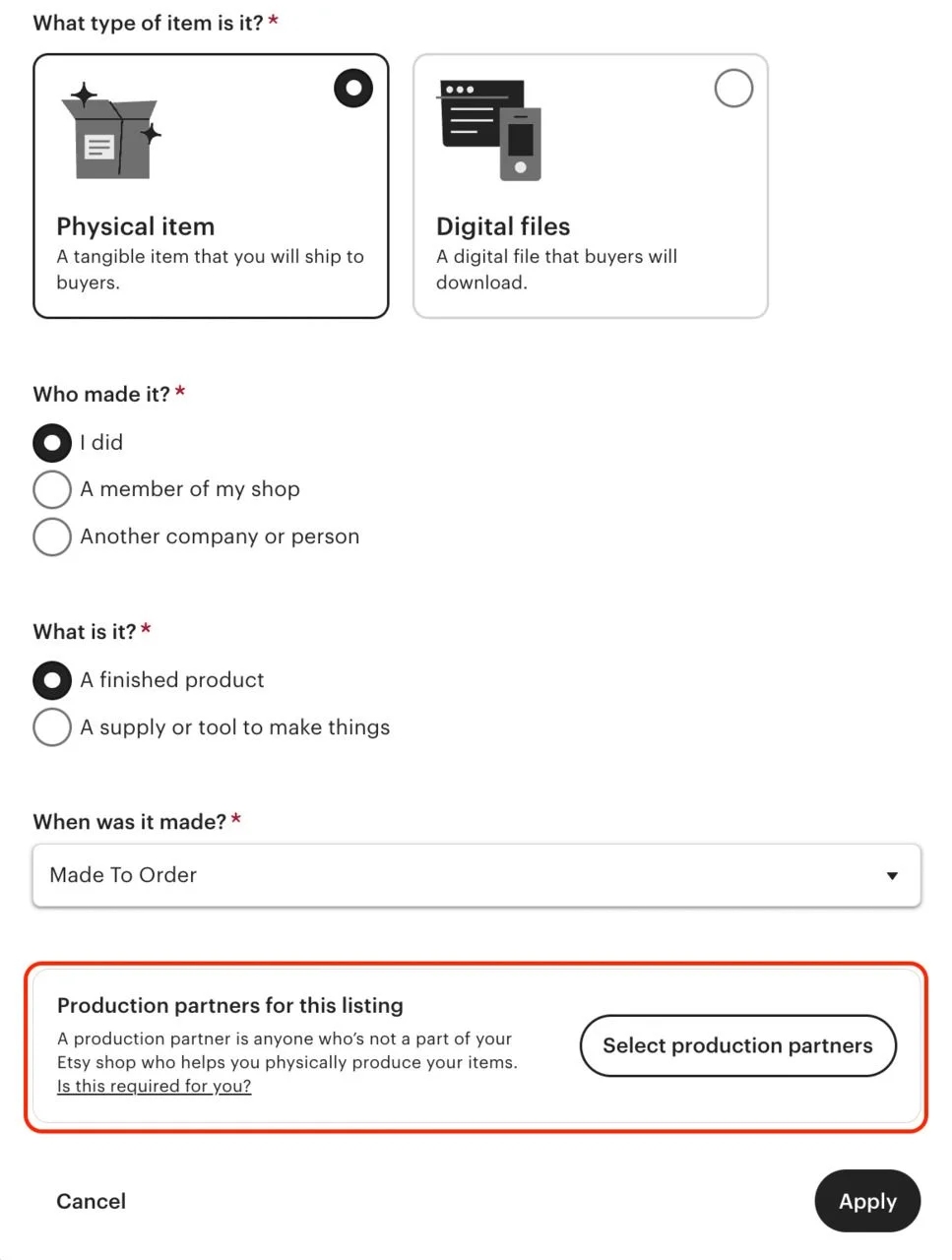
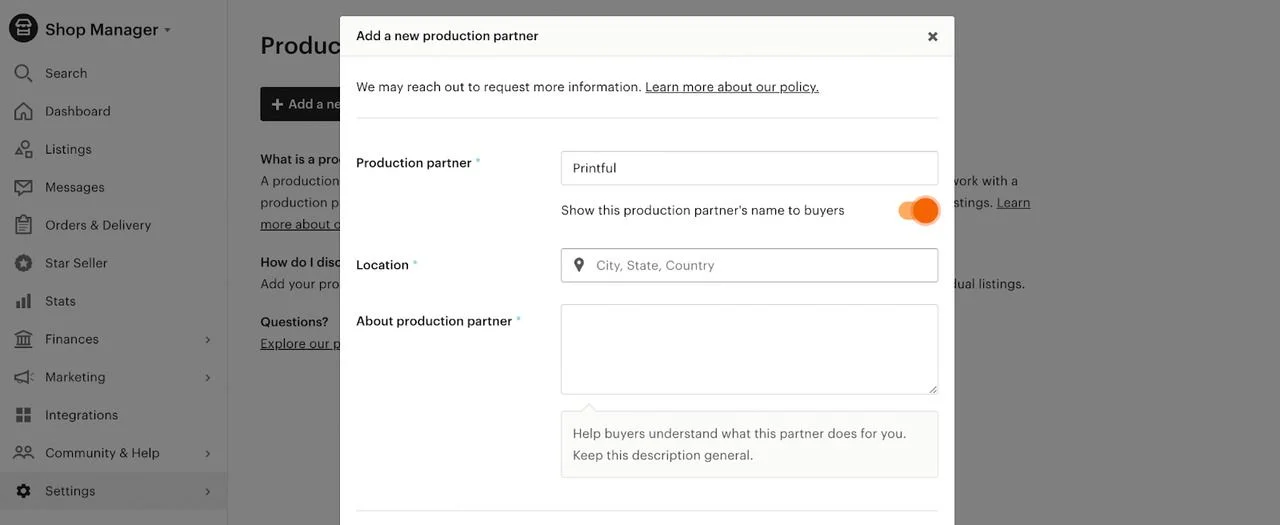
Etsy currently instructs sellers to add a partner through Shop Manager → Settings → Partners you work with → Add a new production partner. Sellers provide the partner's location, explain how the partner contributes to production and connect the partner to relevant listings. Etsy also requires sellers to ensure that shipping origins accurately reflect where the production partner is actually sending the product from.
The Part Most Etsy Dropshipping Guides Miss: The Customer Relationship
The production process may be outsourced.
The customer relationship is not.
Etsy's current Seller Policy requires sellers to honor their processing and shipping commitments, respond to buyers in a timely manner, honor shop policies and resolve disagreements or order issues directly with buyers. If an order cannot be completed, the seller must notify the buyer and cancel it.
Operationally, that means the relationship should look like this:
Customer
↕
Your Etsy Shop
↕
Production Partner
It should not look like:
Customer ↔ Factory
If a customer sends you:
My package hasn't arrived.
Do not answer:
Please contact my supplier.
If the customer says:
The name was printed incorrectly.
Do not send them an email address for a factory in another country.
You resolve the issue with the buyer. Then you resolve the supplier issue separately.
That separation is fundamental.
Supplier Performance Becomes Your Etsy Performance
A production partner may be invisible to most buyers, but its performance is visible through your shop statistics.
| Supplier problem | What the Etsy buyer experiences | What happens to your shop |
|---|---|---|
| Slow production | Order does not ship when expected | On-time shipping performance suffers |
| Invalid tracking | Buyer cannot follow package | More messages and disputes |
| Wrong size | Product does not match order | Replacement/refund risk |
| Wrong personalization | Buyer receives unusable gift | Complaint and possible case |
| Poor print quality | Product differs from listing expectation | Negative review risk |
| Damaged packaging | Damaged item arrives | Refund or replacement |
| Lost parcel | Buyer receives nothing | Non-delivery case risk |
| Wrong shipping origin | Listing information may be inaccurate | Policy/Purchase Protection problems |
| Inconsistent product | Repeat buyers receive different quality | Reputation damage |
This is why choosing an Etsy production partner purely on cost is dangerous.
A supplier that saves you $2 per product but generates twice as many replacements may actually be much more expensive.
Etsy Measures Customer Service
Customer service is not merely a branding issue on Etsy. It is tied to platform performance.
Etsy currently evaluates sellers across four main customer-service areas:
- message response rate
- on-time shipping
- average review rating
- case rate
To meet Etsy's minimum message-response standard, sellers need to respond to at least 80% of first messages in a thread within 48 hours. At least 80% of applicable orders must ship on time under the minimum shipping standard. Etsy says falling below its standards can reduce search visibility, affect Purchase Protection eligibility and, in repeated cases, affect selling privileges.
This makes supplier reliability a customer-service metric.
Imagine you process 100 POD orders.
Your production partner misses the stated processing time on 25 of them.
Even if you personally responded to every customer politely, the operational problem has already put pressure on your shipping performance.
The supplier is not just a vendor.
It is part of your marketplace reputation.
Production Time and Shipping Time Are Not the Same Thing
One of the most common sources of buyer frustration is unrealistic delivery expectations.
Suppose a personalized sweatshirt takes:
- 2 days to process the customization
- 3 business days to produce
- 5 business days in transit
The customer does not have a 3-day order.
They may have a roughly 10-business-day fulfillment journey.
The correct operational flow is:
Order placed
→ personalization information checked
→ order submitted to production
→ product manufactured
→ product packed
→ carrier receives parcel
→ tracking begins moving
→ customer receives order
Do not describe the manufacturing period as the total delivery time.
If the partner says “production in 3 days,” your listing should not imply “delivered in 3 days.”
This becomes even more important around Mother's Day, Christmas, weddings, birthdays and other date-sensitive Etsy purchases.
A late generic T-shirt is annoying.
A personalized wedding gift arriving two days after the wedding may be useless.
How to Set Realistic Processing Times
Before publishing a listing, place test orders.
Do not rely only on the supplier's marketing estimate.
Measure:
Order submitted → production begins
Production begins → carrier acceptance
Carrier acceptance → first tracking scan
First scan → delivery
Run tests to your primary customer markets.
If your partner claims 2 to 4 business days for production but five consecutive samples take four days, build your estimate around the realistic end of the range rather than the most optimistic number.
The goal is not to advertise the fastest possible delivery.
The goal is to advertise a delivery expectation you can consistently meet.
That approach protects reviews and reduces “Where is my order?” messages.
How Customer Problems Should Be Handled
Supplier-backed Etsy stores need a repeatable customer-service process.
You should know what happens before the first complaint arrives.
Scenario 1: “Where is my order?”
Start with the Etsy order and tracking.
Check whether the package has:
- not entered production
- been produced but not scanned
- been accepted by the carrier
- stopped moving
- been marked delivered
If the order is still inside the promised delivery window, give the customer a clear status update.
If there is an unusual delay, open an investigation with the fulfillment partner yourself.
The customer should not have to investigate your production chain.
Scenario 2: The product arrived damaged
Ask for enough evidence to understand the issue, usually a clear photograph where appropriate.
Then determine the solution under your shop policy and applicable Etsy protections.
Your internal supplier workflow should happen separately:
Customer reports damage
→ seller verifies issue
→ seller provides appropriate customer resolution
→ seller files supplier claim
→ supplier reimburses or replaces where its policy applies
A supplier refusing to reimburse you does not automatically remove your responsibilities to the customer.
Etsy states that sellers manage their own cancellations, refunds, returns and exchanges. Physical listings must have a return policy, even when the seller chooses not to accept ordinary returns. If a seller reaches a return or replacement agreement with a buyer through Etsy, Etsy requires that agreement to be honored.
Scenario 3: The personalization is wrong
First determine where the error happened.
Buyer entered the wrong spelling:
“Emily” was submitted, “Emily” was produced.
That may fall under your personalized-item policy.
Buyer entered the correct spelling, but production printed something different:
“Emily” was submitted, “Emliy” was produced.
That is a fulfillment error.
Your backend supplier claim may be straightforward, but from the buyer's perspective this is your store's order.
Scenario 4: The product is not what the listing showed
This is one of the more serious dropshipping problems.
Etsy's case system currently allows buyers to open cases primarily for non-delivery and not-as-described issues after attempting to resolve the problem with the seller. Etsy's rules treat differences such as the wrong color, wrong size, wrong design, wrong material or wrong quantity as examples that may support a not-as-described claim.
That is why copying supplier images without ordering a sample is risky.
If the supplier silently changes the blank T-shirt, mug finish, print position or material, your listing may no longer accurately represent the product.
Scenario 5: The order arrives late
Avoid disappearing until the customer complains again.
Check the carrier status, explain what is known and give a realistic next step.
Etsy's seller obligations emphasize timely buyer communication and direct resolution of order problems.
Etsy Purchase Protection Does Not Remove Seller Responsibility
Etsy Purchase Protection can reduce financial risk, but sellers should not treat it as a replacement for good fulfillment.
As of 2026, eligible orders can receive up to $250 in Etsy Purchase Protection coverage, including shipping and taxes collected on Etsy, even when the total order value is higher. If a $400 eligible order receives a qualifying refund, for example, Etsy may cover up to $250 while the remaining amount can still fall to the seller.
Protection can apply in situations such as qualifying non-delivery, significant lateness and certain not-as-described disputes. Etsy also says the first eligible damaged-item case per calendar year may receive protection, with sellers generally responsible for additional damaged-item cases.
Eligibility matters.
Among Etsy's current Purchase Protection requirements are:
- meeting minimum customer-service standards
- responding to a buyer's Help with Order message within 48 hours
- using an accurate “ships from” location
- providing valid tracking where required
- shipping within your stated processing time
- using Etsy Payments where available
- shipping to the address provided through Etsy
- maintaining complete shop policies
- keeping the shop in good standing
Notice how many of these depend on your production partner.
A supplier that gives you tracking three days after the parcel ships, uses a different fulfillment location without telling you or repeatedly misses your processing window can put Purchase Protection eligibility under pressure.
Your Supplier's Return Policy and Your Etsy Policy Are Two Different Things
This distinction creates one of the most overlooked financial risks in dropshipping.
Suppose your supplier says:
Personalized products are non-refundable.
Your Etsy shop promises:
Incorrectly produced personalized products will be replaced or refunded.
A customer receives an incorrectly printed item.
You refund the customer.
Then the supplier refuses to reimburse you.
The supplier's policy did not override your promise to your Etsy buyer.
You absorb the loss.
That is why supplier policies should be evaluated before you build your Etsy shop policies.
Compare:
- damaged-item policy
- lost-order policy
- misprint policy
- incorrect-size policy
- wrong-personalization policy
- cancellation window
- replacement processing time
- refund method
- evidence requirements
If those policies conflict heavily with what you want to offer buyers, the supplier may be a poor fit even if its manufacturing price is attractive.
The Customer Relationship Has Another Limitation: You Do Not Fully Control It
Etsy gives sellers access to marketplace demand.
In exchange, Etsy also controls much of the transaction environment.
That matters for anyone coming from Shopify or traditional DTC eCommerce.
If a customer purchases through your independent website, you may have significantly more control over your own checkout, CRM, loyalty program and consent-based marketing system.
An Etsy customer remains part of Etsy's marketplace ecosystem.
Etsy's Seller Policy says that buyer information obtained through Etsy, including names, email addresses and shipping information, can only be used in accordance with Etsy's policies and applicable privacy law. Etsy specifically says sellers may not add Etsy members to email or physical mailing lists without appropriate consent, use their identity for unauthorized marketing or send unsolicited commercial communications.
That changes how you should think about “customer ownership.”
You have the responsibility to serve the buyer.
You do not automatically receive unlimited marketing rights over that buyer.
Do Not Move Etsy Customers Off-Platform to Finish the Sale
Etsy's Off-Platform Transactions policy was updated on June 9, 2026. It explicitly prohibits directing Etsy-initiated transactions outside Etsy, including encouraging a buyer to purchase through another venue or using a QR code to move users off-platform.
That means a packaging strategy such as:
“Scan this QR code and buy the same product cheaper on our website.”
creates a policy problem if it is being used to redirect Etsy transactions.
Similarly, Etsy Messages should not be used to offer incentives for a buyer to complete a purchase through another website or payment method.
This is one of the important commercial differences between Etsy and a standalone store.
Etsy can make customer acquisition easier because buyers already exist in the marketplace.
But:
your freedom to move those marketplace relationships into your own commerce ecosystem is more limited.
The Best Etsy Dropshipping Models in 2026
Rather than asking “What random product can I dropship on Etsy?” start by choosing a compliant business model.
1. Print-on-Demand Based on Original Designs
This remains the most straightforward production-partner model.
Suitable products can include:
- T-shirts
- sweatshirts
- hoodies
- tote bags
- mugs
- posters
- wall art
- notebooks
- certain home products
The blank item is only part of the product.
The seller's original graphic, illustration, typography, pattern or other creative contribution is what makes the listing fit Etsy's seller-designed model.
2. Personalized Products
Personalization fits Etsy particularly well because buyers frequently use the platform for gifts and special occasions.
Examples include:
- personalized wedding gifts
- name-based apparel
- anniversary gifts
- engraved items
- baby-name products
- custom pet gifts
- family gifts
- teacher gifts
- event products
The production workflow can remain highly automated, but customer-data accuracy becomes critical.
One incorrect letter can turn a perfectly manufactured product into an unusable order.
3. Seller-Designed Products Manufactured Externally
Not every production partner needs to be POD.
Etsy explicitly recognizes cut-and-sew manufacturers, contract manufacturers and specialized production services when they physically produce items according to the seller's design or specifications.
For example:
Seller designs a custom textile pattern.
A cut-and-sew partner manufactures the finished bag.
The seller handles design, positioning, Etsy listing and customer relationship.
The manufacturer handles sewing and fulfillment.
That can be a much stronger long-term model than simply reselling a generic bag.
4. Eligible Craft and Party Supplies
Craft and Party Supplies are the key exception to Etsy's general prohibition on traditional dropshipping.
Etsy says qualifying supplies that support creative work or events may be dropshipped.
This route needs careful category verification because calling something a “craft product” does not automatically make it eligible.
Products That Make More Sense for Etsy
Product selection should follow Etsy's creativity model instead of generic dropshipping trends.
Personalized apparel
A plain generic sweatshirt has limited Etsy differentiation.
A sweatshirt built around an original seller-created illustration, custom family name or customer-specific personalization is a different proposition.
Personalized gifts
Gift intent creates natural differentiation.
Instead of competing on:
Ceramic Mug
you compete on:
Personalized First Christmas as Grandma Mug
The physical product may still be relatively simple.
The customization carries much of the value.
Wall art and prints
Artists and designers can create original work while outsourcing professional printing and shipping.
The seller controls the intellectual property and creative direction.
The partner provides scalable production.
Personalized jewelry
This category requires particular care.
A seller who simply imports a mass-produced necklace is reselling.
A seller who creates an original design or uses a qualifying partner to produce a buyer-personalized piece may fit a very different model.
Wedding and event products
Custom wedding signs, personalized gifts, printed products and made-to-order event items fit the marketplace because customization is often central to the purchase.
Craft supplies
These can be particularly attractive for sellers who want a model closer to traditional dropshipping while remaining inside Etsy's permitted supply categories.
How to Choose a Production Partner
The best Etsy production partner is not the one with the largest catalog.
It is the one that can consistently deliver what your listing promises.
Evaluate partners across six areas.
Can they actually produce your design?
If their business model is:
Choose one of our finished products and resell it.
you may simply be looking at a wholesaler.
If their model is:
Send us your artwork, pattern, specifications or personalization instructions and we will manufacture it.
the relationship is much closer to the production-partner model Etsy describes.
Can they transmit personalization accurately?
For personalized products, test difficult orders.
Use:
- long names
- accented characters
- multiple lines
- unusual capitalization
- dates
- several variants
You want to discover data-handling weaknesses before paying customers do.
Can they meet the processing time?
Ask for both:
production time
and
carrier transit time
Do not accept one combined marketing estimate without understanding each stage.
Can they provide valid tracking?
Tracking should appear quickly and update through a recognizable carrier.
Do not judge fulfillment quality solely by whether a tracking number exists.
A number that sits on “label created” for six days does not provide a good buyer experience.
How do they resolve mistakes?
Ask before launch:
- What happens if the print is wrong?
- What happens if an item is damaged?
- What if the parcel is lost?
- What evidence is required?
- Who pays for the replacement?
- How fast is the reprint?
- Are shipping costs included?
- Is the buyer ever asked to return a defective personalized product?
Can you order samples?
If the answer is effectively no, consider another partner.
A sample should test more than product quality.
Use it to test the entire order:
Order → production → tracking → packaging → delivery → product
That is the exact experience your customer is buying.
How to Start Etsy Dropshipping the Right Way
A professional launch can be reduced to seven stages.
Step 1: Choose an Etsy-compliant model
Start with one of these:
- original-design POD
- personalized products
- seller-designed manufactured products
- qualifying craft or party supplies
Do not build the business first and ask about Etsy policy later.
Step 2: Create the product value
For POD, create the original design.
For personalized products, design the customization system.
For manufactured products, create the specifications, artwork or product design.
The creative contribution should exist before the supplier relationship is used to fulfill it.
Step 3: Find and test a production partner
Compare more than price.
Evaluate:
- quality
- processing time
- fulfillment location
- tracking
- packaging
- replacement policy
- personalization
- scalability
Order samples to your main markets.
Step 4: Define your customer-service rules
Before launching, decide what happens if:
- the item is late
- the item is lost
- the item arrives damaged
- personalization is wrong
- the buyer supplied incorrect information
- the wrong variant is produced
- the customer requests cancellation
- a replacement is needed
Then make sure your supplier agreement can reasonably support those policies.
Step 5: Add the production partner correctly
Etsy currently directs sellers to:
Shop Manager → Settings → Partners you work with → Add a new production partner
You will provide the partner's details, location and information about the production relationship.
The production partner must then be connected to the applicable listings.
Step 6: Build accurate listings
Your listing should accurately show:
- what the buyer receives
- how it is personalized
- available variants
- materials
- dimensions
- realistic processing time
- realistic shipping expectations
- shipping origin
- production-partner involvement where required
Etsy's current Seller Policy requires sellers to accurately represent how an item was made, by whom and where it ships from.
Step 7: Monitor fulfillment as carefully as sales
Do not look only at revenue.
Track:
On-time production rate
Average fulfillment time
Tracking delay
Wrong-order rate
Damage rate
Replacement rate
Refund rate
Customer message rate
Case rate
Average rating
A supplier producing cheaper items but creating more customer-service work may be reducing your real profit.
Etsy Dropshipping and CJdropshipping
CJdropshipping can play a role in an Etsy seller's supply chain, but it is important to describe that role accurately.
Using CJdropshipping does not automatically make an item eligible for Etsy.
A generic CJ catalog product does not become a seller-designed Etsy product merely because the order is fulfilled through CJ.
For example:
Generic supplier product → no meaningful seller design → Etsy resale
remains fundamentally different from:
Seller creates original product/design → qualifying production process → fulfillment partner ships
CJ may be useful in areas such as sourcing, product customization, print-on-demand-related production, packaging, inventory and fulfillment. The Etsy seller must still evaluate whether the specific product and production relationship meet Etsy's Creativity Standards and production-partner requirements.
This distinction is particularly important because Etsy explicitly says white-label manufacturers, OEMs, ODMs and wholesalers are not automatically qualifying production partners when the seller is simply rebranding ready-made goods.
The right question is therefore not:
“Can CJ ship this product?”
It is:
“Does my product and production relationship satisfy Etsy's rules, and can this fulfillment partner deliver the customer experience my shop promises?”
Etsy vs. Shopify: The Customer Relationship Difference
The two platforms can support very different business models.
| Area | Etsy | Shopify |
|---|---|---|
| Existing buyer marketplace | Yes | No built-in marketplace equivalent |
| Generic dropshipping | Heavily restricted | Generally possible subject to product/platform rules |
| POD | Allowed when Etsy requirements are met | Generally allowed |
| Seller design requirement | Important for relevant Etsy products | Not generally required by Shopify |
| Customer checkout | Etsy | Your own store |
| Customer communication | Mainly Etsy ecosystem | Seller-controlled tools |
| Customer data usage | Restricted by Etsy policy and applicable law | More seller control, still subject to consent/privacy law |
| Production-partner disclosure | Required for applicable Etsy products | Typically not a Shopify marketplace requirement |
| Brand control | Moderate | High |
| Marketplace discovery | Stronger built-in opportunity | Seller usually drives traffic |
For a seller whose competitive advantage is original design, personalization or creative products, Etsy's audience can be valuable.
For a seller whose strategy is mainly sourcing ready-made products, applying a markup and running advertising, an independent store may be structurally better suited.
Is Etsy Dropshipping Worth It in 2026?
Yes, but only if the term “Etsy dropshipping” is understood correctly.
The attractive opportunity is not classic product arbitrage.
It is asset-light creative commerce.
You can create the design without owning the printer.
You can sell personalized gifts without owning an engraving machine.
You can design apparel without operating a sewing factory.
You can grow production volume without turning your home into a warehouse.
That is the real value of a production partner.
But there is a trade-off.
You outsource manufacturing while keeping much of the customer responsibility.
Your supplier may print the product, but your shop is judged on whether it arrives correctly.
Your supplier may create the tracking number, but your shop is measured against shipping expectations.
Your supplier may make a mistake, but your buyer leaves the review on your listing.
Etsy's minimum customer-service standards directly measure response time, on-time shipping, reviews and case performance. Repeated poor performance can affect visibility and potentially seller privileges.
That makes supplier management part of customer management.
The biggest misconception about Etsy dropshipping in 2026 is that fulfillment and responsibility are the same thing.
They are not.
A production partner can manufacture the product.
A print-on-demand company can print it.
A fulfillment provider can package it.
A carrier can deliver it.
But the buyer still purchased from your Etsy shop.
That means you are responsible for the promise made in the listing, the processing time you publish, the shipping expectations you create, the way you communicate, the policies you offer and the way problems are resolved.
At the same time, Etsy gives sellers access to a large existing marketplace. The platform reported roughly 87 million active buyers in Q2 2026, which makes it difficult to ignore for creators selling personalized, designed and made-to-order products.
The strongest model is therefore not:
Find the cheapest supplier and automate everything.
It is:
Create something customers want, use a reliable production partner to manufacture it efficiently, and keep control of the customer experience.
When those three pieces work together, Etsy's production-partner model can give a small seller manufacturing scale without requiring a factory or warehouse.
When they do not, outsourcing becomes a liability.
A supplier can fulfill the order.
Only the seller can protect the relationship with the customer.