
A dropshipper is an online retailer that sells products without keeping every item in a private warehouse. After a customer places an order, the retailer sends the order information to a supplier. The supplier then packs and ships the product directly to the customer.
This arrangement reduces the need to purchase large amounts of inventory before making a sale. However, it does not remove the responsibilities of running an ecommerce business.
A dropshipper still needs to choose products, research customers, select suppliers, create a store, set prices, attract traffic, process payments, track orders, and handle customer service.
The supplier manages the physical product. The dropshipper manages the customer relationship.
Shopify describes dropshipping as a model that allows merchants to sell products without handling inventory or shipping. Suppliers fulfill orders directly for customers. Amazon also explains that the retailer remains responsible for pricing, recording the sale, and acting as the seller of record.
This guide explains the dropshipper definition, what dropshippers actually do, how they make money, and how to build a more reliable dropshipping business in 2026.
What Is a Dropshipper?
Dropshipper Definition
The simplest dropshipper definition is:
A dropshipper is a retailer that sells products to customers while using a third-party supplier to store, pack, and ship those products.
A dropshipper does not normally touch each product before it reaches the customer. However, the retailer remains responsible for the sale.
This includes:
- Choosing which products to sell
- Setting retail prices
- Building the online store
- Writing product descriptions
- Creating advertisements
- Collecting customer payments
- Communicating delivery expectations
- Processing refunds
- Handling customer complaints
- Protecting the brand’s reputation
A supplier usually manages:
- Product sourcing or manufacturing
- Inventory storage
- Picking and packing
- Shipping label creation
- Carrier handoff
- Tracking information
- Basic fulfillment operations
The exact responsibilities depend on the agreement. Some suppliers only ship products. Others offer sourcing, quality inspection, custom packaging, photography, warehousing, and automated order processing.
The Three-Party Model
Most dropshipping transactions involve three parties.
The first party is the customer. The customer visits the online store and purchases a product.
The second party is the dropshipper. The dropshipper presents the product, collects payment, and manages the customer experience.
The third party is the supplier. The supplier stores or sources the product and ships it directly to the customer.
The customer usually has no direct relationship with the supplier. When something goes wrong, the customer contacts the retailer.
This is why a drop shipper cannot simply blame the supplier for late delivery, damaged products, or missing items. The store that accepted the customer’s payment must provide a solution.
Seller Responsibility
Dropshipping is a fulfillment method. It is not a way to transfer every business responsibility to another company.
A professional dropshipper remains responsible for:
- Product accuracy
- Delivery promises
- Customer support
- Refund processing
- Product safety
- Advertising claims
- Marketplace compliance
- Tax and customs obligations
- Customer data protection
Even when a supplier makes the mistake, the retailer must communicate with the customer and manage the resolution.
How Does Dropshipping Work?
Customer Order
The process begins when a customer finds a product.
The customer may arrive through:
- A Google search
- A social media post
- A paid advertisement
- An influencer
- An email campaign
- An affiliate link
- An online marketplace
- A product review
The customer reads the product information, checks the delivery terms, and completes the payment.
The order is recorded in the dropshipper’s store.
Supplier Submission
The retailer sends the order information to the supplier.
This can happen through:
- An ecommerce application
- A store integration
- An API
- A CSV file
- A spreadsheet
- A manual order
The supplier normally receives the customer’s name, address, product variation, quantity, and shipping method.
Automatic order syncing can save time. However, automation does not remove the need to monitor orders.
Incorrect addresses, unavailable products, duplicate orders, and failed payments still require human review.
Product Fulfillment
The supplier selects the product from inventory, checks the order information, prepares the package, and creates a shipping label.
The package is then handed to a carrier.
The product travels directly from the supplier or fulfillment warehouse to the customer. The dropshipper does not normally receive or repack the order.
A basic order flow looks like this:
Customer → Online Store → Supplier → Shipping Carrier → Customer
The payment flow is different:
Customer Payment → Dropshipper → Supplier and Service Providers
The dropshipper keeps the amount remaining after all costs are paid.
Tracking and Delivery
Once the supplier ships the order, a tracking number should be returned to the retailer.
The dropshipper then sends the tracking information to the customer.
Useful order notifications include:
- Order confirmation
- Payment confirmation
- Processing update
- Shipping confirmation
- Tracking update
- Delivery confirmation
- Delay notice
Clear communication can reduce customer anxiety and prevent avoidable payment disputes.
A tracking number alone is not enough. The dropshipper should monitor whether the tracking becomes active and whether the package continues moving.
Returns and Customer Support
The customer contacts the store when an order is:
- Delayed
- Lost
- Damaged
- Incorrect
- Incomplete
- Different from the product description
The supplier may investigate the issue. However, the retailer must provide the customer with a clear resolution.
Possible solutions include:
- Sending a replacement
- Reshipping missing parts
- Issuing a partial refund
- Issuing a full refund
- Providing a return address
- Offering store credit
The refund and replacement process should be defined before the product is launched.
Suggested visual: Create an original dropshipping order-flow diagram showing the customer, online store, supplier, carrier, and final delivery.
What Do Dropshippers Do?
Product Research
Product research is one of the most important parts of the business.
Dropshippers do not only search for products with viral videos. They need to find products that have demand, workable margins, reliable delivery, and manageable customer-service risks.
A promising product often has one or more of these qualities:
- It solves a visible problem.
- It saves time or effort.
- It supports a hobby.
- It creates a strong emotional response.
- It is difficult to find locally.
- It can be demonstrated in a short video.
- It has useful accessories.
- It can be sold as part of a bundle.
- It is affordable to ship.
- It has enough margin for marketing.
A product with millions of views is not automatically profitable.
It may be expensive to ship. It may break easily. It may be restricted by advertising platforms. It may also attract many competitors selling the same item.
The goal is not only to find a product that can generate orders. The goal is to find a product that can generate profitable and successfully delivered orders.
Customer Research
A strong dropshipper understands the customer before creating the offer.
Customer research should identify:
- The problem the customer wants to solve
- The outcome the customer wants
- The language the customer uses
- The price the customer expects
- The concerns that prevent a purchase
- The platforms the customer uses
- The alternatives the customer already knows
For example, someone buying a travel organizer may care about saving luggage space, preventing leaks, or passing airport security.
The product page and advertisements should focus on those customer needs rather than listing generic features.
Supplier Selection
Supplier selection affects product quality, shipping performance, refund rates, and brand reputation.
The cheapest supplier is not always the most profitable option.
A low product price can create higher costs through:
- Slow processing
- Poor packaging
- Invalid tracking
- Damaged products
- Missing accessories
- Refunds
- Chargebacks
- Negative reviews
- Additional support work
A reliable supplier should offer clear communication, consistent product quality, accurate inventory, and reasonable problem-resolution policies.
Store Development
A dropshipping store should make the customer feel confident before checkout.
Important pages include:
- Product pages
- Contact page
- Shipping policy
- Return and refund policy
- Privacy policy
- Terms and conditions
- Order tracking page
- Frequently asked questions
The store should clearly explain what the customer is purchasing and when the order is expected to arrive.
Avoid copying supplier descriptions without editing them.
Supplier listings may contain unclear language, missing measurements, inaccurate claims, or information written for wholesale buyers.
A retail product page should explain:
- The main benefit
- The target user
- Product dimensions
- Materials
- Package contents
- Instructions
- Compatibility
- Delivery time
- Return conditions
Offer Creation
The supplier provides an item. The dropshipper creates the offer.
A complete offer includes:
- The product
- The target customer
- The customer problem
- The main benefit
- The retail price
- Product images
- Demonstration videos
- A useful bundle
- The shipping promise
- The guarantee
- Customer support
Two stores can sell the same basic product and achieve different results.
One store may use generic supplier photos and a short description. Another may create original videos, clearer instructions, a stronger bundle, and more responsive customer support.
The second store gives customers more reasons to purchase.
Marketing and Customer Acquisition
A new online store usually has no existing traffic.
Dropshippers must attract customers through one or more channels.
Common options include:
- Search engine optimization
- Google Ads
- Meta advertising
- TikTok advertising
- Organic social media
- Influencer partnerships
- Affiliate marketing
- Email marketing
- YouTube
- Online marketplaces
- Niche communities
The best channel depends on the product.
A visually interesting problem-solving product may work well through short videos. A technical product may require search content, tutorials, and detailed comparisons.
New sellers should begin with one main traffic channel. They can learn its costs and customer behavior before expanding into several platforms.
Order Operations
Dropshippers need to know the status of every order.
An order should be tracked through the following stages:
- Paid
- Submitted
- Accepted
- Processing
- Shipped
- In transit
- Delivered
- Delayed
- Refunded
- Replaced
- Disputed
Automation can reduce repetitive work, but it should not replace operational control.
Inventory changes, supplier delays, and tracking problems must be identified before they affect a large number of customers.
Customer Service
Customer service is one of the most important responsibilities of a dropshipper.
Customers may ask about:
- Product details
- Sizing
- Compatibility
- Delivery time
- Tracking
- Damaged products
- Missing parts
- Refunds
- Returns
A helpful response should clearly explain:
- What happened
- What action the store is taking
- When the customer will receive another update
- What resolution is available
Avoid vague messages such as “Please wait a few more days.”
Give the customer a specific next step and a realistic date.
How Do Dropshippers Make Money?
Profit Formula
A dropshipper earns money by selling products for more than the complete cost of acquiring, fulfilling, and supporting each order.
Use this formula:
Net profit per order = Selling price − product cost − shipping − payment fees − advertising − refunds − operating costs − taxes
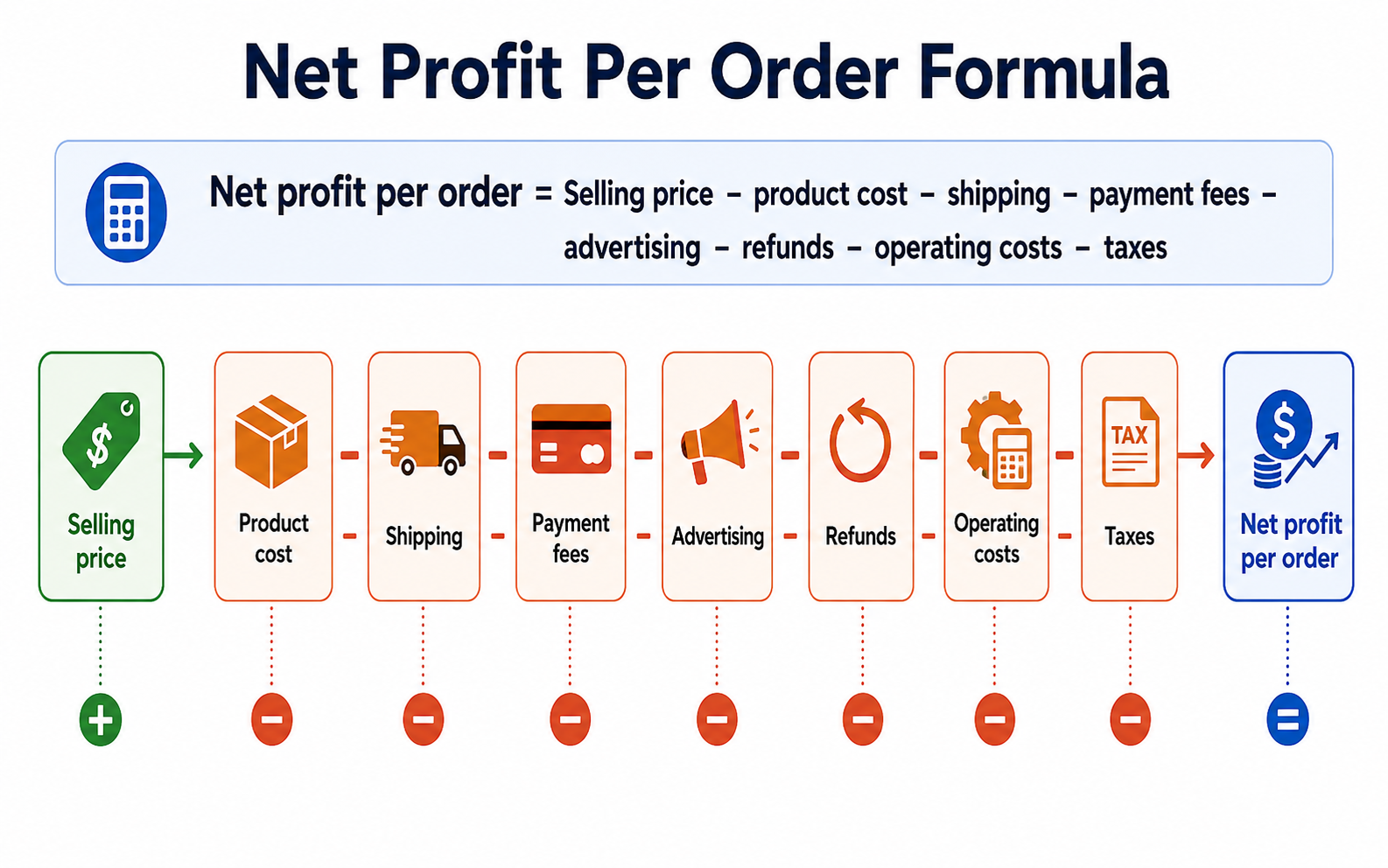
The difference between the retail price and the supplier price is not final profit.
Every order may also include:
- Shipping fees
- Payment processing
- Currency conversion
- Advertising
- Software
- Customer support
- Refunds
- Replacements
- Chargebacks
- Taxes
- Customs duties
A product with a large markup can still produce a low profit.
Profit Example
Imagine that a dropshipper sells a product for $49.
The product costs $14. Shipping costs $6. The payment fee is $1.47. Advertising costs $12 per order. The business sets aside $2.50 for refunds and replacements. Software and customer support add another $3.
The calculation is:
$49 − $14 − $6 − $1.47 − $12 − $2.50 − $3 = $10.03
The estimated profit before tax is $10.03.
The profit margin is:
$10.03 ÷ $49 × 100 = 20.47%
The product appears to generate $35 when only the supplier price is considered.
However, the estimated profit falls to $10.03 after the other costs are included.
This is why dropshippers should calculate the complete cost before launching advertising.
Break-Even Customer Acquisition Cost
Customer acquisition cost is the amount spent to acquire one new customer.
Use this formula:
Customer acquisition cost = Total marketing spend ÷ Number of new customers
Break-even customer acquisition cost is the highest amount the business can spend on advertising before an order becomes unprofitable.
Suppose an order produces $20 after product, shipping, payment, and refund costs.
The break-even acquisition cost is $20.
Spending $25 to acquire the customer would create a $5 first-order loss.
The store may recover that amount through repeat purchases, subscriptions, or upsells. However, these future purchases should be supported by actual customer data.
Do not assume every customer will return.
Contribution Margin
Contribution margin is the money remaining after variable costs.
Variable costs may include:
- Product cost
- Shipping
- Advertising
- Payment processing
- Packaging
- Refunds
- Replacements
Contribution margin shows whether each additional order contributes money toward fixed costs and profit.
A store can generate high revenue while losing money.
For example, a business may produce $100,000 in monthly sales. If its total costs reach $110,000, the business has lost $10,000.
Dropshippers should track profit per delivered order, not only revenue per order placed.
Cash-Flow Management
Profit and cash flow are different.
A supplier may require immediate payment. An advertising platform may also charge the store before the payment processor releases all customer funds.
Refunds and payment reserves can create additional delays.
A fast-growing store may be profitable on paper but still lack enough cash to pay suppliers.
A drop shipper should forecast:
- Supplier payments
- Advertising charges
- Payment processor payouts
- Refund requests
- Chargebacks
- Software subscriptions
- Tax payments
Keep a cash reserve instead of using the full budget for advertisements.
Suggested visual: Create a waterfall chart showing how a $49 sale becomes $10.03 in estimated profit after each cost is deducted.
What Costs Should a Dropshipper Expect?
Store Setup
Common setup costs include:
- Domain registration
- Ecommerce platform
- Store design
- Theme
- Business email
- Payment setup
- Analytics tools
- Legal pages
A beginner does not need an expensive custom website. The store should be clear, fast, mobile-friendly, and trustworthy.
Product Validation
Product validation may require:
- Product samples
- Test orders
- Shipping tests
- Product photography
- Video production
- Quality inspections
These costs help prevent larger losses later.
Spending money on a sample is usually less expensive than refunding dozens of customers because the product was never tested.
Marketing Expenses
Marketing costs may include:
- Paid advertising
- Influencer fees
- Affiliate commissions
- Product samples for creators
- Content production
- Email software
- SEO tools
New sellers should set a fixed testing budget.
Do not keep increasing advertising spend without understanding the conversion rate and profit per order.
Hidden Operating Costs
Dropshippers often underestimate:
- Refunds
- Reshipments
- Lost parcels
- Payment disputes
- Currency conversion
- Customer support
- App subscriptions
- Tax preparation
- Customs duties
A 90-day operating budget is more useful than calculating only the website and product costs.
How Do You Find Reliable Dropshipping Suppliers?
Supplier Evaluation
Evaluate suppliers based on:
- Product quality
- Inventory accuracy
- Processing speed
- Shipping options
- Tracking reliability
- Communication
- Problem resolution
- Packaging
- Return procedures
- Total landed cost
Total landed cost includes the product, shipping, fees, and applicable duties.
A product with a lower supplier price may still cost more after delivery problems and refunds are included.
Supplier Questions
Ask potential suppliers:
- Is the product physically in stock?
- How often is inventory updated?
- What is the average processing time?
- What is the maximum processing time?
- Which shipping options are available?
- How quickly is tracking uploaded?
- What happens when a parcel is lost?
- Who pays for damaged products?
- Can unrelated invoices be removed?
- Can third-party branding be removed?
- Are product certificates available?
- Is custom packaging available?
- Can inventory be stored locally?
- Is there a local return address?
- Can the supplier handle seasonal volume?
- Is quality inspection available?
A reliable supplier should provide clear and specific answers.
Sample Testing
Order samples from at least two suppliers when possible.
Use the same shipping route that real customers will use.
Review:
- Processing time
- Tracking speed
- Delivery time
- Product quality
- Package condition
- Product accuracy
- Instructions
- Labels
- Missing parts
- Supplier branding
Save the order date, shipping date, first tracking update, and delivery date.
This information will help you write accurate delivery estimates.
Backup Planning
A dropshipper should avoid depending completely on one supplier.
Suppliers can experience:
- Factory delays
- Inventory shortages
- Quality changes
- Carrier problems
- Holiday closures
- Sudden price increases
Important products should have a backup supplier or alternative shipping method.
How Can CJdropshipping Support Dropshippers?
Product Sourcing
Dropshippers may find a product online but struggle to locate a suitable supplier.
CJdropshipping provides product sourcing, store integration, order management, fulfillment, shipping, and related services for ecommerce sellers. Its official platform overview describes support for product sourcing, store connections, automatic product connections, order handling, and bulk inventory purchasing.
When a product is not available in the existing catalog, sellers can submit a request through the CJdropshipping sourcing service.
The request can include:
- A product link
- A product image
- A competitor listing
- Product specifications
- Material requirements
- Color options
- Packaging requirements
CJ’s sourcing page states that sellers can submit links, images, and product descriptions when requesting items that are not already available on the platform.
A sourcing result should still be reviewed carefully.
Check:
- Product specifications
- Materials
- Size
- Colors
- Processing time
- Shipping methods
- Packaging
- Quality standards
- Total cost
Store Integration
Connecting a store to a fulfillment platform can reduce manual work.
CJdropshipping’s platform overview lists integrations with platforms such as Shopify, WooCommerce, TikTok, eBay, Etsy, Wix, Magento, BigCommerce, and others.
Integration can support:
- Product listing
- Product connection
- Order syncing
- Tracking updates
- Inventory management
- Fulfillment processing
Automation should be monitored. Incorrect product connections or variations can still cause fulfillment errors.
Fulfillment and Branding
Dropshippers who already have inventory can also use CJdropshipping’s 3PL fulfillment service.
The service page describes options for storing products, processing orders, custom labeling, thank-you cards, and branded packaging.
These services may become useful after a product has proven demand.
A practical progression is:
Test through dropshipping → Validate demand → Purchase inventory → Improve packaging → Use warehouse fulfillment
This gives the seller more control over delivery speed, branding, and product availability.
CJdropshipping should be evaluated in the same way as any other supplier or fulfillment partner. Test the specific product, warehouse, shipping route, and destination before scaling.
How Do You Find Products to Sell?
Demand Signals
Use several demand signals instead of relying on one tool.
Useful sources include:
- Search trends
- Keyword volume
- Marketplace sales
- Customer reviews
- Social media comments
- Competitor advertisements
- Community discussions
- Price history
Strong demand is useful, but it does not guarantee profit.
The product must also have workable shipping, acceptable quality, and enough margin.
Review Analysis
Customer reviews reveal opportunities.
Positive reviews show what customers value. Negative reviews show what customers want improved.
Look for repeated complaints about:
- Poor packaging
- Missing instructions
- Incorrect sizing
- Cheap materials
- Slow delivery
- Missing accessories
- Difficult installation
- Misleading photos
A dropshipper may improve the offer by:
- Choosing a better supplier
- Adding clear instructions
- Including a sizing guide
- Producing an installation video
- Adding a useful accessory
- Improving packaging
- Setting more accurate expectations
Margin Screening
Before listing a product, estimate:
- Product cost
- Shipping
- Payment fees
- Advertising
- Refund allowance
- Customer support
- Software
- Taxes and duties
Do not choose a product that only becomes profitable under perfect conditions.
The margin should allow for normal problems.
Compliance Screening
Check whether the product requires:
- Safety certificates
- Warning labels
- Local-language instructions
- Battery documentation
- Import permits
- Trademark authorization
- Age restrictions
- Advertising approval
Higher-risk categories include supplements, cosmetics, children’s products, electronics, batteries, medical items, and protective equipment.
How Do You Start as a Dropshipper in 2026?
Niche Selection
Start with a specific customer group rather than a general store containing unrelated products.
Examples include:
- Apartment pet owners
- Remote workers
- Frequent travelers
- Home fitness beginners
- New parents
- Beauty professionals
- Outdoor hobbyists
- Home organization customers
A focused niche makes product selection and marketing easier.
Product Validation
Choose several product ideas and compare:
- Demand
- Competition
- Supplier price
- Retail price
- Shipping cost
- Delivery time
- Return risk
- Product restrictions
Order samples before making a final decision.
Store Setup
Create a simple and trustworthy store.
Include:
- Accurate product information
- Clear contact details
- Original images or videos
- Shipping policy
- Return and refund policy
- Privacy policy
- Terms and conditions
- Secure checkout
- Order tracking
- Product FAQs
The store should clearly explain what the customer is buying and when it should arrive.
Controlled Launch
Choose one main marketing channel.
Set a fixed test budget and define success before launching.
Track:
- Click-through rate
- Add-to-cart rate
- Checkout rate
- Conversion rate
- Cost per purchase
- Average order value
- Contribution margin
- Refund requests
- Delivery performance
- Customer questions
The first test should collect information. It does not need to generate large revenue.
Performance Review
Review results after enough orders have been delivered.
Early sales do not include future refunds, shipping complaints, or chargebacks.
A product should not be scaled until:
- Quality is stable
- Delivery is reliable
- Tracking works
- Customer questions are manageable
- Profit remains positive after refunds
- The supplier can handle more volume
What Are the Advantages and Risks?
Main Advantages
Dropshipping can offer:
- Lower upfront inventory requirements
- Faster product testing
- Wider product selection
- Lower warehouse costs
- Easier market entry
- Flexible fulfillment options
A store can test a product before purchasing it in bulk.
Successful products can later be moved into local inventory.
Main Risks
Common risks include:
- Limited quality control
- Supplier dependence
- Inventory changes
- Shipping delays
- Price competition
- Complicated returns
- Low margins
- Cash-flow pressure
- Brand reputation damage
Dropshipping reduces inventory risk but creates more supplier and fulfillment risk.
Risk Controls
Dropshippers can reduce risk by:
- Ordering samples
- Testing shipping routes
- Keeping backup suppliers
- Monitoring inventory
- Using realistic delivery estimates
- Keeping a refund reserve
- Tracking defect rates
- Reviewing complaints
- Avoiding restricted products
- Pre-stocking winning products
How Can a Dropshipper Scale?
Winning Product Validation
Do not scale a product based only on early sales.
Wait until enough orders have been delivered.
Review:
- Delivered-order profit
- Refund rate
- Defect rate
- Delivery time
- Support tickets
- Customer reviews
- Repeat purchases
A profitable advertisement does not compensate for poor product quality or unreliable shipping.
Local Inventory
Once demand becomes stable, consider buying inventory in bulk.
Local or regional inventory can improve:
- Delivery speed
- Inventory control
- Packaging consistency
- Customer satisfaction
- Shipping cost
- Return handling
Do not purchase large quantities until demand is supported by real sales data.
Brand Development
Create value beyond access to the product.
A dropshipper can differentiate through:
- Original photos and videos
- Better instructions
- Product bundles
- Custom packaging
- Branded inserts
- Faster support
- Local returns
- Product improvements
- Educational content
The long-term goal is to give customers a reason to choose the store instead of the cheapest competitor.
What Rules Should Dropshippers Understand?
Shipping Promises
In the United States, sellers must have a reasonable basis for the shipping time they advertise.
When no shipping time is provided, the FTC rule generally requires sellers to have a reasonable basis to expect shipment within 30 days. When the seller cannot ship within the promised period, it must obtain the customer’s agreement to the delay or refund the unshipped order.
A dropshipper should verify:
- Supplier processing time
- Carrier transit time
- Tracking speed
- Peak-season performance
- Destination-specific delays
Separate processing time from shipping time.
For example:
- Processing time: 1–3 business days
- Shipping time: 5–8 business days
- Estimated delivery time: 6–11 business days
Marketplace Policies
Amazon explains that a dropshipping seller should remain the seller of record and accept responsibility for the sale. The seller sets the price, records the revenue, and manages its responsibilities as the retailer.
Marketplace policies can change.
Review current requirements before listing products on Amazon or another marketplace.
Product Safety
A dropshipper may still be responsible for product safety, warnings, labels, and compliance.
Do not assume that a supplier’s product is automatically legal in every country.
Review the requirements of the target market and seek professional advice for regulated products.
How Large Is the Ecommerce Opportunity in 2026?
Current Market Data
The U.S. Census Bureau estimated seasonally adjusted U.S. retail ecommerce sales at $326.7 billion in the first quarter of 2026.
This was 9.8% higher than the first quarter of 2025. Ecommerce represented 16.9% of total U.S. retail sales during the quarter.
These figures show that online shopping remains an important retail channel.
However, market growth does not guarantee that every dropshipper will succeed.
Each store still needs:
- A useful product
- Reliable suppliers
- Healthy margins
- Clear positioning
- Accurate delivery promises
- Effective marketing
- Responsive customer service
Suggested visual: Create an original chart showing Q1 2026 U.S. ecommerce sales of $326.7 billion and ecommerce’s 16.9% share of total retail sales. Credit the U.S. Census Bureau.
How Can You Follow a 30-Day Launch Plan?
Week 1: Market Research
Choose one target customer.
Identify ten product ideas. Review demand, competition, shipping, restrictions, and estimated profit.
Select three products for deeper research.
Week 2: Supplier Testing
Contact several suppliers.
Order samples. Test shipping routes. Confirm processing, tracking, packaging, replacement, and return policies.
Remove products that fail the quality or margin test.
Week 3: Store Development
Create a focused product page.
Produce original images and videos. Calculate the selling price and break-even customer acquisition cost.
Publish clear shipping and return policies.
Set up tracking, analytics, and customer emails.
Week 4: Controlled Launch
Launch through one marketing channel with a fixed budget.
Measure:
- Conversion
- Acquisition cost
- Contribution margin
- Supplier performance
- Delivery
- Customer feedback
At the end of the month, choose one action:
- Stop because the economics do not work
- Continue testing because more data is needed
- Scale gradually because profit and fulfillment are stable
Stopping a weak product is not a failure. It protects time and capital.
What Is the Bottom Line?
A dropshipper is an online retailer that sells products while a third-party supplier stores, packs, and ships the orders.
The model can reduce upfront inventory costs and make product testing easier. However, it does not remove the responsibilities of running an ecommerce business.
A drop shipper still manages:
- Product research
- Supplier selection
- Pricing
- Marketing
- Customer acquisition
- Order monitoring
- Customer service
- Refunds
- Compliance
- Brand reputation
Successful dropshippers do not treat dropshipping as a shortcut.
They order samples, calculate every cost, test suppliers, communicate realistic delivery times, and measure profit per delivered order.
Once a product has proven demand, the seller can negotiate better costs, improve packaging, add branding, and move inventory closer to customers.
This is how dropshipping can develop from a product-testing method into a sustainable ecommerce business.
FAQ
Is a dropshipper the same as a supplier?
No. The dropshipper sells the product and manages the customer relationship. The supplier stores, sources, or ships the product on behalf of the retailer.
How do dropshippers make money?
Dropshippers keep the amount remaining after product costs, shipping, advertising, payment fees, refunds, software, taxes, and other operating expenses are deducted from revenue.
How much money does a dropshipper need to start?
There is no fixed amount. Common costs include a domain, ecommerce platform, product samples, marketing, software, customer support, and a refund reserve. A 90-day budget is more useful than calculating only the website cost.
Is dropshipping legal?
Dropshipping is generally a legal fulfillment method. Sellers must still comply with product safety, consumer protection, tax, customs, advertising, privacy, and marketplace requirements.
Can a dropshipper use CJdropshipping?
Yes. Sellers can use CJdropshipping for product sourcing, store connections, order syncing, fulfillment, international shipping, custom packaging, and warehouse services.
How long does it take to become profitable?
There is no guaranteed timeline. Profitability depends on product selection, supplier performance, pricing, marketing costs, conversion rates, shipping, refunds, and customer retention.