
Dropshipping has always looked deceptively simple from the outside: build a store, list products, find customers, and let a supplier handle fulfillment.
That description is technically correct. It is also incomplete.
The real advantages and disadvantages of dropshipping only become clear when orders begin arriving. The model removes much of the capital tied up in inventory, warehousing, and fulfillment infrastructure, but in exchange, the seller gives up some control over stock, product quality, packing, and delivery.
That trade-off matters even more in 2026.
Online retail is still expanding. U.S. Census Bureau data shows that seasonally adjusted U.S. e-commerce sales reached $326.7 billion in the first quarter of 2026, up 9.8% from a year earlier. E-commerce represented 16.9% of total U.S. retail sales during the quarter.
Yet selling online has also become less forgiving. Customers compare prices instantly, expect clearer delivery promises, abandon stores with weak fulfillment options, and return a meaningful share of what they buy.
So the question is no longer simply:
“Is dropshipping easy to start?”
A better question is:
“Can dropshipping create a profitable and defensible e-commerce business for the type of store I want to build?”
The answer is yes—but only if you understand where the model is strong, where it is weak, and how to manage those weaknesses as the business grows.
What Is Dropshipping?
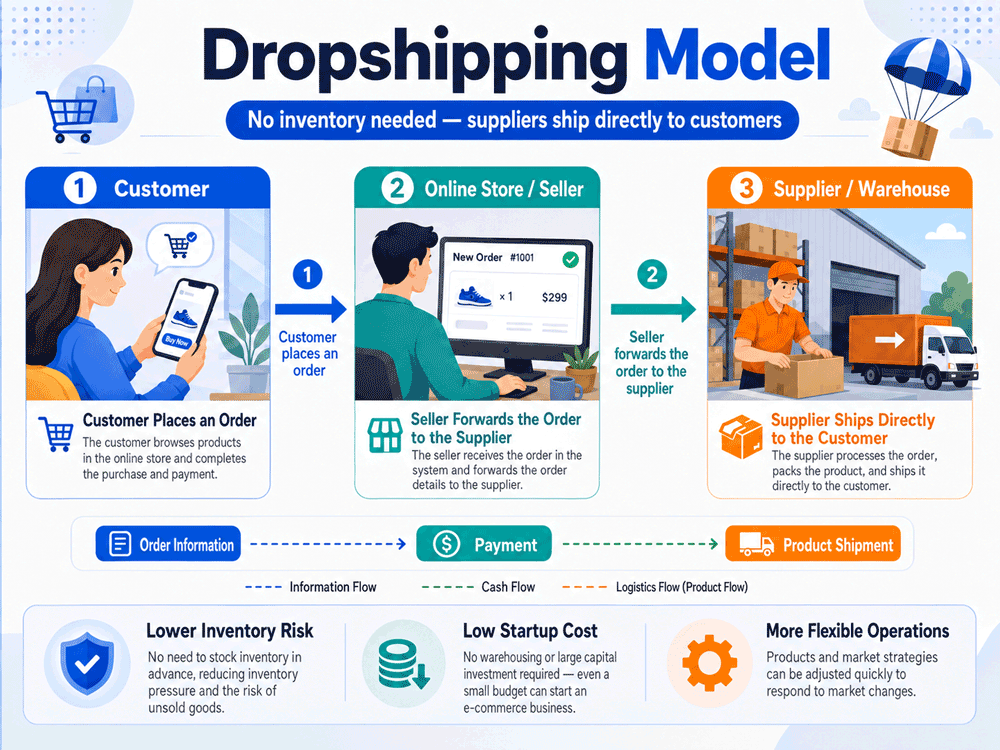
Dropshipping is a retail fulfillment model in which the seller markets products and accepts customer orders without keeping all of those products physically in stock.
The basic process looks like this:
-
The seller lists a product in an online store.
-
A customer places and pays for an order.
-
The order information is sent to the supplier or fulfillment partner.
-
The supplier picks, packs, and ships the product.
-
The seller remains responsible for the customer's overall shopping experience.
That last point is important.
The supplier may ship the parcel, but from the customer's perspective, your store made the promise.
If the wrong product arrives, the parcel is delayed, or tracking does not update, the customer contacts you—not the factory.
Shopify identifies lower margins, inventory volatility, and shipping complexity among the core drawbacks of the dropshipping model, particularly when sellers depend on multiple suppliers or cross-border fulfillment.
This is why supplier selection is not simply a purchasing decision. It is part of customer experience management.
Advantages of Dropshipping
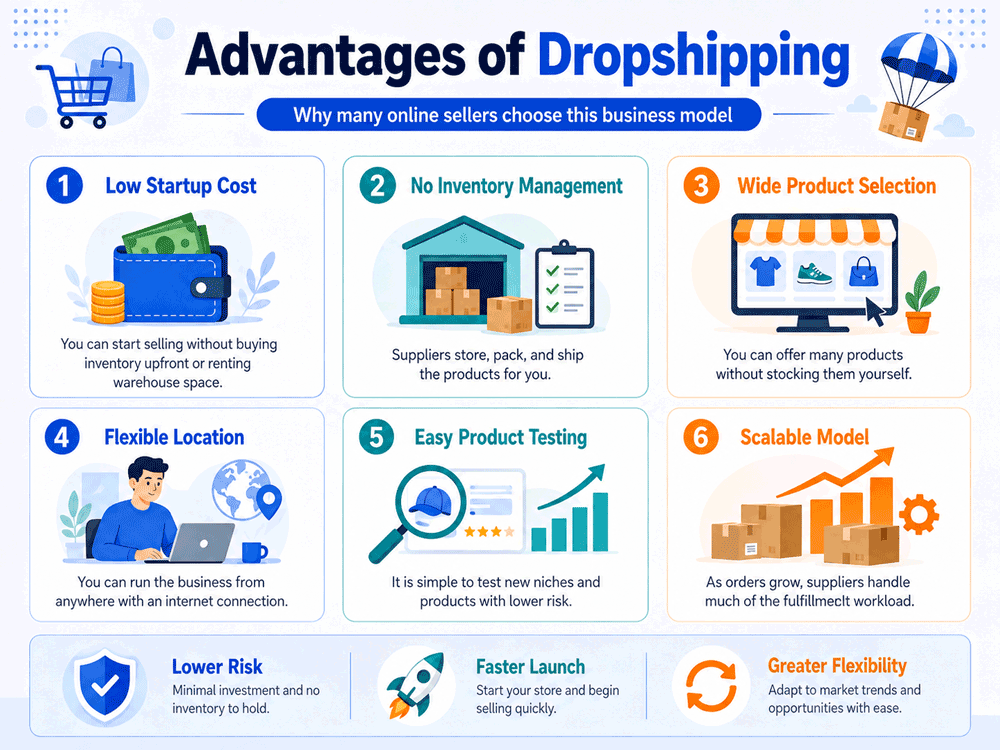
1. Lower Upfront Inventory Investment
The most obvious advantage of dropshipping is that you do not have to purchase hundreds or thousands of units before you know whether customers actually want them.
Traditional retail often works like this:
Buy inventory → store inventory → market inventory → hope it sells.
Dropshipping changes the sequence:
Market product → receive order → fulfill order.
That difference can dramatically reduce the amount of capital required to test a new product.
Imagine you want to test a kitchen accessory that costs $8 per unit.
Buying 500 units would immediately require $4,000 in product inventory before freight, warehousing, packaging, advertising, or payment fees.
With dropshipping, you can first test whether customers will buy the product.
That does not make product testing free—you may still spend money on store development, samples, creative production, apps, advertising, and customer acquisition—but it reduces one of the largest traditional retail risks: paying for inventory before validating demand.
For entrepreneurs operating with limited capital, that is a meaningful advantage.
2. Less Risk of Being Stuck With Unsold Inventory
Inventory is an asset when it sells.
When it does not sell, it becomes a problem.
A retailer that buys 2,000 units of a trending product must eventually sell those units, discount them, liquidate them, or absorb the loss.
The risk becomes even greater with:
-
seasonal products;
-
fast-changing trends;
-
fashion items;
-
holiday merchandise;
-
products tied to short social-media trends.
Dropshipping allows sellers to test these categories without committing to the same level of stock.
Suppose a product performs well on TikTok for three weeks and then interest collapses.
A traditional seller may still have hundreds of units in a warehouse.
A dropshipper can often stop marketing the product and move on.
This flexibility is one of the reasons dropshipping works particularly well as a product-validation model.
3. You Do Not Need to Operate Your Own Warehouse
Warehousing sounds straightforward until you actually have to manage it.
Running an internal fulfillment operation can involve:
-
storage space;
-
shelves and bins;
-
receiving inventory;
-
stock counting;
-
warehouse software;
-
picking;
-
packing;
-
packaging materials;
-
shipping labels;
-
carrier collection;
-
damaged inventory;
-
warehouse employees;
-
returns processing.
Dropshipping transfers much of this physical infrastructure to the supplier or fulfillment partner.
For a small e-commerce company, that can make the organization considerably leaner.
Instead of spending the first months building logistics infrastructure, the seller can focus more resources on:
-
product research;
-
website conversion;
-
content;
-
advertising;
-
customer acquisition;
-
customer service;
-
merchandising.
This does not mean logistics stop mattering.
It means you are managing logistics through partners instead of owning the entire logistics operation yourself.
That distinction becomes important as the business scales.
4. Products Can Be Tested Much Faster
One of dropshipping's strongest advantages is not simply low cost.
It is speed of experimentation.
A seller can test different:
-
products;
-
niches;
-
offers;
-
price points;
-
landing pages;
-
advertising hooks;
-
countries;
-
audiences;
-
bundles.
without purchasing a large quantity of every product first.
Consider two stores.
Store A buys 1,000 units of one product because the owner believes it will become a winner.
Store B tests five products with relatively limited inventory exposure and collects real conversion data before committing further capital.
Store B may discover that the product everyone expected to win performs poorly, while an overlooked product has a much stronger conversion rate.
That information has value.
Successful e-commerce is often less about predicting perfectly and more about creating an inexpensive system for discovering what customers actually want.
Dropshipping can provide that system.
5. A Large Product Catalog Is Possible Without Matching Warehouse Space
In traditional retail, every new SKU creates inventory requirements.
More SKUs usually mean more:
-
capital;
-
storage;
-
receiving work;
-
stock forecasting;
-
inventory management.
Dropshipping weakens that relationship.
A seller can introduce new product categories without physically allocating warehouse shelves to every item.
This is particularly useful for stores that want to test related products around an existing niche.
A pet store selling dog walking accessories, for example, could test:
-
harnesses;
-
portable water bottles;
-
paw cleaners;
-
dog raincoats;
-
travel bowls;
-
car seat covers.
The seller does not necessarily have to buy cartons of every item first.
But there is an important distinction:
Catalog scalability is not the same as business scalability.
Adding 100 products is easy.
Getting the right customers to buy those products profitably is much harder.
A huge catalog with poor merchandising can actually make a store weaker.
6. Dropshipping Offers Geographic Flexibility
A dropshipping business does not normally require the owner to be physically present in a warehouse every day.
Many core activities can be managed online:
-
reviewing orders;
-
communicating with suppliers;
-
checking advertising;
-
answering customers;
-
managing content;
-
analyzing conversion data;
-
adjusting prices;
-
researching products.
This gives operators more geographic flexibility than many traditional retail businesses.
However, the phrase “location-independent business” is sometimes misunderstood.
Location independence does not mean effort independence.
Customer messages still need replies. Supplier problems still need solutions. Advertising still needs optimization. Finance still needs management.
You may be able to manage the business from another city or country, but you still have to manage it.
7. It Can Make Market Expansion Easier to Test
Suppose your main customer base is in the United States, but you believe one of your products could also perform in Germany, France, or the United Kingdom.
With traditional inventory, entering a new market may require additional stock placement and logistics planning before demand is clear.
Dropshipping can make the first stage of geographic testing more flexible.
You can evaluate:
-
customer acquisition cost;
-
conversion rate;
-
shipping cost;
-
delivery performance;
-
refund rate;
-
local pricing;
-
product-market fit;
before making a larger local inventory commitment.
This is particularly valuable because cross-border demand exists, but logistics can strongly affect conversion.
DHL's 2026 e-commerce research shows that 57% of global shoppers say free delivery would encourage them to purchase from international retailers, while 31% say delivery by a trusted provider would encourage cross-border purchases.
In other words, geographic reach is an opportunity—but fulfillment quality determines how much of that opportunity can actually be converted into sales.
8. Dropshipping Is an Effective Product-Validation Model
This may be the most strategically important advantage.
Dropshipping does not have to be the final form of an e-commerce business.
It can be the first stage.
A more mature path looks like this:
Dropshipping → Validate Demand → Buy Inventory → Improve Fulfillment → Add Branding → Scale
Imagine that you test a product and reach stable sales of 20 orders per day.
At that point, continuing to buy one unit at a time may no longer be optimal.
You can compare the economics of purchasing inventory in bulk.
Bulk purchasing may provide:
-
better product pricing;
-
more stable inventory;
-
better packaging options;
-
faster processing;
-
local warehouse opportunities.
This creates a hybrid model that combines the lower-risk testing advantages of dropshipping with the operational advantages of inventory ownership.
For many serious sellers, this is a much stronger strategy than insisting that every product must remain pure dropshipping forever.
Disadvantages of Dropshipping
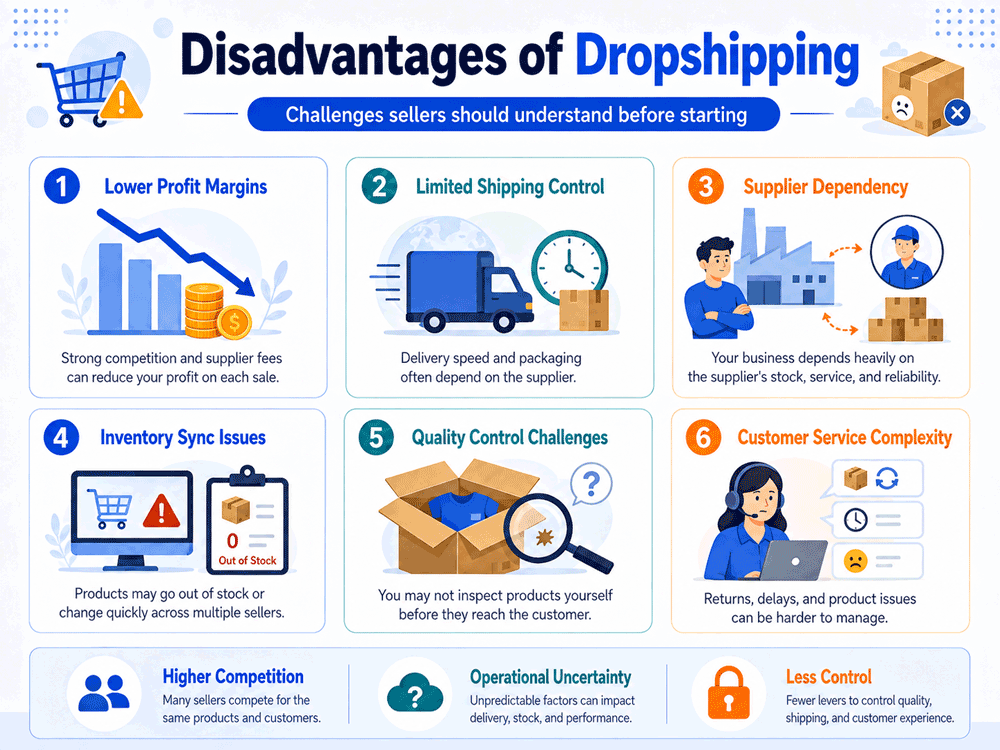
The strengths of the model are real.
So are the weaknesses.
Most dropshipping failures occur when sellers understand the advantages but design their businesses as though the disadvantages do not exist.
1. Profit Margins Can Be Thin
Dropshipping reduces inventory risk, but that benefit often comes at a cost.
Buying products individually or in small quantities usually gives you less purchasing power than buying large quantities directly from a manufacturer.
Meanwhile, the selling price is only one side of the equation.
A useful profitability calculation is:
Contribution Profit = Selling Price − Product Cost − Shipping − Payment Fees − Advertising Cost − Refund/Return Cost
Consider a hypothetical order:
| Cost Item | Amount |
|---|---|
| Selling Price | $39.99 |
| Product Cost | $9.00 |
| Shipping | $6.50 |
| Payment/Platform Fees | $1.50 |
| Customer Acquisition Cost | $12.00 |
| Estimated Returns/Support Cost | $2.00 |
| Contribution Profit | $8.99 |
The store generated almost $40 in revenue.
It did not generate $40 in profit.
And that $8.99 still may need to contribute toward software, salaries, taxes, creative production, chargebacks, and other overhead.
This is why successful dropshipping is often a unit-economics game.
A product with an attractive retail price can still be a poor business if shipping and acquisition costs consume the margin.
Shopify likewise identifies lower margins as one of the central drawbacks of dropshipping, noting that accessibility can create pricing competition between sellers offering similar products.
2. You Have Less Direct Control Over Product Quality
When you do not physically touch every item before it reaches the customer, you are relying on someone else's quality-control process.
Potential problems include:
-
incorrect colors;
-
manufacturing defects;
-
inconsistent materials;
-
damaged products;
-
wrong variants;
-
poor packaging;
-
differences between supplier photos and the actual item.
The first defense is simple:
Order a sample.
Do not build a serious advertising campaign around a product you have never seen when quality materially affects the buying experience.
A sample allows you to inspect:
-
material;
-
dimensions;
-
color;
-
functionality;
-
packaging;
-
instructions;
-
delivery time.
It also gives you an opportunity to create original photography and video instead of using the same supplier assets as every other store.
Once sales increase, quality-control procedures should become more formal.
3. Shipping Can Decide Whether the Store Converts
Shipping is no longer something customers consider after buying.
It affects whether they buy at all.
DHL's 2026 global e-commerce research found that 67% of shoppers have abandoned an online purchase because the available delivery offering did not meet their expectations. The same research found that 76% would not purchase from an online retailer if they did not trust the delivery or returns provider.
Those numbers are especially relevant to dropshipping.
If competitors can deliver in three days and your product takes two or three weeks, you need a strong reason for customers to choose you.
Sometimes that reason exists:
-
a unique product;
-
a lower price;
-
better customization;
-
stronger content;
-
unavailable local inventory.
Sometimes it does not.
The solution is not to hide delivery time.
That usually creates the second problem: customer complaints after purchase.
A better approach is to evaluate shipping before listing the product.
Ask:
-
Which warehouse holds the product?
-
What shipping methods are available?
-
What is the expected delivery range?
-
Is tracking reliable?
-
What happens during peak season?
-
What is the total landed cost?
-
Is there a faster local-warehouse option?
Delivery should be treated as part of the product offer, not an administrative detail.
4. Supplier Inventory Can Change Unexpectedly
One of the attractive features of dropshipping is that you do not own the inventory.
One of the dangerous features of dropshipping is also that you do not own the inventory.
A supplier may be serving multiple merchants.
A product showing 800 units today may have very different availability tomorrow.
Shopify highlights this inventory volatility as a structural disadvantage of dropshipping because suppliers may fulfill orders for several retailers simultaneously, causing availability to change unexpectedly.
This becomes especially painful after an advertisement starts working.
Imagine spending a week optimizing a campaign until it finally becomes profitable.
Then the supplier runs out of the best-selling color.
Your choices may include:
-
stopping the campaign;
-
switching suppliers;
-
delaying orders;
-
persuading customers to select another variant;
-
issuing refunds.
None is ideal.
For proven products, private or pre-stocked inventory can substantially reduce this risk.
5. Competition Can Be Intense
The same low barrier to entry that helps you start also helps everyone else start.
If a supplier has a popular product, dozens—or hundreds—of stores may discover it.
Competition becomes particularly difficult when sellers use:
-
identical photos;
-
identical product descriptions;
-
identical product titles;
-
identical ad concepts;
-
identical offers.
At that point, price becomes one of the few remaining differences.
That is rarely a strong position.
The more sustainable alternative is to differentiate the offer, not just the product.
That can include:
-
better creative;
-
better product education;
-
bundles;
-
stronger guarantees;
-
niche positioning;
-
faster delivery;
-
better support;
-
branded packaging;
-
exclusive product variations.
A portable dog water bottle can be a commodity.
A thoughtfully positioned “Weekend Hiking Kit for Small Dogs” containing the bottle, collapsible bowl, and travel pouch is a different offer.
The underlying products may still be available elsewhere, but the merchandising becomes harder to copy.
6. The Seller Carries the Reputation Risk
A dropshipping supplier may pack the parcel.
The customer usually does not care.
They purchased from your store.
If something goes wrong, your brand receives the:
-
complaint;
-
chargeback;
-
negative review;
-
refund request;
-
support ticket.
This creates an unusual risk allocation.
You outsource execution, but not responsibility.
That is why the cheapest supplier is often not the most profitable supplier.
Suppose Supplier A saves $1.20 per order but produces more wrong-item shipments and delivery complaints.
Supplier B costs slightly more but delivers reliably.
Once refunds, support labor, payment disputes, and reputation are considered, Supplier B may have substantially better economics.
Supplier evaluation should therefore include total operating cost, not only unit price.
7. Returns Can Be More Complicated Than Sellers Expect
Returns are often treated as a minor detail when building a dropshipping store.
They should not be.
The National Retail Federation's 2025 Retail Returns Landscape estimated that 19.3% of online sales would be returned, while 82% of consumers said free returns were an important consideration when shopping online.
The exact return rate of an individual dropshipping store will vary significantly by category, product quality, fit, customer expectations, and policy.
But the broader point is clear:
Returns are part of online retail economics.
In dropshipping, the process can involve several parties:
Customer → Seller → Supplier → Warehouse/Carrier
Questions quickly appear:
Where should the customer return the item?
Who pays the return shipping?
Is a return economically sensible for a low-value product?
Can the supplier replace the item?
What evidence is required for damage claims?
How quickly will the customer receive a refund?
A store needs answers before the first return happens.
Not after.
8. Branding Is Harder With Generic Fulfillment
Dropshipping stores often struggle when they try to build a premium brand using a completely generic fulfillment experience.
The customer may receive:
-
an unbranded mailer;
-
generic packaging;
-
no insert;
-
no brand story;
-
no reason to remember the store.
This is acceptable during early product testing.
It becomes more limiting once the product is validated.
A seller spending heavily on brand design, premium photography, and paid acquisition should eventually ask:
Does the parcel customers receive look like it came from the same company they saw online?
If the answer is no, there is room to improve.
Branding can gradually evolve through:
-
logo stickers;
-
thank-you cards;
-
custom mailers;
-
branded boxes;
-
product inserts;
-
private labels;
-
customized products.
The important word is gradually.
You do not necessarily need expensive custom manufacturing before proving demand.
Advantages and Disadvantages of Dropshipping at a Glance
| Advantages | Disadvantages |
|---|---|
| Lower upfront inventory investment | Potentially thinner margins |
| Reduced unsold-stock risk | Less direct quality control |
| No need to operate your own warehouse | Shipping can be slower or more complex |
| Faster product testing | Supplier inventory can fluctuate |
| Easier catalog expansion | Low barriers create competition |
| Geographic flexibility | Seller carries customer-facing responsibility |
| Easier market testing | Returns can be complicated |
| Useful for product validation | Generic fulfillment can weaken branding |
The table makes the basic trade-off clear:
Dropshipping gives you flexibility by giving up control.
The goal of a mature dropshipping operation is to keep as much flexibility as possible while gradually regaining control where it matters most.
Is Dropshipping Profitable in 2026?
Yes, dropshipping can be profitable.
But the phrase “dropshipping is profitable” is not very useful by itself.
Restaurants can be profitable. Software companies can be profitable. Retail stores can be profitable.
That does not mean every restaurant, software company, or retail store makes money.
The business model creates a framework.
Execution determines the result.
For dropshipping, five numbers deserve particular attention.
1. Gross Margin Before Advertising
Calculate:
Selling Price − Product Cost − Shipping
If very little money remains before customer acquisition, the product will be difficult to scale.
2. Customer Acquisition Cost
If you earn $15 before advertising but spend $20 to acquire every customer, volume will make the problem larger rather than solving it.
3. Conversion Rate
Improving conversion allows the same advertising traffic to generate more sales.
Product page quality, pricing, reviews, delivery information, payment methods, and trust all influence this.
4. Average Order Value
A store does not have to rely entirely on raising prices.
Bundles, quantity breaks, complementary products, and upsells can increase revenue per customer.
5. Refund and Return Cost
Refunds should be included in financial planning rather than treated as exceptional accidents.
A product with strong front-end sales but a high complaint rate may be far less attractive than the advertising dashboard suggests.
A More Useful Profit Example
Suppose two stores sell the same $39.99 product.
Store A
Product + Shipping: $16
Advertising: $15
Fees/Support/Returns: $4
Contribution profit:
$39.99 − $16 − $15 − $4 = $4.99
Store B
Product + Shipping: $15
Advertising: $10
Fees/Support/Returns: $3
Contribution profit:
$39.99 − $15 − $10 − $3 = $11.99
Same product.
Same selling price.
Very different business.
This is why asking:
“What is a good dropshipping profit margin?”
is less valuable than understanding which operational lever is consuming your margin.
Who Is Dropshipping Good For?
Dropshipping can make sense for several types of sellers.
New E-commerce Entrepreneurs
The lower inventory commitment makes it possible to learn product research, store management, customer service, advertising, and fulfillment without immediately purchasing large amounts of stock.
Existing E-commerce Stores
A retailer can use dropshipping to test complementary categories before adding them to permanent inventory.
Content Creators
Creators with established audiences can test merchandise or niche products without initially building warehouse operations.
Sellers Entering New Markets
Dropshipping can help validate geographic demand before positioning stock locally.
Brands Testing New Products
Even established businesses can use a low-inventory model to gather demand signals before committing to larger production runs.
Who May Not Be a Good Fit for Dropshipping?
Dropshipping is not the right answer for every business.
It may be less suitable if your business requires:
-
extremely tight control over every package;
-
guaranteed same-day fulfillment;
-
highly specialized handling;
-
complex regulated products;
-
unusually high levels of product customization from the first order;
-
complete ownership of inventory availability.
There are also people for whom dropshipping is simply a poor personal fit.
If you dislike customer service, supplier communication, advertising analysis, and operational problem-solving, the fact that you do not own a warehouse will not make the business passive.
How to Reduce the Disadvantages of Dropshipping
The best dropshipping operators do not try to pretend the weaknesses do not exist.
They design around them.
Order Samples Before Scaling
A sample can reveal problems with:
-
quality;
-
dimensions;
-
instructions;
-
packaging;
-
shipping;
-
product photography.
Finding a problem before spending $5,000 on advertising is much cheaper than finding it afterward.
Use More Than Supplier Price to Choose Products
Evaluate:
Product Cost + Shipping + Reliability + Delivery Speed + Return Risk + Customer Support Burden
A slightly more expensive product may produce a healthier business if it generates fewer customer problems.
Use Accurate Delivery Expectations
Do not advertise a five-day delivery time when the realistic range is eight to twelve days.
DHL's 2026 findings show just how strongly delivery options affect online conversion, with 67% of global shoppers reporting that they had abandoned an online purchase because the delivery offer failed to meet expectations.
Clear expectations may reduce some impulse purchases.
They can also reduce disappointment after purchase.
Build Backup Supply Options
For important products, know what happens if the primary source becomes unavailable.
Can another supplier provide the product?
Can a similar SKU replace it?
Can inventory be pre-stocked?
A backup plan is especially important once a product becomes responsible for a significant share of revenue.
Move Winning Products Into Inventory
Do not treat inventory as the enemy.
Inventory is risky before demand is validated.
Once demand becomes predictable, inventory can become an advantage.
The question changes from:
“How do I avoid inventory?”
to:
“How much inventory can I hold safely based on real sales velocity?”
That is a much more mature question.
How CJdropshipping Can Help Reduce Common Dropshipping Problems
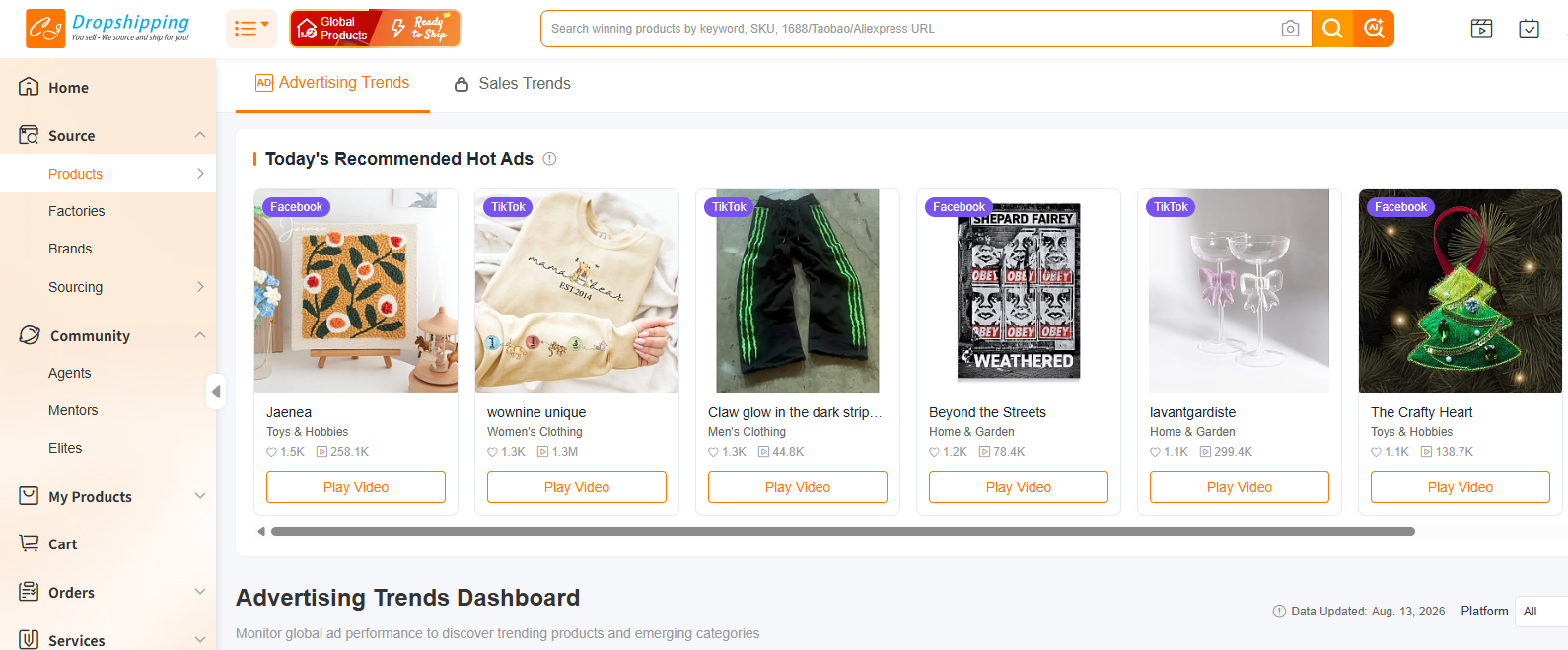
No fulfillment platform can remove every disadvantage of dropshipping.
But a more integrated supply chain can reduce some of the fragmentation that makes the model difficult to manage.
This is where CJdropshipping can fit into the process.
CJ combines product sourcing, store integration, order processing, shipping, wholesale purchasing, and warehousing within the same ecosystem. Its current platform supports store integrations including Shopify, WooCommerce, TikTok, eBay, Etsy, Wix, Magento, BigCommerce, and several other channels.
Product Sourcing
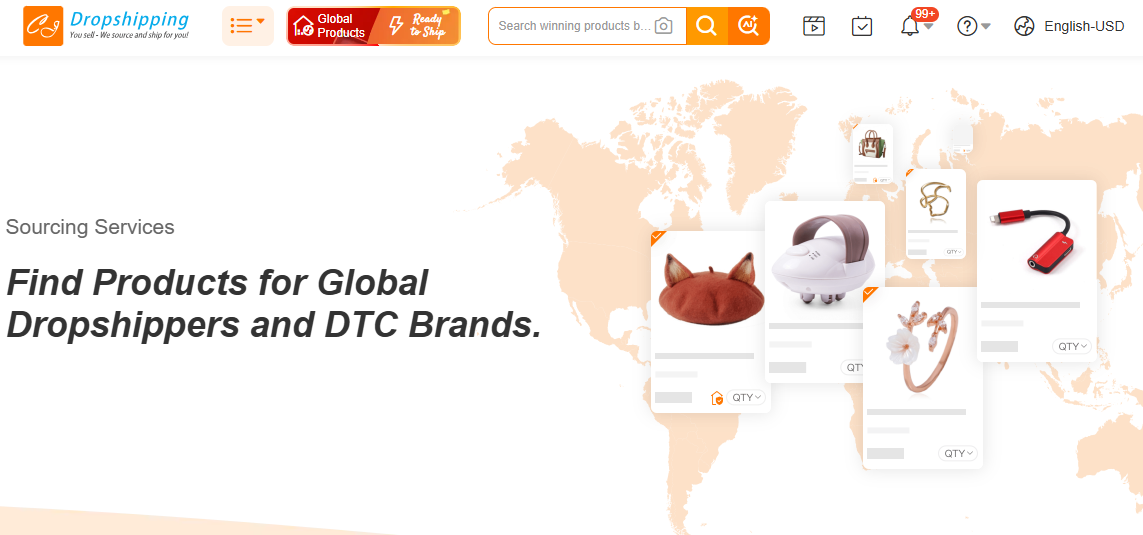
A seller does not necessarily need to limit the store to products already visible in the catalog.
CJ allows users to submit sourcing requests when they cannot find the exact product they want.
This becomes useful when you find a product concept from:
-
another supplier;
-
social media;
-
a competitor;
-
an offline market;
-
your own research.
Instead of rebuilding the entire supplier relationship manually, sourcing can become part of the same workflow used for fulfillment.
Store and Order Integration
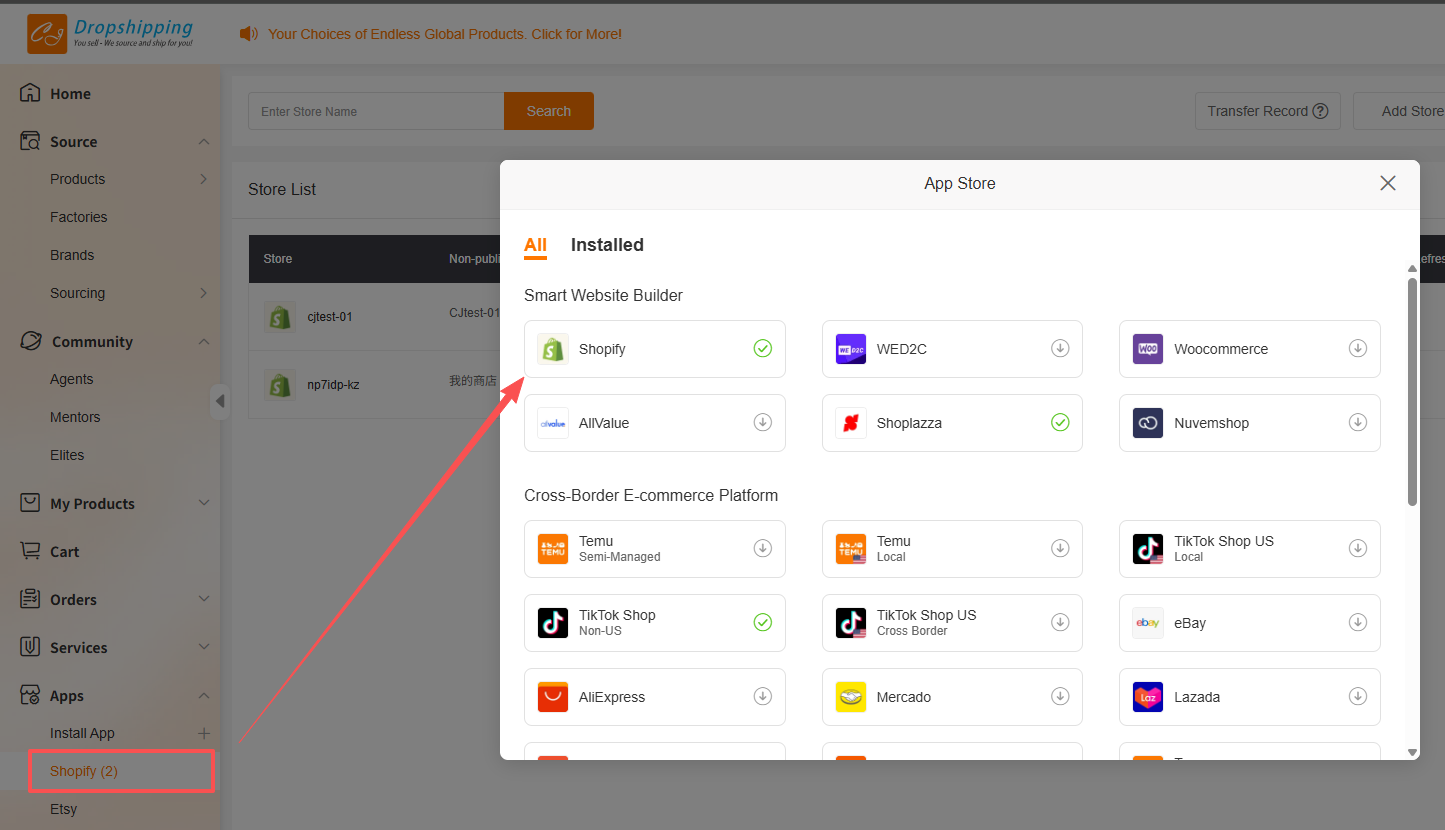
Once a store and products are connected, orders can be imported into the CJ system for fulfillment. CJ's platform also supports product listing and connection workflows for integrated stores.
Automation matters less when a store processes three orders per day.
It matters considerably more when the store processes 300.
Manual copying creates additional opportunities for:
-
wrong addresses;
-
wrong variants;
-
duplicate orders;
-
missed orders.
Reducing repetitive order handling allows operators to spend more time on exceptions instead of routine transactions.
Shipping Comparison
Product cost should never be evaluated independently of shipping.
CJ provides tools for comparing available shipping options, costs, and estimated delivery times for supported routes.
That allows sellers to evaluate the actual landed cost before choosing a product.
For example, Product A may cost $2 less than Product B.
But if Product A is heavier and costs $5 more to ship to your main market, it is not actually cheaper.
From Dropshipping to Bulk Inventory
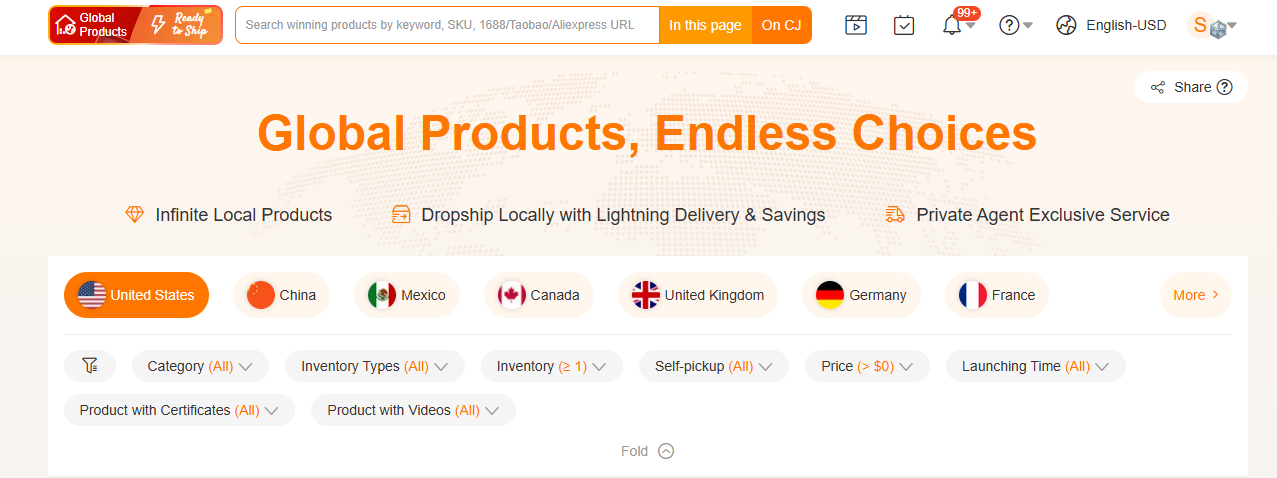
CJ also supports wholesale purchasing and inventory storage, which creates a natural path for sellers who validate a product and later want to move beyond one-by-one fulfillment.
That makes the model more flexible:
Test without heavy inventory → identify sales velocity → purchase winning inventory → improve fulfillment economics
This is often more sensible than forcing every product to remain in the same fulfillment structure forever.
Custom Packaging and Branding
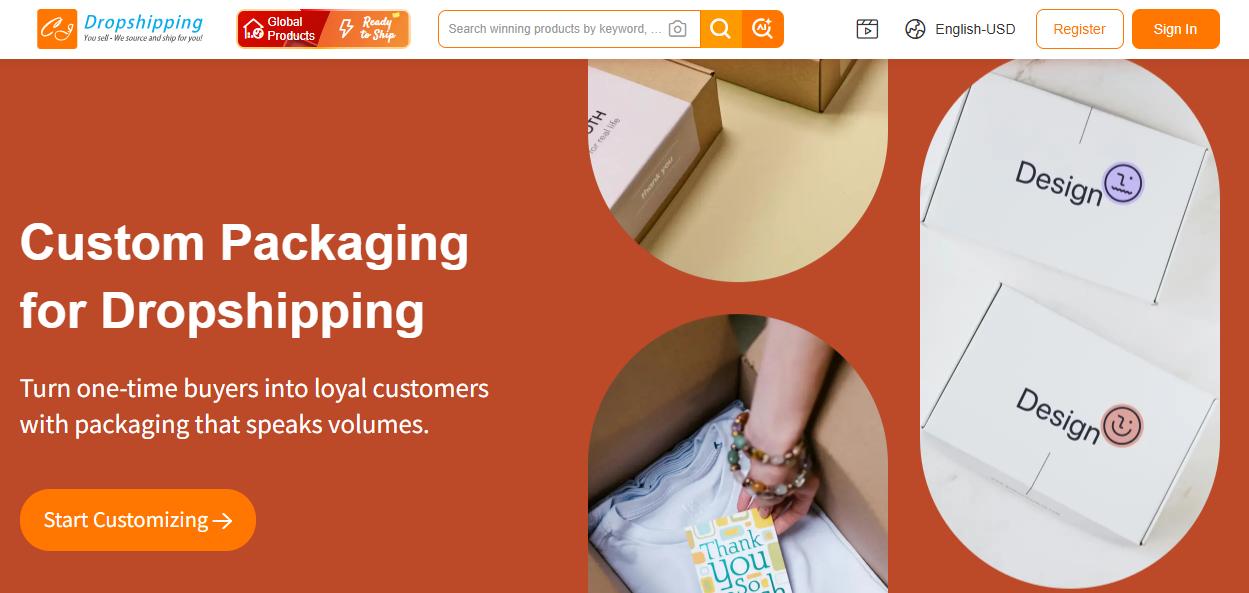
CJ currently offers customizable packaging options that allow sellers to add a more branded experience after a product has been validated. Its official packaging service includes different packaging formats and supports custom designs for eligible products.
This is particularly relevant to one of dropshipping's biggest long-term weaknesses: generic customer experience.
A seller can start lean and gradually improve packaging as sales justify the investment.
That progression is healthier than spending heavily on branding for a product that has never generated a sale.
Dropshipping vs. Traditional Inventory
Neither model is universally better.
They solve different problems.
| Factor | Dropshipping | Traditional Inventory |
|---|---|---|
| Upfront Inventory Cost | Lower | Higher |
| Unsold Inventory Risk | Lower | Higher |
| Product Testing | Easier | More capital intensive |
| Product Quality Control | Lower | Higher |
| Inventory Control | Lower | Higher |
| Fulfillment Control | Lower | Higher |
| Warehouse Requirement | Usually outsourced | Seller or 3PL required |
| Branding Potential | Moderate initially | High |
| Bulk Product Cost | Usually higher | Often lower |
| Speed to Test New SKUs | Fast | Slower |
| Operational Commitment | Flexible | Greater |
The most interesting model sits between the two.
The Hybrid Dropshipping Model: A Better Long-Term Strategy
Pure dropshipping and traditional inventory are not opposites that require a permanent choice.
They can be stages.
Consider this six-step model.
Stage 1: Test With Dropshipping
Launch the product without purchasing significant inventory.
The goal is not huge profit.
The goal is information.
Measure:
-
clicks;
-
add-to-cart rate;
-
conversion rate;
-
customer acquisition cost;
-
refund rate;
-
customer feedback.
Stage 2: Validate Repeatable Demand
Do not call something a winner because it produced five orders.
Look for consistency.
Can the product continue selling when:
-
the creative changes;
-
the audience expands;
-
advertising spend increases?
Stage 3: Improve Purchasing Economics
Once sales are predictable, compare bulk purchasing opportunities.
Calculate whether lower product cost justifies inventory investment.
Stage 4: Position Inventory Closer to Customers
If a large percentage of customers come from one market, local or regional inventory may improve delivery speed and customer experience.
That matters because delivery is directly tied to purchase decisions. DHL reports that 76% of global shoppers would not buy from an online retailer if they did not trust the delivery or returns provider.
Stage 5: Add Brand Assets
Introduce:
-
custom packaging;
-
branded inserts;
-
product customization;
-
stronger photography;
-
better instructional content.
Now the store begins moving away from commodity competition.
Stage 6: Build Retention
The strongest e-commerce businesses are not forced to purchase every customer repeatedly.
Once fulfillment and product quality are stable, invest in:
-
email;
-
loyalty;
-
customer service;
-
complementary products;
-
replenishment;
-
repeat-purchase campaigns.
At this point, the business is no longer simply “a dropshipping store.”
It is an e-commerce brand that happened to use dropshipping as one of its early fulfillment strategies.
Is Dropshipping Worth It in 2026?
For the right business, yes.
Dropshipping remains useful because it solves a genuine problem:
How do you test demand without placing a large inventory bet first?
That is still valuable in a growing online retail market. U.S. e-commerce sales increased 9.8% year over year in the first quarter of 2026, according to the U.S. Census Bureau.
But 2026 dropshipping is not particularly forgiving of weak operations.
Customers care deeply about delivery and returns. DHL reports that 67% of global shoppers have abandoned purchases because the delivery offering did not meet their expectations, while NRF estimates that 19.3% of online sales were returned in 2025.
That means the old approach—
find random product → copy supplier images → launch ads → hope for profit
—is increasingly fragile.
A stronger model is:
Research → Test → Measure → Improve → Stock Winners → Build Brand
Dropshipping is most powerful when you treat it as a flexible supply-chain strategy rather than a shortcut around building a real business.
Final Thoughts
The advantages of dropshipping are substantial.
You can start with less inventory capital, test products more quickly, avoid operating your own warehouse, expand a catalog with less stock exposure, and validate new products or markets before making larger commitments.
The disadvantages are equally real.
Margins can be tight. Inventory can disappear. Quality is harder to control. Shipping can hurt conversion. Returns create cost. Suppliers can make mistakes that ultimately become your responsibility.
The answer is not to ignore those disadvantages.
It is to build a business that gradually reduces them.
Start with low inventory risk.
Collect real demand data.
Strengthen supplier relationships.
Improve fulfillment.
Stock proven products.
Add packaging.
Create a brand customers remember.
Platforms such as CJdropshipping can support this progression by bringing sourcing, store integration, fulfillment, shipping, warehousing, wholesale inventory, and custom packaging into a more connected workflow.
The objective should never be to stay “a dropshipper” forever simply because that is how the business began.
The objective is to build the most reliable and profitable fulfillment system for the stage your business is currently in.
And sometimes, dropshipping is exactly the right place to start.
Frequently Asked Questions
What are the main advantages of dropshipping?
The main advantages include lower upfront inventory investment, reduced risk of unsold stock, no requirement to operate your own warehouse, faster product testing, easier catalog expansion, and greater flexibility when validating new products or markets.
The key advantage is not that dropshipping eliminates business risk. It changes the type of risk you take—from inventory risk toward supplier, fulfillment, and marketing risk.
What is the biggest disadvantage of dropshipping?
For many sellers, the biggest disadvantage is reduced supply-chain control.
Product availability, quality control, processing, packing, and delivery may all depend partly on external suppliers.
Shipping deserves particular attention: DHL's 2026 global research found that 67% of shoppers had abandoned an online purchase when delivery options failed to meet their expectations.
Can dropshipping become a long-term business?
Yes, but long-term businesses often evolve beyond pure order-by-order dropshipping.
A common progression is:
Dropshipping → Product Validation → Bulk Inventory → Faster Fulfillment → Custom Packaging → Brand Development
The fulfillment model should evolve as sales volume and customer expectations change.