
Choosing the right pet product dropshipping suppliers is not simply about finding inexpensive dog toys or cat accessories. For an ecommerce business, supplier selection affects product quality, delivery performance, customer retention, refund rates, and the margin left after every order is fulfilled.
As the pet retail market continues to attract ecommerce sellers, the more useful question is not which supplier has the largest catalogue. It is which supplier can consistently deliver the products your customers want, at a cost and service level that supports a sustainable business.
This guide compares eight pet dropshipping suppliers and sourcing platforms for different business models, from sellers testing their first product to established stores building a recognizable pet brand. It also explains how to assess supplier reliability, calculate actual order profitability, and test a product before committing more advertising budget.
Editorial note: Supplier catalogues, integrations, fees, warehouse availability, and shipping policies can change. Confirm current terms for the specific product and destination before making a sourcing decision.
Why Supplier Selection Matters in the Pet Products Market
Pet products cover several distinct purchasing needs: everyday care, enrichment, travel, grooming, home protection, and personalized accessories. These categories may appeal to similar customers, but their sourcing requirements are not interchangeable.
The American Pet Products Association (APPA), in its 2026 State of the Industry Report, cites its 2025 National Pet Owners Survey, which found that 95 million U.S. households owned a pet. This provides useful context for the size of the potential customer base, but it does not establish demand or profitability for any individual product. See APPA's industry statistics.
For dropshippers, the commercial opportunity lies in matching a specific customer need with a suitable product and dependable fulfillment. A supplier with a broad catalogue may be useful for product discovery, while a specialist distributor may be a better fit for established brands, regulated product categories, or customers who expect domestic delivery.
The following comparison focuses on those differences rather than treating every supplier as interchangeable.
Quick Comparison of Pet Dropshipping Suppliers
| Supplier | Best Fit | Main Strength | What to Verify |
|---|---|---|---|
| CJdropshipping | Flexible sourcing and fulfillment | Product discovery, sourcing support, fulfillment services, and store integrations | SKU-level warehouse stock, shipping cost, delivery estimates, and customization terms |
| PetDropshipper | U.S.-focused pet stores | Pet-specialist catalogue with established pet brands | Brand authorization, subscription costs, return policies, and product restrictions |
| TopDawg | Domestic U.S. wholesale sourcing | U.S. supplier network and ecommerce integrations | Supplier-specific processing times, stock accuracy, and shipping charges |
| Spocket | Stores targeting the U.S. and Europe | Marketplace for products from U.S. and European suppliers | Actual dispatch location, delivery estimates, subscription fees, and supplier terms |
| Syncee | Multi-supplier product discovery | Marketplace connecting retailers with pet product suppliers | Individual supplier reliability, inventory synchronization, and return handling |
| AppScenic | Automated store operations | Product and order synchronization with suppliers in multiple regions | Supplier coverage, integration compatibility, and plan limits |
| Avasam | UK-oriented pet stores | UK supplier network and channel integrations | Supplier location, product availability, shipping zones, and marketplace rules |
| Wholesale2B | Broad catalogue sourcing | Pet supplies catalogue and tools for product and order management | Individual product costs, supplier origin, subscription fees, and fulfillment terms |
How to use this comparison: Treat these providers as different sourcing options, not as a universal ranking. A specialist U.S. distributor may suit a brand built around established pet products. A flexible sourcing platform may be more useful when testing product concepts or expanding a catalogue across multiple markets.
8 Best Pet Product Dropshipping Suppliers in 2027
1. CJdropshipping — Best for Flexible Sourcing and Fulfillment
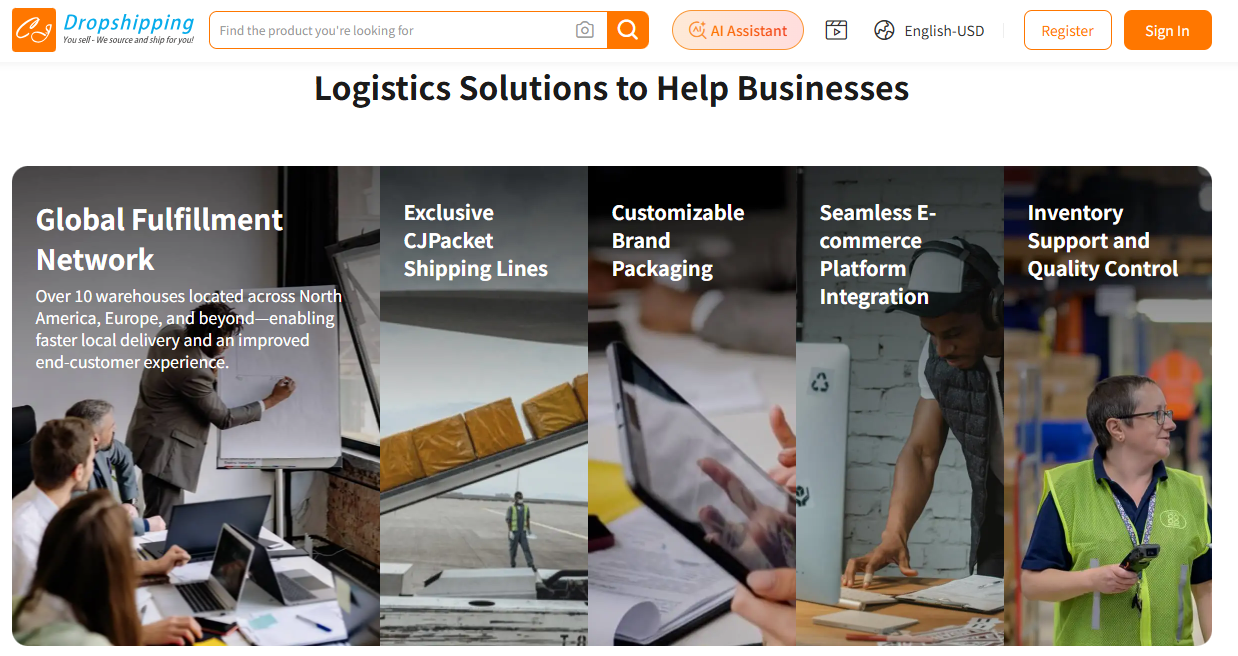
CJdropshipping is worth considering for sellers who need more than a fixed wholesale catalogue. Its pet supplies selection supports product discovery, while its broader sourcing and fulfillment services can help stores manage products, orders, and shipping through a connected workflow.
This flexibility is particularly relevant when a store is testing several product concepts or planning to expand beyond a single generic accessory. Sellers can compare available products, assess sourcing options, and investigate whether a particular SKU can be fulfilled through a suitable shipping route or warehouse.
Why Consider CJdropshipping?
- Product sourcing: Explore existing pet products and request sourcing assistance when a suitable item is not readily available.
- Fulfillment options: Evaluate available shipping methods and warehouse stock for the specific product and destination.
- Store integrations: Use supported ecommerce integrations to connect product listings and order workflows.
- Brand development: Ask about applicable customization, packaging, or product-development options when building a differentiated pet brand.
What Should You Check Before Launching?
Do not assume every product is stocked in every warehouse or that every customization option is available for every SKU. Confirm inventory location, product specifications, processing time, shipping charges, and any minimum requirements before publishing a listing.
Best for: Sellers who value flexible sourcing, connected fulfillment workflows, and the ability to investigate product differentiation as the business grows.
2. PetDropshipper
PetDropshipper is a pet-focused supplier that lists products from established pet brands. Its specialist focus makes it relevant to stores that want to build a catalogue around recognized pet care, grooming, toy, and accessory brands rather than relying entirely on generic products.
This model can be attractive when product credibility matters as much as visual appeal. Recognizable brands may help customers understand what they are buying, but sellers still need to confirm the right to resell each product and use its associated trademarks, images, and descriptions.
Potential Advantages
- A catalogue dedicated to pet products.
- Access to products from established brands.
- Published information about dropshipping without minimum orders or dropship fees.
- A Shopify app for sellers who want to connect product sourcing with their store.
What to Check
Confirm current membership costs, brand restrictions, shipping coverage, product-level availability, and the process for handling returns or damaged items. A supplier specializing in pet products does not automatically guarantee that every brand or product is suitable for your business model.
Best for: U.S.-oriented stores that prioritize a specialist catalogue and established pet brands.
3. TopDawg — Best for U.S. Wholesale Pet Supplies
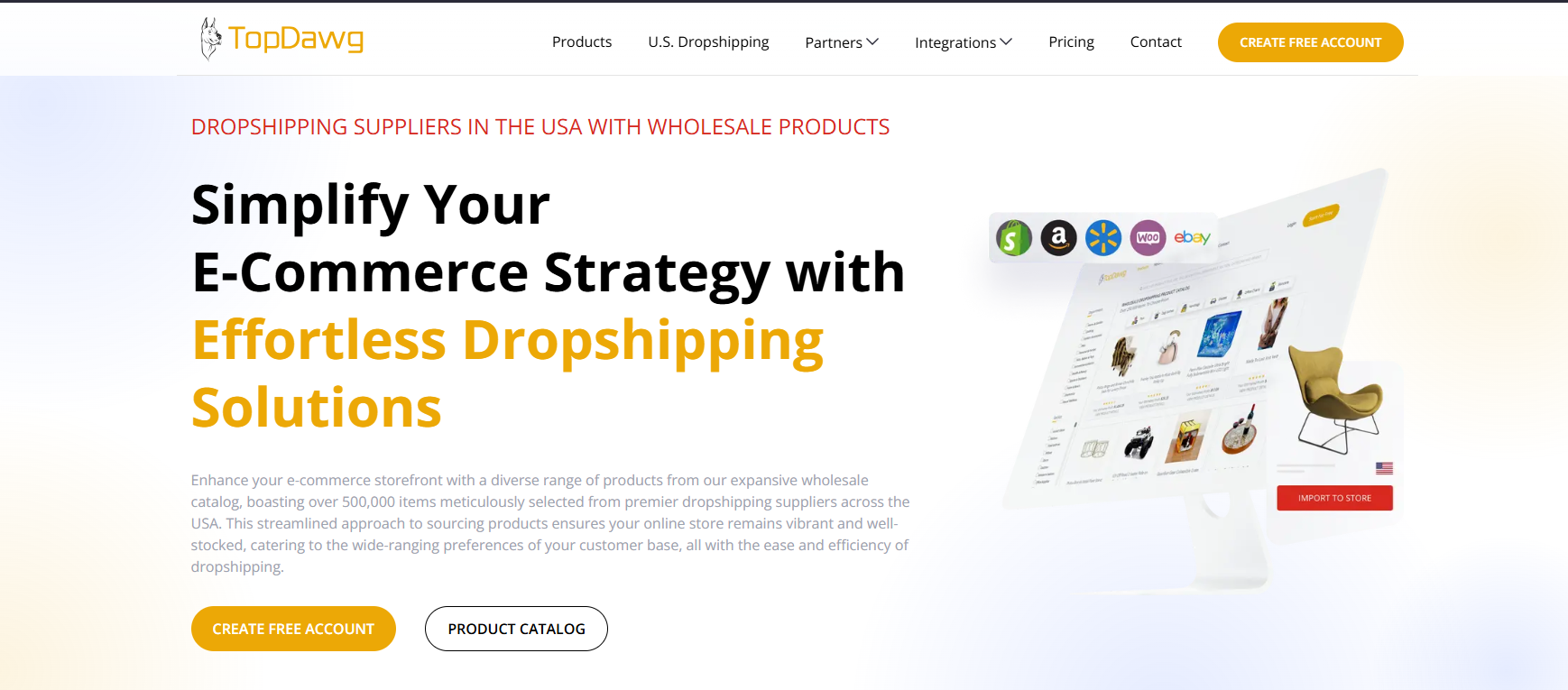
TopDawg connects online retailers with U.S. wholesale suppliers and offers a dedicated pet supplies category. Its catalogue includes product types such as dog toys, beds, clothing, cat accessories, and other pet essentials.
For a store targeting U.S. customers, domestic sourcing can simplify delivery planning and make it easier to communicate shipping expectations. However, the supplier network should be evaluated at the product level because dispatch locations, inventory, and processing performance can differ.
Where It Can Help
- Access to a broad range of wholesale pet products.
- Integration options for supported ecommerce channels.
- Supplier and order-management tools for reducing manual work.
- Potentially suitable domestic sourcing for U.S.-focused stores.
What to Check
Verify the shipping origin for each shortlisted SKU. Ask how stock updates are handled, when tracking information becomes available, and who is responsible for resolving missing or damaged shipments. Also confirm the total platform cost before comparing it with alternatives.
Best for: Sellers who prioritize U.S. wholesale sourcing and want to compare domestic pet product options.
4. Spocket

Spocket provides a marketplace for dropshipping products from suppliers in the United States and Europe, including pet care products, toys, collars, leashes, and pet accessories.
Its regional supplier focus can be useful when a store wants to compare domestic or regional fulfillment options without negotiating separately with every wholesaler from the beginning.
However, marketplace-level shipping claims should not replace a product-level check. A supplier's dispatch location, handling time, shipping method, and delivery performance are more useful than a general platform promise.
What to Check
- The actual shipping origin and destination coverage.
- The current subscription plan and its limitations.
- Product-level shipping costs and estimated delivery windows.
- Whether product data and order workflows meet your store's needs.
Best for: Sellers who want to test regional pet products and prioritize the customer experience in U.S. or European markets.
5. Syncee — Best for Multi-Supplier Product Discovery
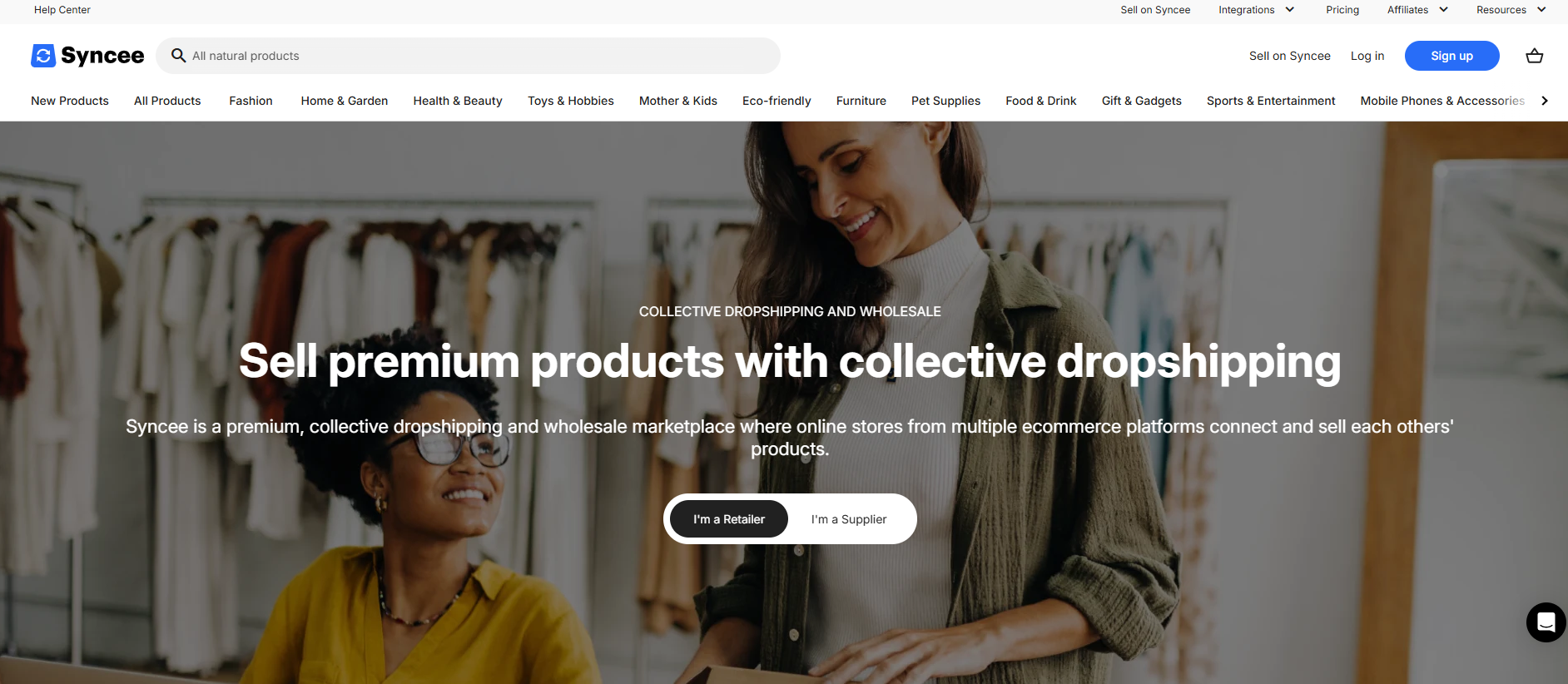
Syncee is a supplier marketplace that connects retailers with businesses offering wholesale and dropshipping products. Its pet supplies category allows sellers to explore different product ranges and supplier relationships through one platform.
This is useful when the goal is to compare several product concepts or find suppliers in different markets. The important distinction is that a marketplace helps you discover suppliers; it does not remove the need to evaluate each supplier's commercial terms and operational performance.
What to Check
- Supplier location and the countries they ship to.
- Inventory update frequency and order synchronization.
- Whether product descriptions and images can be used in your store.
- Return policies, restocking rules, and support responsibilities.
Best for: Sellers who want to explore products from multiple suppliers without managing every relationship entirely manually.
6. AppScenic — Best for Automated Supplier Workflows
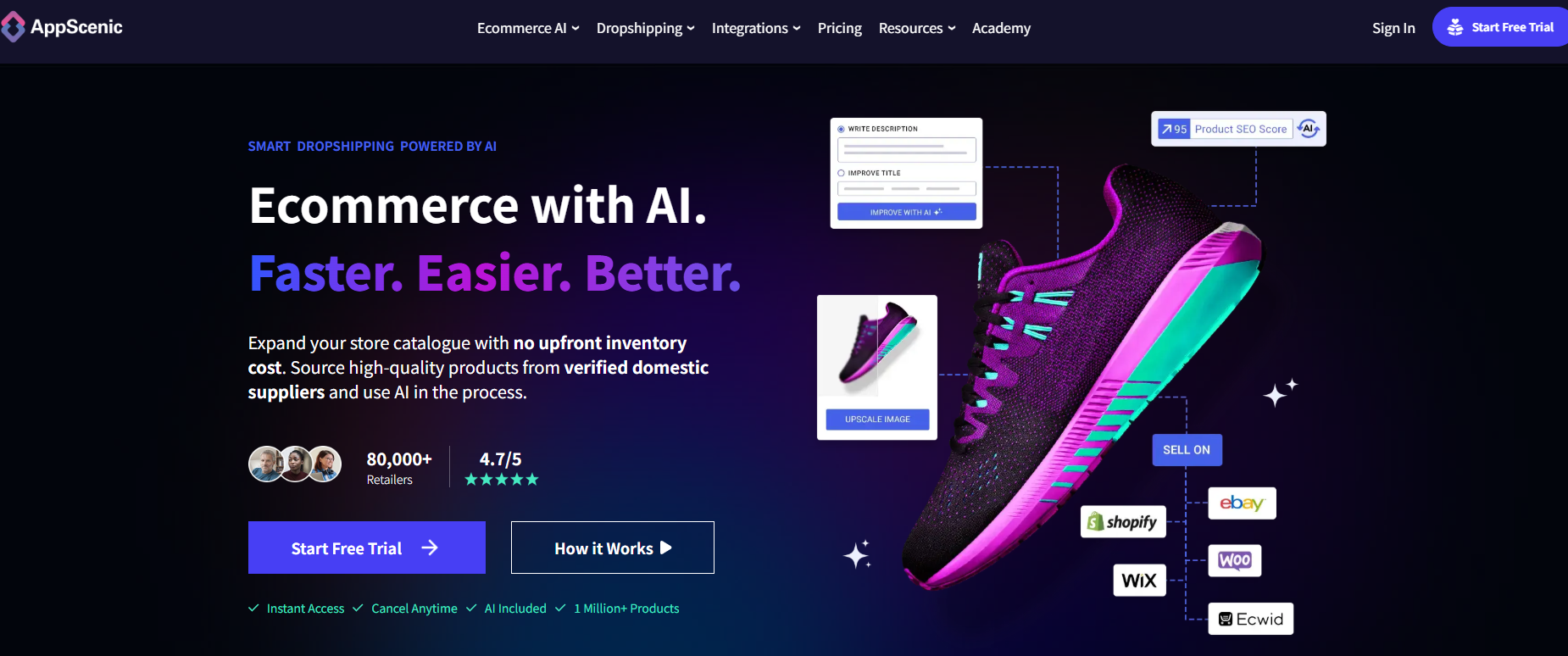
AppScenic offers a pet products category and connects retailers with suppliers in regions including the United States, United Kingdom, Europe, and Canada. Its platform supports product imports and synchronization for orders, payments, and tracking information.
These capabilities may be useful once a store has enough products and orders that manual updates become inefficient. Automated synchronization can reduce repetitive work, although it cannot compensate for poor supplier inventory management or weak product quality.
What to Check
- Compatibility with your ecommerce platform.
- Which automation features are included in your plan.
- Whether suppliers serve your target delivery regions.
- How inventory discrepancies and failed orders are handled.
Best for: Sellers who want to reduce manual catalogue and order-management work while working with suppliers across several regions.
7. Avasam
Avasam offers pet products through a network of suppliers, with a particular focus on the UK market. Its published integration options include supported ecommerce stores and marketplaces, making it worth evaluating for sellers who need a connected product and inventory workflow.
For UK-focused businesses, supplier location matters because it affects delivery expectations, return logistics, and the customer's overall experience. A domestic supplier may be operationally more suitable than a cheaper overseas source when fast and predictable fulfillment is part of the offer.
What to Check
- Whether the specific product is stocked and dispatched in the UK.
- Shipping rates, delivery estimates, and destination restrictions.
- Compatibility with your store and sales channels.
- Current subscription and supplier fees.
Best for: Sellers building a pet store around UK suppliers and supported channel integrations.
8. Wholesale2B — Best for Broad Catalogue Access
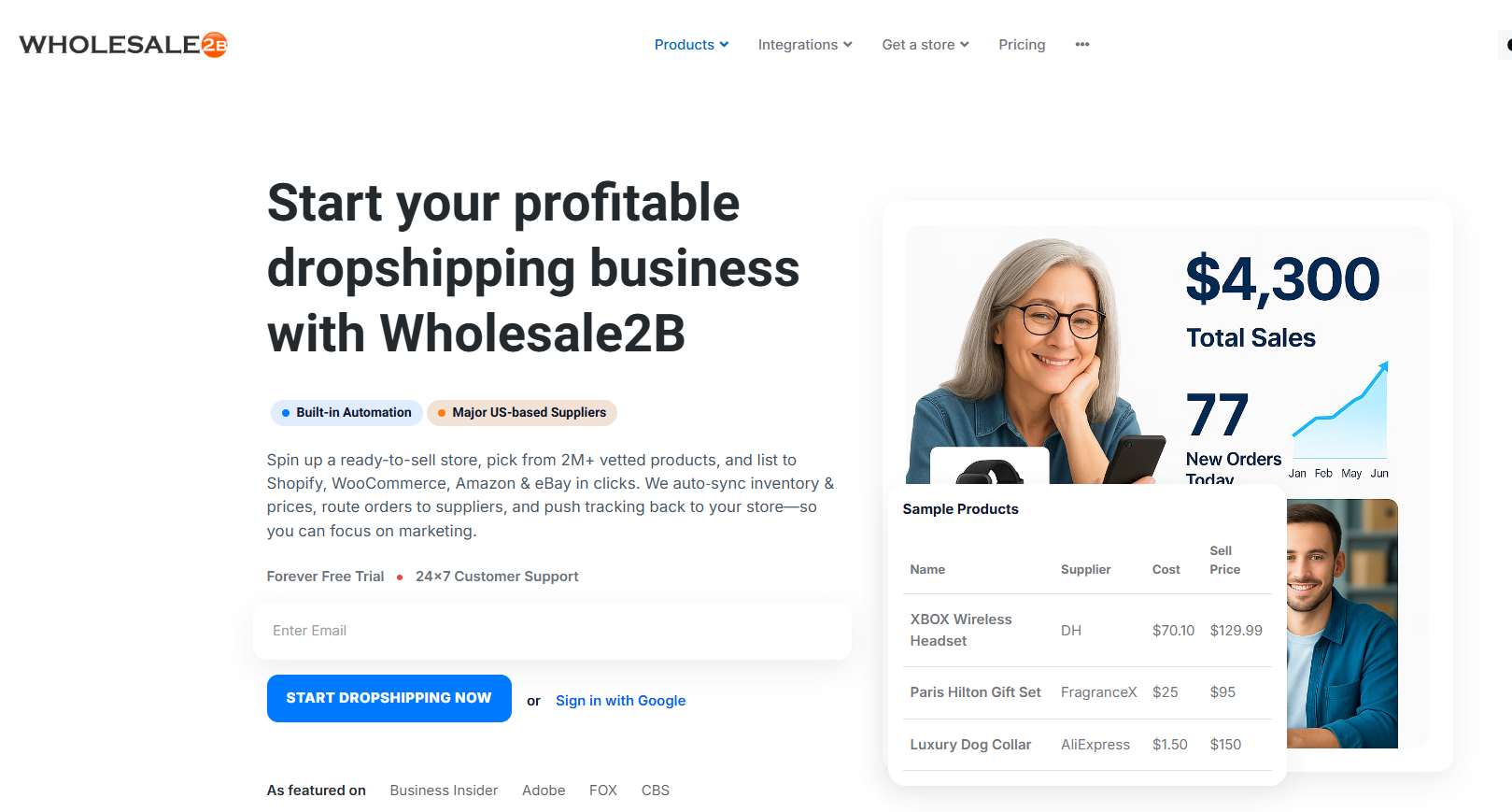
Wholesale2B provides access to dropshipping products across multiple categories, including pet supplies. Its tools support product imports and aspects of order and inventory management for supported sales channels.
A broad catalogue can be useful when you want to compare product variations or expand an existing store. It can also create unnecessary complexity if you import hundreds of similar products without a clear merchandising strategy.
What to Check
- Whether the specific product comes from a suitable supplier.
- Actual product and shipping costs rather than headline wholesale prices.
- Integration support for your current sales channel.
- Monthly charges and any additional costs associated with your chosen workflow.
Best for: Sellers who value catalogue breadth and want tools to manage products from multiple suppliers.
How to Choose the Right Pet Product Dropshipping Supplier
The most suitable supplier is the one that meets your product, customer, and operational requirements. Rather than relying on catalogue size or a supplier's general reputation, evaluate the specific products you intend to sell.
1. Confirm the Actual Shipping Origin
A supplier may have access to several warehouses without stocking every product in each location. Check the inventory location for the exact SKU, variant, and destination.
Compare the complete delivery estimate, including order processing, dispatch, transit, and potential delays. Do not advertise a delivery window based only on a supplier's fastest available shipping option.
2. Calculate Landed Cost, Not Just Product Cost
The supplier's listed product price is only one component of your cost. Depending on the arrangement, you may also need to account for shipping, handling, platform subscriptions, packaging, customization, currency conversion, and replacement orders.
Request a current quote for the exact product and delivery destination. Use the same destination, quantity, and shipping service when comparing multiple suppliers.
3. Order Samples Before Advertising
Product images cannot establish whether a pet harness fits correctly, a grooming brush feels durable, or a toy withstands normal use. Order samples from your strongest candidates and inspect the actual item before promoting it.
Evaluate packaging, product dimensions, materials, instructions, workmanship, and whether the item matches the listing. For products where fit or usability is important, test representative variants rather than assuming that every size or model performs identically.
4. Review Returns and Defect Responsibilities
A supplier's return policy should be assessed alongside product cost and shipping speed. Ask what happens when an item arrives damaged, the wrong variant is shipped, a parcel is lost, or a product differs materially from its description.
Establish who pays for return shipping, whether photo evidence is required, how replacements are arranged, and what deadlines apply. These details become especially important when paid advertising generates orders faster than you can manually resolve problems.
5. Check Product Documentation and Safety
Pet products are used by animals that cannot assess product risks themselves. Review materials, dimensions, age or size suitability, care instructions, warnings, and relevant product documentation.
Exercise additional care with electrical devices, ingestible products, supplements, topical treatments, and items marketed with health or medical claims. Confirm applicable requirements for the destination market before listing them, and never rely on unsupported safety or health claims.
6. Evaluate Automation and Support
Inventory synchronization, tracking updates, and automated order processing can reduce operational work. However, the useful question is whether these functions work reliably with your chosen store, supplier, and product.
Test the complete workflow, including order placement, stock changes, cancellations, tracking updates, and exception handling. A supplier with a slightly higher product cost may still be the better choice if it materially reduces manual work and customer-service problems.
A Practical Supplier Evaluation Scorecard
Use the following weighted scorecard to compare two or three shortlisted suppliers. Score each criterion from 1 to 5, where 1 is poor and 5 is excellent. Base the score on samples, written policies, quotes, and test orders rather than sales claims alone.
| Criterion | Weight | Evidence to Review |
|---|---|---|
| Product quality and consistency | 25% | Physical samples, specifications, defect handling |
| Delivery and fulfillment | 20% | Processing times, shipping quotes, test tracking |
| Total landed cost | 20% | Product, shipping, platform, and handling costs |
| Inventory and order synchronization | 10% | Stock updates, order imports, tracking updates |
| Returns and replacements | 10% | Written policies, evidence requirements, response times |
| Packaging and brand options | 10% | Packaging samples, customization availability, minimums |
| Support and documentation | 5% | Response quality, product specifications, compliance documents |
How to calculate the score: Multiply each criterion's score by its weight and add the results. A supplier receiving a score of 4 out of 5 for product quality contributes 20 points to the total score because quality carries a 25% weight.
Use the score to support a decision, not to override critical failures. A supplier should not pass simply because it offers low prices if its products have unresolved safety concerns, its shipping promises are unreliable, or its return terms leave you unable to serve customers.
Which Pet Products Should You Source for Dropshipping in 2027?
Product selection should start with a customer problem and a viable fulfillment model. The following categories are useful starting points for supplier research, not guaranteed winners or predictions of future sales.
1. Walking and Travel Accessories
Consider portable water bottles, travel organizers, car-seat accessories, walking pouches, and storage products for pet owners. These items can solve specific problems and may work well in product demonstrations.
Pay particular attention to fit, material quality, dimensions, and durability. Products that restrain or secure an animal require additional scrutiny because failure can create safety risks.
2. Grooming and Cleanup Tools
Grooming brushes, lint removers, washable cleanup accessories, and storage products can support practical demonstrations and repeat content ideas. Check the materials and usability on different coat types, and avoid making unsupported claims about skin or health benefits.
3. Enrichment and Feeding Accessories
Interactive toys, puzzle feeders, and selected feeding accessories may appeal to owners looking for ways to keep pets engaged. Evaluate the intended animal size, detachable parts, cleaning requirements, and suitability for the advertised use.
4. Home Organization and Protection
Storage containers, furniture-protection accessories, washable mats, and pet-related organization products can fit a broader home-and-pet lifestyle store. These products may also be easier to bundle when they serve a coherent customer need.
5. Personalized and Brandable Accessories
Custom name accessories, coordinated pet-owner products, and differentiated packaging can help a store compete on something other than price. Confirm customization options, production lead times, personalization accuracy, and minimum order requirements before advertising a custom product.
For a more detailed product-level research starting point, see Most Popular Pet Dropshipping Products in the U.S. . Treat product ideas as hypotheses to test rather than proof of current demand.
Categories That Need Extra Due Diligence
Avoid choosing a product solely because its selling price appears attractive. Products involving ingestion, health claims, electrical heating, batteries, or critical safety functions can introduce documentation, compliance, defect, and liability concerns that generic accessories may not have.
If your team cannot verify the product's specifications, appropriate use, safety information, and relevant market requirements, choose a lower-risk category until those questions can be resolved.
How to Calculate Real Profitability Before Scaling
A low supplier quote does not guarantee a profitable product. Calculate contribution profit after the variable costs associated with acquiring and fulfilling an order.
A useful starting formula is:
Contribution Profit = Net Sales Revenue − Product Cost − Shipping − Payment Fees − Advertising Cost − Expected Returns and Replacements − Other Variable Costs
Net sales revenue should reflect discounts and refunds as appropriate for the accounting period. Include applicable transaction fees, currency conversion, packaging, and other variable expenses where relevant. Allocate fixed operating costs separately when evaluating overall business profitability.
Illustrative Example: A Pet Accessory
The following figures are hypothetical and are not supplier quotes, market averages, or a prediction of what a pet product will earn.
| Item | Amount |
|---|---|
| Customer selling price, after discounts | $34.99 |
| Product cost | −$8.50 |
| Shipping and fulfillment | −$4.75 |
| Payment processing | −$1.35 |
| Expected returns and replacements allowance | −$1.50 |
| Customer acquisition cost | −$10.00 |
| Other variable costs | −$1.00 |
| Contribution profit per order | $7.89 |
Under these assumptions, contribution profit is $7.89 per order, approximately 22.5% of the selling price, before fixed overhead and any costs not included in the example.
If a competing supplier reduces the product price by $1 but increases shipping by $2, the alternative may actually make the order less profitable. Likewise, a faster shipping option may justify a higher fulfillment cost if it improves the customer experience enough to support the business model.
For a more detailed breakdown, read The Hidden Costs of Dropshipping: What Sellers Often Forget to Calculate and High-Margin vs. High-Volume Dropshipping Products .
How to Test a Pet Dropshipping Supplier Before Scaling
The goal of supplier testing is to reduce uncertainty before a product receives meaningful advertising spend. Use the following process to establish whether the product, supplier, and economics work together.
- Shortlist two or three suppliers. Compare the same product type, intended destination, shipping service, and order requirements.
- Request written quotations. Confirm product specifications, total cost, stock location, processing time, shipping estimates, and replacement terms.
- Order samples. Inspect quality, packaging, product dimensions, instructions, and whether the item matches the listing.
- Run a real delivery test. Track the order from placement through delivery. Record processing time, tracking accuracy, actual transit time, and any unexpected charges.
- Build a focused product listing. Use accurate dimensions, clear photos, appropriate warnings, honest shipping estimates, and a description that addresses the customer's actual use case.
- Test demand with controlled spending. Set a maximum test budget and acceptable acquisition cost before running campaigns. Do not increase spending just because clicks or orders begin to appear.
- Review delivered-order performance. Measure contribution profit, delivery delays, defects, refunds, customer complaints, and repeat-purchase signals where relevant.
A supplier can perform well in a sample order and still struggle during a sales spike. Continue monitoring inventory accuracy and fulfillment performance as order volume changes.
If a product attracts traffic but consistently fails to convert, diagnose pricing, product-page clarity, delivery expectations, and customer trust before blaming the supplier. If quality or fulfillment problems persist, compare alternative suppliers before investing further.
For a structured decision process, see When Should You Stop Selling a Product? A Practical Guide for Dropshippers .
Common Mistakes When Choosing Pet Dropshipping Suppliers
Choosing the Lowest Product Price
A cheap product can become expensive when shipping, returns, defects, and advertising are included. Compare complete order economics rather than supplier prices in isolation.
Assuming All Products Ship from the Same Warehouse
Suppliers may source different SKUs from different locations. Verify stock and delivery estimates for the exact variant and destination before publishing a shipping promise.
Importing Too Many Products at Once
A large catalogue creates more work for product-page maintenance, supplier monitoring, and customer support. Begin with a focused selection that serves a clear audience, then expand based on performance.
Ignoring Brand Rights and Product Documentation
Supplier access does not automatically grant permission to use trademarks, branded photographs, or protected product designs. Confirm applicable resale and content-use permissions before publishing a listing.
Scaling Before Fulfillment Is Proven
A successful advertisement does not establish that a supplier can fulfill orders consistently. Confirm stock availability, delivery performance, and replacement procedures before materially increasing order volume.
Failing to Build a Distinctive Brand
If several stores sell the same generic item with identical images, price may become the main basis of competition. Consider improving product education, bundles, customer support, packaging, or personalization where feasible.
Once a product has demonstrated demand, explore How to Turn a One-Product Store Into a Sustainable Ecommerce Brand for ways to develop a more durable business beyond a single product.
Frequently Asked Questions About Pet Product Dropshipping Suppliers
1. What is the best pet product dropshipping supplier in 2027?
There is no single best supplier for every store. CJdropshipping is worth evaluating for flexible sourcing and fulfillment. PetDropshipper is relevant to stores seeking established pet brands, while TopDawg is worth comparing for U.S. wholesale sourcing. Spocket, Syncee, AppScenic, Avasam, and Wholesale2B offer other marketplace or supplier-network options. The best choice depends on product quality, destination, total cost, and fulfillment needs.
2. Can I dropship pet products from U.S. suppliers?
Yes. Platforms such as PetDropshipper and TopDawg offer U.S.-focused pet product sourcing options. Other platforms may also provide products from domestic suppliers. Confirm the actual dispatch location for each SKU because not every product in a supplier's catalogue necessarily ships from the same warehouse.
3. How do I know whether a pet dropshipping supplier is reliable?
Order samples, compare written quotations, verify stock information, review shipping and return policies, and place test orders to your target market. Track product quality, actual delivery times, inventory accuracy, support response quality, and replacement handling. Continue monitoring performance after launch.
Final Thoughts: Choose Suppliers That Support Sustainable Growth
The best pet product dropshipping suppliers for 2027 are not necessarily those with the largest catalogues, the lowest listed prices, or the most aggressive shipping claims. They are the suppliers that can consistently meet your product, customer, and financial requirements.
Start by defining your target customer and selecting a small group of products worth testing. Compare suppliers using complete landed costs, order samples, validate delivery performance, and document the terms that matter when something goes wrong.
If you need flexible product sourcing alongside fulfillment and ecommerce integrations, explore CJdropshipping's pet supplies catalogue . Review the available options for each SKU and destination, and investigate sourcing or customization possibilities when you need a more differentiated offer.
The objective is not simply to find a supplier that can ship a product. It is to build a sourcing and fulfillment process that supports a dependable customer experience and leaves enough margin to grow the business responsibly.