
The dropshipping business model is a retail arrangement in which a seller accepts customer orders and a supplier ships the products directly to those customers. In a typical setup, the seller purchases each item after receiving an order instead of buying inventory in advance. The seller manages the storefront, pricing, marketing, and customer relationship.
For entrepreneurs, the appeal is clear: you can test a product without committing to a large stock purchase or running a warehouse. For established retailers, dropshipping can also provide a way to test new categories or offer products that would be expensive to keep in stock.
A sustainable operation needs three things: a reason for customers to buy from you, enough margin to serve them profitably, and fulfillment that matches your promises.
How Does the Dropshipping Business Model Work?
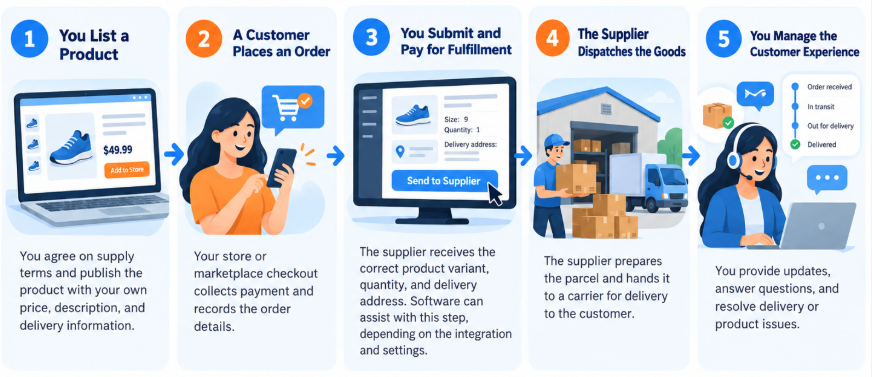
A typical order moves through five stages:
- You list a product. You agree on supply terms and publish the product with your own price, description, and delivery information.
- A customer places an order. Your store or marketplace checkout collects payment and records the order details.
- You submit and pay for fulfillment. The supplier receives the correct product variant, quantity, and delivery address. Software can assist with this step, depending on the integration and settings.
- The supplier dispatches the goods. The supplier prepares the parcel and hands it to a carrier for delivery to the customer.
- You manage the customer experience. You provide updates, answer questions, and resolve delivery or product issues.
The product moves from the supplier to the buyer. Payment and responsibility follow separate paths through your business.
That distinction matters. An order can appear as paid in your store before the payment processor releases the money to your bank account. You may still need to fund fulfillment immediately.
Likewise, outsourcing shipping does not remove the need to investigate a missing parcel. Your operating process should define who contacts the carrier, what evidence is needed, and when the customer receives a resolution.
Dropshipping vs. Other Ecommerce Models
Dropshipping describes how orders are supplied and fulfilled. Branding, product development, and customer acquisition are separate decisions.
| Approach | Typical inventory commitment | Who fulfills the order? | Main business challenge |
|---|---|---|---|
| Dropshipping | The seller generally buys after receiving an order | A supplier or its fulfillment partner | Maintaining margin and dependable service |
| Stocked ecommerce with self-fulfillment | The seller purchases stock in advance | The seller’s own operation | Forecasting demand and managing inventory |
| Stocked ecommerce with a 3PL | The seller purchases stock in advance | A third-party logistics provider | Balancing stock, storage, and fulfillment costs |
| Print on demand | Finished products are generally made after an order | A production and fulfillment partner | Design demand, production quality, and lead times |
| Affiliate marketing | The publisher does not purchase the goods | The merchant being promoted | Generating qualified referrals that earn commission |
Private labeling can overlap with several of these approaches. It concerns selling a product under your brand. It may require minimum orders, packaging purchases, or advance inventory, depending on the supplier’s terms.
For example, a store might dropship a new organizer to test demand, then purchase stock of its best-selling version and place it with a fulfillment partner. The customer-facing brand stays the same while the inventory strategy changes.
What Are the Advantages and Disadvantages of Dropshipping?
Lower inventory exposure and easier product testing
The clearest advantage is reducing the amount of money committed to unsold stock. You can test a focused assortment, learn which features customers value, and make larger purchasing decisions with better evidence.
Dropshipping can also reduce the physical work of storage, packing, and dispatch. This leaves more time for merchandising, content, and customer service, provided the supplier relationship works well.
An existing retailer can use the model selectively. Products with uncertain demand may suit supplier fulfillment, while predictable sellers remain in local inventory.
Less direct control over fulfillment
The trade-off is dependence on another company’s stock accuracy, product consistency, and dispatch process. A supplier’s late shipment becomes a problem your support team must explain.
Margins can also be narrow. The apparent gap between a supplier’s product price and your retail price must cover shipping, payment fees, customer acquisition, and post-sale losses.
Competition creates another constraint. When several stores sell the same item using the same photographs, shoppers have little reason to choose the more expensive store. Useful product information, credible demonstrations, a well-chosen assortment, and reliable service help create that reason.
This model suits sellers who want to learn retail operations while limiting early inventory exposure. It still requires money, time, and daily attention.
Is Dropshipping Profitable? Calculate the Economics First
Dropshipping can be profitable when the revenue from an order exceeds the full cost of acquiring and serving it, with enough left over to cover business overhead. A large product markup alone does not establish profitability.
Start with contribution per order: the amount left after costs that rise with sales.
Contribution per order = sales revenue − product cost − fulfillment and shipping − seller-paid import costs − transaction fees − expected post-sale losses − customer acquisition cost.
An illustrative $40 order
The following figures are hypothetical planning inputs in US dollars. They are not industry averages, supplier quotes, payment-provider rates, or tariff guidance.
| Item | Amount per order |
|---|---|
| Sales revenue after discounts, excluding tax collected for remittance | $40.00 |
| Product cost | −$12.00 |
| Fulfillment and shipping | −$6.00 |
| Seller-paid duties and clearance charges | −$2.00 |
| Payment processing | −$1.50 |
| Expected refunds, replacements, and dispute losses, net of recoveries | −$2.50 |
| Advertising cost per acquired order | −$10.00 |
| Contribution before fixed costs and income tax | $6.00 |
The contribution margin is 15%: $6 ÷ $40.
This $6 still needs to help pay for subscriptions, salaries, accounting, and other overhead. Include any additional variable costs, such as marketplace commissions, affiliate fees, or per-order support labor, where applicable.
The post-sale allowance includes expected refund-related revenue losses and additional service costs, less recoveries. When replacing estimates with actual figures, avoid subtracting the same refund both from revenue and again as an expense.
Find your advertising ceiling
In this example, non-advertising variable costs total $24. That leaves $16 available before advertising.
The break-even advertising cost per order is therefore $16, before fixed costs. If you want to retain $6 in contribution, your target advertising cost per order is $10 or less.
Using the same revenue basis:
Break-even return on ad spend = $40 ÷ $16 = 2.5.
At a 2.5 ROAS, the order covers these modeled variable costs but contributes nothing toward overhead. At a $10 acquisition cost, ROAS is 4.0 and contribution is $6.
Keep these calculations consistent with how your advertising platform reports revenue. Tax-inclusive revenue or sales later refunded can make dashboard ROAS look stronger than the underlying economics.
Stress-test the margin
Suppose shipping rises by $2 and acquisition cost rises by $3. Contribution falls from $6 to $1.
That is why a product should be assessed under several scenarios. Test a higher shipping quote, a weaker conversion rate, and a larger refund allowance before increasing spend.
Build the model for each important destination and product variant. A product that works financially in one shipping zone may lose money in another.
How Much Money Do You Need to Start Dropshipping?
There is no useful universal startup figure. Your budget depends on the product, target market, sales channel, and payment cycle.
Build it from five components: samples, store setup, content production, customer acquisition tests, and operating cash. Add a separate buffer for refunds and unexpected costs.
The operating cash requirement deserves particular attention. Suppose you receive 20 orders per day, must pay $20 per order to fund the supplier and related fulfillment costs, and face a seven-day gap before customer payments become available.
Illustrative fulfillment cash requirement = 20 × $20 × 7 = $2,800.
That estimate excludes advertising payments, refunds, processor reserves, and overhead. Your actual requirement depends on when each payment enters or leaves the business.
A store can show positive contribution and still run short of cash. Before launching, map your supplier payment terms against your processor’s actual payout schedule and any account restrictions.
How to Choose Products That Fit the Model
Start with a specific customer problem. A narrow use case makes it easier to evaluate products, write useful content, and explain why your offer deserves attention.
For example, a store serving people who work at small desks can compare organizers by footprint, usable capacity, cable access, and ease of cleaning. Those details provide a stronger buying guide than a generic claim that an organizer is a must-have.
Evaluate each candidate against four questions.
Can customers understand the benefit quickly? You should be able to demonstrate the product’s function with an honest photograph, short video, or clear explanation.
Does the delivered cost leave enough room? Request a quote using the packed dimensions, weight, destination, and selected shipping service. A small-looking product can still be expensive to ship if its packaging is bulky.
What could cause a return? Review sizing, compatibility, assembly, material expectations, and likely misuse. A product page should answer these concerns before purchase.
Can you verify the product and its claims? Request applicable documentation and check whether you have the knowledge to evaluate it. Treat products involving ingestion, medical claims, child safety, or electrical hazards as requiring additional specialist review before selection.
Order samples of the exact variants you intend to sell. Use them to check the product, measure it, create original content, and identify instructions customers will need. One sample is a starting check; it does not establish long-term consistency or replace required testing.
How to Evaluate a Dropshipping Supplier
Assess the supplier at the product and shipping-route level. A broad service offering does not establish that a particular variant is available or that a particular destination can be served reliably.
| Area to verify | Evidence to request |
|---|---|
| Product specification | Exact variant details, dimensions, materials, and relevant documentation |
| Stock status | Whether goods are physically available or must first be purchased from another source |
| Processing | Time from payment or order release to carrier handover |
| Delivery | Route-specific estimates, tracking availability, and observed delivery results |
| Total cost | Product, packaging, pick-and-pack, shipping, and import-related charges |
| Problem resolution | Written terms for defects, shortages, lost parcels, claims, and returns |
Place a test order through the same process your customer orders will use. Check the product received, parcel condition, tracking messages, and time between the order, dispatch, and delivery.
A tracking number alone does not prove the carrier has received the parcel. Monitor the first physical carrier scan as a separate event.
Where CJdropshipping fits
CJdropshipping’s services include product sourcing, product listing support, inventory options, order fulfillment, and shipping. Its custom packaging service provides options for adding brand presentation to parcels.
To evaluate CJ for a particular product, prepare the product reference, required variants, target country, expected order volume, and delivery requirement. Ask for a current product-and-shipping quote and confirm the stock position before publishing delivery promises.
For packaging, confirm the minimum purchase, production time, compatibility with the product, and any storage or handling charges. A product sample and a clear quote provide a practical basis for deciding whether the arrangement fits your store.
What Legal and Platform Responsibilities Remain With the Seller?
Outsourced fulfillment still requires a business to set accurate expectations and handle customer obligations. Work out the requirements for your location, target market, and product category before accepting orders.
Delivery promises and refunds
In the United States, the FTC’s Mail, Internet, or Telephone Order Merchandise Rule generally requires a reasonable basis for shipping within the advertised time. If no shipping time is stated, the rule generally uses 30 days. If the seller cannot ship on time, it must follow the rule’s delay-consent or refund requirements.
This concerns shipment timing; it does not establish a universal 30-day delivery promise. Keep processing and transit estimates distinct in your customer communications.
For EU distance sales of goods, consumers generally have a 14-day withdrawal period starting after delivery, subject to exceptions and detailed requirements. Review the EU’s guidance for online sellers when designing your cancellation and return process.
Your supplier agreement also needs attention. Establish where returns go, who inspects them, what evidence supports a claim, and which costs the supplier will reimburse. Supplier reimbursement and your customer-facing obligations can operate on different timelines.
Marketplace restrictions
Platform permission is a separate question from whether the underlying business arrangement is lawful.
For example, eBay’s dropshipping guidance permits qualifying arrangements involving inventory you own or an agreement with a wholesale supplier. Listing an item and then purchasing it from another retailer or marketplace to ship directly to the buyer is prohibited.
Review the policy for each channel you plan to use. A store integration does not itself establish permission to sell every available product through that channel.
Imports, taxes, and product requirements
For cross-border orders, establish who is responsible for import clearance and charges. Obtain a current quote for the actual route and product; avoid building pricing around an assumed duty-free threshold. US sellers can start with CBP’s ecommerce guidance.
Map registration, tax, labeling, product-safety, privacy, and intellectual-property requirements to the markets you serve. Keep supporting records and obtain qualified local advice where the requirements are unclear.
A Practical Plan for Launching Your Store
The following sequence can structure an initial month of work. Extend the timeline when sampling, compliance checks, or delivery testing require more time.
Week 1: Define the customer and offer
Choose one initial market and a small product assortment built around a clear use case. Review customer questions, competing offers, and common complaints.
Write down why a buyer would choose your store. That reason might be better product guidance, a useful bundle, clearer compatibility information, or a delivery option you can reliably support.
Set a maximum test budget and a target contribution per order. These should guide the product and supplier decisions that follow.
Week 2: Verify supply and economics
Request comparable supplier quotes, order samples, and calculate contribution using destination-specific costs.
Document stock availability, processing time, tracking, and the procedure for resolving damaged or missing orders. Confirm whether a bundle can ship in one parcel; separate shipments can change both costs and customer expectations.
Proceed when the product and fulfillment evidence support the proposed offer.
Week 3: Build the store around buyer questions
Publish product pages that explain what the item does, its dimensions, materials, compatibility, package contents, and limitations. Use photographs and demonstrations that accurately represent the product.
Make shipping estimates, return information, and business contact details easy to find. Test checkout on mobile, verify variant mapping, and place an end-to-end order.
For search traffic, create content tied to real purchase decisions. A comparison of organizer sizes for narrow desks can answer a useful question and lead naturally to the relevant product page.
Week 4: Run a controlled launch
Start with a channel where you can produce credible content or reach a defined audience. Keep the initial test focused enough to understand why customers respond.
Check the path from traffic to product views, checkout, payment, dispatch, and delivery. If visitors leave after seeing shipping charges, investigate the delivered offer. If paid orders arrive but parcels stall, address fulfillment before expanding demand.
Set review points based on spend, orders, and operational results. Early sales provide a signal; stronger decisions require delivery outcomes and enough time for returns or disputes to appear.
What Should You Measure After Launch?
Review profitability and service together. Revenue growth can hide a deterioration in either.
| Metric | What it helps you decide |
|---|---|
| Contribution per order | Whether the product and destination justify continued selling |
| Advertising cost per order | Whether acquisition fits the margin available |
| Time to carrier handover | Whether processing supports the advertised timeline |
| Delivery within the promised window | Whether the shipping route meets customer expectations |
| Refunds, defects, and disputes | Whether product quality or expectations need correction |
| Available cash against upcoming obligations | Whether current growth can be funded |
Review results by product, supplier, destination, and acquisition channel where order volume permits. Store-wide averages can hide an unprofitable route or a defective variant.
Group orders by purchase week and revisit them after delivery and the relevant return period. Otherwise, a new campaign can look profitable while its later refunds remain invisible.
Use automation for repeatable tasks such as order routing, tracking updates, and exception alerts. AI can help draft support responses or summarize recurring complaints when given verified information. Check stock, specifications, prices, and delivery claims against current records before publishing or sending them.
Keep human review for refunds, disputes, unusual order changes, and other decisions where a mistaken action can create a direct loss or harm the customer relationship.
When Should You Move Beyond Pure Dropshipping?
As demand becomes more predictable, compare dropshipping with purchasing selected inventory in advance.
Potential benefits include improved product availability, more control over packaging, and shorter processing times. The calculation also needs to include inbound freight, storage, handling, financing, and unsold-stock risk.
A lower unit purchase price can be offset by inventory that takes too long to sell. Use actual sales history, lead times, and a realistic cash budget when assessing a stock purchase.
A hybrid approach can keep new products on a dropshipping basis while proven products move into stocked fulfillment. Set the decision at the SKU level rather than moving the entire catalog at once.
Before increasing volume under either arrangement, confirm that contribution remains positive, service meets your promises, and cash can support the next level of demand.
Frequently Asked Questions About the Dropshipping Business Model
Is dropshipping suitable for beginners?
Dropshipping can help beginners test products with less upfront inventory commitment. It still requires product research, supplier checks, customer support, and cost control. A small assortment and one initial market make those responsibilities easier to learn.
Can you start dropshipping with no money?
You can research ideas without spending, but operating a store normally involves costs. Samples, selling tools, order fulfillment, and refunds require funding. Even when the customer pays first, that payment may not be available when the supplier needs to be paid.
What is a good dropshipping profit margin?
A useful target must cover your actual costs and business goals. Calculate contribution after acquisition, fulfillment, transaction fees, and post-sale losses, then account for overhead. The 15% contribution margin in this guide is an illustrative calculation, not an industry benchmark or guaranteed result.
Do dropshipping suppliers have to be overseas?
No. Dropshipping describes the fulfillment arrangement, not the supplier’s location. A supplier may ship domestically or across borders. Compare the actual stock location, total delivered cost, and service for the target customer.
Build a Business You Can Deliver Reliably
The most useful next step is to take one product through the complete decision process: define the customer, inspect a sample, confirm the shipping route, calculate contribution, and test the order experience.
If you are considering CJdropshipping, start with a product sourcing and fulfillment inquiry based on a specific item and destination. Use the resulting quote and sample to determine whether the product meets your quality, delivery, and margin requirements.
Expand when the evidence supports it. Each additional product and market should meet the same standard as the first.